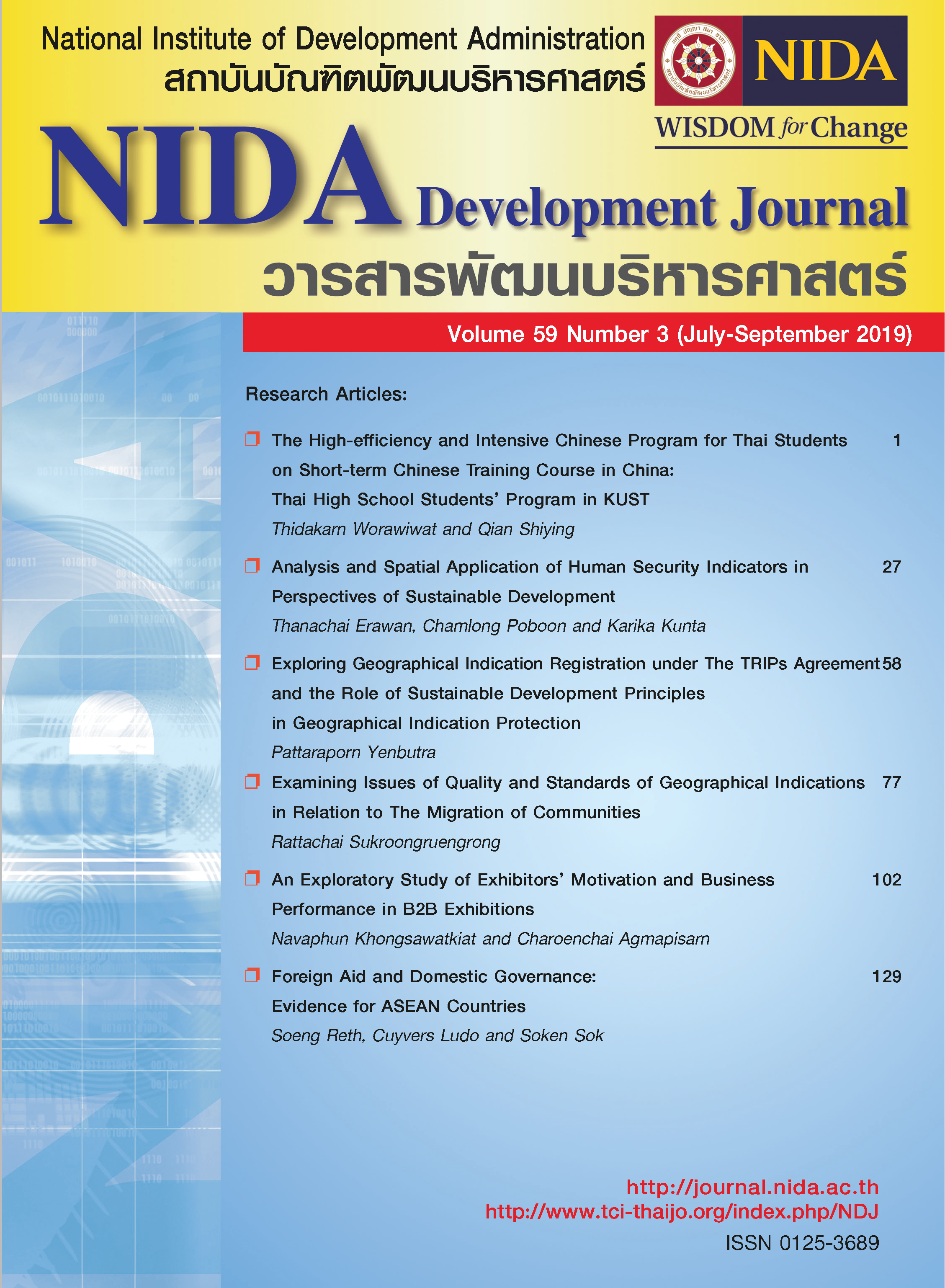
การช่วยเหลือจากต่างประเทศและวิธีการปกครองภายในประเทศ : หลักฐานสำหรับกลุ่มประเทศอาเซียน
คำสำคัญ:
Foreign aid, Governance, ASEAN, FDI, Corruption controlบทคัดย่อ
ผลกระทบของความร่วมมือเพื่อการพัฒนาว่าด้วยวิธีการปกครองภายในประเทศ สำหรับกลุ่มประเทศอาเซียนนั้น ผ่านการทบสอบเชิญประจักษ์โดยใช้กลุ่มข้อมูลแบบพาแนล ในช่วงปี ค.ศ. 1996-2015 ด้วยวิธีของ ฮูสแมน-เทเลอร์ ซึ่งเป็นเทคนิคที่มีประสิทธิภาพสำหรับปัญหาตัวแปรที่ใช้ในการอธิบายมีความสัมพันธ์กับค่าความคลาดเคลื่อน ทั้งนี้ข้อมูลดังกล่าวมาจาก ดัชนีวัดธรรมาภิบาลโลกและดัชนีวัดการพัฒนาโลกของธนาคารโลก ประกอบกับฐานข้อมูลขององค์การเพื่อความร่วมมือและการพัฒนาทางเศรษฐกิจ จากการทดสอบแบบวินิจฉัยที่สำคัญบางประการ มีการยอมรับสมมุติฐานที่ว่าระดับความร่วมมือเพื่อการพัฒนาที่สูงกว่าสัมพันธ์กับธรรมภิบาลที่ดีขึ้น อีกทั้งยังพบว่า ระดับความร่วมมือเพื่อพัฒนาที่สูงขึ้น สัมพันธ์กับการควบคุมการทุจริตที่ดีขึ้น และวิธีปฏิบัติตามระบอบประชาธิปไตยในระดับสูง ส่งเสริมต่อหลักนิติธรรมและการควบคุมการทุจริตที่ดีขึ้น นอกจากนี้การลงทุนโดยตรงจากต่างประเทศมีความสำคัญต่อการพัฒนาคุณภาพวิธีการปกครอง โดยประเทศที่ใช้ “รูปแบบกฎหมายจากสหราชอาณาจักร” สามารถดำรงระดับคุณภาพวิธีการปกครองได้สูงกว่า ทั้งนี้มีนัยสำหรับการพัฒนาวิธีการปกครองภายในประเทศ โดยเฉพาะที่เกี่ยวกับการควบคุมการทุจริต สำหรับกลุ่มประเทศอาเซียน กลุ่มประเทศเศรษฐกิจเปลี่ยนผ่านและประเทศกำลังพัฒนา
เอกสารอ้างอิง
Al-Marhubi, F. (2004). The determinants of governance: A cross-country analysis. Contemporary Economic Policy, 2(3), 394-406.
Alvi, E., & Senbeta, A. (2012). Does foreign aid reduce poverty?. Journal of International Development, 24(8), 955-976.
Amsden, A. H. (2007). Escape from Empire: The developing world’s journey through heaven and hell. Cambridge, MA: MIT Press.
Arndt, C., Jones, S., & Tarp, F. (2015). What is the aggregate economic rate of return to foreign aid? World Bank Economic Review, 30(3), 446-474.
Askarov, Z., & Doucouliagos, H. (2015). Development aid and growth in transition countries. World Development, 66, 383-399, doi: 10.1016/j.worlddev.2014.08.014
Asongua, S. A., & Nwachukwu, J. C. (2016). Foreign aid and governance in Africa. International Review of Applied Economics, 30(1), 69-88.
Boone, P. (1996). Politics and the effectiveness of foreign aid. European Economic Review, 40(2), 289-329.
Bräutigam, D. A., & Knack, S. (2004). Foreign aid, institutions, and governance in Sub‐Saharan Africa. Economic Development and Cultural Change, 52(2), 255-285.
Brazys, S. (2016). Aid and governance: Negative returns?. European Journal of Development Research, 28(2), 294-313.
Breusch, T. S., & Pagan, A. R. (1980). The Lagrange multiplier test and its applications to model specification in econometrics. Review of Economics Studies, 47(1), 239-253.
Brücker, M. (2013). On the simultaneity problem in the aid and growth debate. Journal of Applied Econometrics, 28(1), 126-150.
Busse, M., & Gröning, S. (2009). Does foreign aid improve governance?. Economics Letters, 104(2), 76-78.
Clemens, M. A., Radelet, S., Bhavnani, B. R., & Bazzi, S. (2012). Counting chickens when they hatch: Timing and the effects of aid on growth. Economic Journal, 122(561), 590-617.
Crivelli, E., & Gupta, S. (2017). Does conditionality mitigate the potential negative effect of aid on revenues?. Journal of Development Studies, 53(7), 1057-1074.
Dadasov, R. (2016). European aid and governance: Does the source matter?. European Journal of Development Research, 29(2), 269-288.
Dalgaard, C-J., & Hansen, H. (2001). On aid, growth and good policies. Journal of Development Studies, 37(6), 17-41.
Degnbol‐Martinussen, J. (2002). Development goals, governance and capacity building: Aid as a catalyst. Development and Change, 33(2), 269-279.
De Jong, E., & Bogmans, C. (2011). Does corruption discourage international trade?. European Journal of Political Economy, 27(2), 385-398.
Dutta, N., Leeson, P. T., Williamson, C. R. (2013). The amplification effect: foreign aid’s impact on political institutions. Kyklos, 66(2), 208-228.
Ear, S. (2007a). Does aid dependence worsen governance?. International Public Management Journal, 10(3), 259-286.
Ear, S. (2007b). The political economy of aid and governance in Cambodia. Asian Journal of Political Science, 15(1), 68-96.
Farazmand, A. (1999). Globalization and public administration. Public Administration Review, 59(6), 509-522.
Farazmand, A. (2001). Globalization, the state and public administration: A theoretical analysis with policy implications for developmental states. Public Organization Review: A Global Journal, 1, 437-463.
Farazmand, A. (2004). Sound governance: policy and administrative innovations. Westport, CT: Praeger/Greenwood Press.
Feeny, S. (2005). The impact of foreign aid on economic growth in Papua New Guinea. Journal of Development Studies, 41(6), 1092-1117.
Finkel, S. E., Pérez-Liñán, A., Seligson, M. A. (2007). The effects of U.S. foreign assistance on democracy building, 1990-2003. World Politics, 59(3), 404-439.
Fukuyama, F. (2013). What is governance?. Governance, 26(3), 347-368.
Gani, A. (2011). Governance and growth in developing countries. Journal of Economic Issues, 45(1), 19-40.
Garcia-Sanchez, I. M., & Cuadrado-Ballesteros, B. (2013). Determinants of government effectiveness. International Journal of Public Administration, 36(3), 567-577.
Goh, S. K., Wong, K. N., & Tham, S. Y. (2013). Trade linkages of inward and outward FDI: Evidence from Malaysia. Economic Modelling, 35, 224-230, doi: 10.1016/j.econmod.2013.06.035
Gradstein, M. (2004). Governance and growth. Journal of Development Economics, 73(2), 505-518.
Greene, W.H. (2012). Econometric analysis. New Jersey: Pearson Education.
Hamilton, E. K. (Ed.). (1989). America’s global interests: A new agenda. New York: W.W. Norton.
Hansen, H., & Tarp, F. (2001). Aid and growth regressions. Journal of Development Economics, 64(2), 547-570.
Hausman, J. A. (1978). Specification tests in econometrics. Econometrica, 46(6), 1251-1271.
Hausman, J. A., & Taylor, W. E. (1981). Panel data and unobservable individual effects. Econometrica, 49(6), 1377-1398.
Hodler, R. (2007). Rent seeking and aid effectiveness. International Tax Public Finance, 14(5), 525-541.
Hsiao, C. (2003). Analysis of panel data. Cambridge: Cambridge University Press (Econometric Society Monograph No. 34).
Hsiao, C. (2005). Why panel data?. Singapore Economic Review, 50(2), 143-154.
Hsiao, C. (2007). Panel data: Advantages and challenges. TEST, 16(1), 1-22.
Jones, S., & Tarp, F. (2016). Does foreign aid harm political institutions?. Journal of Development Economics, 118, 266-281,
https://doi.org/10.1016/j.jdeveco.2015.09.004
Kaufmann, D., Kraay, A., & Mastruzzi, M. (2010). Worldwide governance indicators methodology and analytical issues. Policy Research Working Paper 5430, The World Bank.
Kaya, O., Kaya, I., & Gunter, L. (2013). Foreign aid and the quest for poverty reduction: Is aid to agriculture effective? Journal of Agricultural Economics, 64(3), 583-596.
Keeley, B. (2012). From aid to development: The global fight against poverty. Paris: OECD publishing.
Kersting, E., & Kilby, C. (2014). Aid and democracy redux, European Economic Review, 67, 125-143,
https://doi.org/10.1016/j.euroecorev.2014.01.016
Klerman, D.M., Mahoney, P.G., Spamann, H., & Weinstein, M.I. (2011). Legal origin or colonial history?. Journal of Legal Analysis, 3(2), 379–409,
Knack, S. (2001). Aid dependence and the quality of governance: Cross-country empirical tests. Southern Economic Journal, 68(2), 310-329.
Knack, S. (2004). Does foreign aid promote democracy?. International Studies Quarterly, 48(1), 251-266.
La Porta, R., Lopez-de-Silanes, F., Shleifer, A., & Vishny, R. (1999). The quality of government. Journal of Law, Economics and Organization, 15(1), 222-279.
La Porta, R., Lopez-De-Silanes, F., & Shleifer, A. (2008). The economic consequences of legal origins. Journal of Economic Literature, 46(2), 285–332.
McPherson, M. Q., & Trumbull, W. N. (2008). Rescuing observed fixed effects: Using the Hausman-Taylor method for out-of-sample trade projections. International Trade Journal, 22(3), 315-340.
Minoiu, C., & Reddy, S.G. (2010). Development aid and economic growth: A positive long-run relation. Quarterly Review of Economics and Finance, 50(2), 27-39.
Mohamed, M.R., & Azman-Saini, W.N.W. (2015). Effect of foreign aid on corruption: evidence from Sub-Saharan African countries. International Journal of Social Economics, 42(1), 47-63.
North, D.C. (1990). Institutions, institutional change and economic performance. Cambridge: Cambridge University Press.
Okada, K., & Samreth, S. (2012). The effects of foreign aid on corruption: A quantile regression approach. Economics Letters, 115(2), 240-243.
Plasmans, J. (2006). Modern linear and nonlinear econometrics. New York: Springer Verlag.
Rault, C., Sova, R., & Sova, A. M. (2009). Modelling international trade flows between CEEC and OECD countries. Applied Economics Letters, 16(15), 1547-1554.
Ravallion, M. (2014). On the role of aid in the Great Escape. Review of Income and Wealth, 60(4), 967-984.
Seldadyo, H., Elhorst, J. P., & De Haan, J. (2010). Geography and governance: Does space matter?. Papers in Reginal Science, 89(3), 625-640.
Scott, J. M., Steele, C. A. (2011). Sponsoring democracy: The United States and democracy aid to the developing world, 1988-2001. International Studies Quarterly, 55(1), 47-69.
Svensson, J. (2000). Foreign aid and rent seeking. Journal of International Economics, 51(2), 437-461.
Tavares, J. (2003). Does foreign aid corrupt?. Economics Letters, 79(1), 99-106.
Verbeek, M. (2004). A guide to modern econometrics, 2nd Edition. Chichester: John Wiley & Sons.
Williamson, C. R. (2008). Foreign aid and human development: The impact of foreign aid to the health sector. Southern Economic Journal, 75(1), 188-207.
World Bank (1992). Governance and development. Washington D.C.: The World Bank.
ดาวน์โหลด
เผยแพร่แล้ว
รูปแบบการอ้างอิง
ฉบับ
ประเภทบทความ
สัญญาอนุญาต
ลิขสิทธิ์ (c) 2020 วารสารพัฒนบริหารศาสตร์

อนุญาตภายใต้เงื่อนไข Creative Commons Attribution-NonCommercial-NoDerivatives 4.0 International License.