
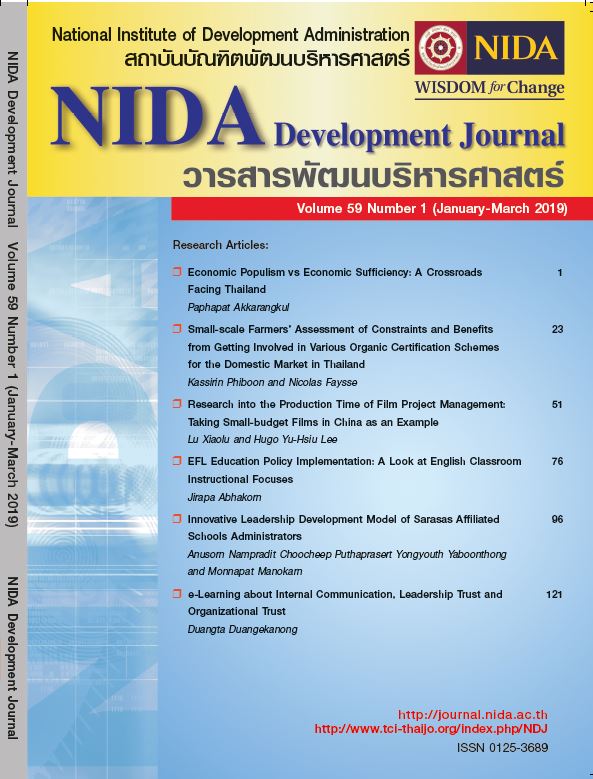
ทางเลือกนโยบายประชานิยมกับเศรษฐกิจพอเพียง และผลกระทบที่แตกต่างของไทย
คำสำคัญ:
ประชานิยม, เศรษฐกิจพอเพียง, นโยบาย, เศรษฐกิจไทยบทคัดย่อ
การแก้ไขปัญหาเศรษฐกิจด้วยนโยบายประชานิยมมีเป้าหมายที่เศรษฐกิจเติบโตอย่างรวดเร็ว ตรงกันข้าม นโยบายเศรษฐกิจพอเพียงมีเป้าหมายที่เศรษฐกิจเติบโตอย่างค่อยเป็นค่อยไป กรณีประเทศไทยมีการพึ่งพาต่างประเทศสูงทั้งการค้า การลงทุน และการนำเข้าน้ำมันเชื้อเพลิงและพลังงาน ทั้งหมดสะท้อนถึงการไม่พึ่งพาตนเอง การอาศัยต่างประเทศช่วยขับเคลื่อนเศรษฐกิจ เมื่อเกิดความผันผวนภายนอกจึงเลี่ยงไม่ได้ที่ส่งผลกระทบต่อเศรษฐกิจไทย ดังนั้น ประเทศไทยควรเลือกดำเนินนโยบายใดเพื่อหาทางออกจากปัญหานี้
เอกสารอ้างอิง
Bank of Thailand. (2003). Bank of Thailand’s macroeconometric model. Retrieved May 16, 2004, from http://www.bot.or.th/Thai?MonetaryPolicy/Inflation/Download /Pages/2546.aspx
Bayoumi, T., & Eichengreen, B. (1995, March). Restraining yourself: The implications of fiscal rules for economic stabilization. International Monetary Fund, 42(1), 32-48.
Bhanupong Nidhiprabha. (1984). External shocks and adjustment policies in Thailand. Unpublished doctoral dissertation, The Johns Hopkins University.
Bodart, V., & Dem, J. L. (1996). Labor market representation in quantitative macroeconomic models for developing countries: Application to Cote d’Ivoire. International Monetary Fund, 43(2), 419-451.
Chaiyindeepum, S. (1992). External shocks and macroeconomic adjustments in the Philippines and Thailand: A comparative study. Unpublished doctoral dissertation, Australian National University.
Chantrasmi, M. (1990). Government budget deficit, crowding-out, and inflation in Thailand, 1970-1986. Unpublished doctoral dissertation, University of Hawaii.
Chen, S. (1999). Complex dynamics of the real exchange rate in an open macroeconomic model. Journal of Macroeconomics, 21(3), 493-508.
Clarida, R., Gali, J., & Gertler, M. (2000, February). Monetary policy rules and macroeconomic stability: Evidence and some theory. The Quarterly Journal of Economics, 115(1), 147-180.
Cohen, D., & Follette, G. (2000, April). The automatic fiscal stabilizers: Quietly doing their thing. Economic Policy Review, 6(1), 35-67.
Fair, R. C. (1999). What can macroeconometric models say about Asia-type Crises? Retrieved May 16, 2004, from http://fairmodel.econ.yale.edu/ 1999
Jamarik, S. (2001). The sufficiency economy during globalization. Bangkok: Manager Publishing House. Monday, 17th September edition.
Jitsuchon, S. (1999). Greedy behavior and economic consequences. Proceedings of the 1999 TDRI Conference.
Kerr, W., & King, R. G. (1996). Limits on interest rate rules in the IS model. Economic Quarterly, 82(2), 47-75.
Leeper, E. M., & Zha, T. (2001). Assessing simple policy rules: A view from a complete macroeconomic model. Economic Review, 4, 13-36.
Levin, A., Rogers, J., & Tryon, R. (1997). Evaluating international economic policy with the Federal Reserve’s Global Model. Federal Reserve Bulletin, 83(10), 797-817.
Limskul, K. (1990). A quarterly macro-econometric model of Thailand. Retrieved May 16, 2004, from http://www.hsu-hh.de/download-1.4.1.php?brick_id=EwOk0hhKRSx54o7E
Limskul, K., & Koonmee, K. (1994). Impact of EC’s integration: The case of Thailand, in: Impact of EC integration of Asian industrializing region. Retrieved May 16, 2004, from http://www2.hsu-hh.de/uebe/modelle/Thailand/Thailand-94-1.pdf
Mauskopf, E., & Reifschneider, D. (1997, September). Dynamic scoring, fiscal policy, and the short-run behavior of the macroeconomy. National Tax Journal, 50(3), 631-655.
Mesinsi, S. (2006). The turning point of Thailand: the sufficiency economy during globalization. Bangkok: Siam M&B Publishing.
Nidhiprabha, B. (1984). External shocks and adjustment policies in Thailand. Unpublished doctoral dissertation, The Johns Hopkins University.
Olsen, K., & Wulfsberg, F. (2001). The role of assessments and judgement in the macroeconomic model RIMINI. Economic Bulletin, 72(2), 55-64.
Otsubo, S. (1988). Market disequilibria and industrial transformation. Unpublished doctoral dissertation, Stanford University.
Panthasen, A., Piampongsarn, P., Puntasen, S. T., & Piamyat, S. (2006). A knowledge synthesis of the Sufficiency Economy. Bangkok: The Thailand Research Fund.
Panthasen, A., Premchuen, S., & Kiatdetpanya, P. (2003). The application of HM the King’s sufficiency economy principle for SMEs. Bangkok: The Thailand Research Fund.
Pasuk Phongpaichit, & Baker, C. (2000). Thailand’s crisis. Chiang Mai: Silkworm Books.
Poapongsakorn, N. (1999). The development of Thai industry and the concept of the sufficiency economy. Proceedings of the 1999 TDRI Conference.
Reifschneider, D., Tetlow, R., & Williams, J. (1999, January). Aggregate disturbances, monetary policy, and the macroeconomy: The FRB/US perspective. Federal Reserve Bulletin, 85(1), 1-19.
Saguansin, P. (1991). A macroeconometric model of the Thai economy. Unpublished doctoral dissertation, Colorado State University.
Sawamiphakdi, D., Somjitt, N., Srikulwong, M., Kiatchaipipat, P., & Fongarunrung, T. (1993). Macroeconometric model for Thailand. Development Papers, 14, 295-313.
Schmidt-Hebbel, K., & Serven, L. (1994). Dynamic response to external shocks in Classical and Keynesian economies. Policy Research Working Papers, 1300, 1-64.
Setthabunsang, S. (2007). 7 Steps to Sufficiency Economy. Bangkok: SE-EDUCATION Public.
Setthabunsang, S. (2008). Sufficiency Economy Active Learning. Bangkok: Fa-Apai.
Sinnathambu, A. (2001). Macroeconometric models for Thailand and Sri Lanka: Self-correcting and policy adjustment to external shocks. Unpublished doctoral dissertation, Thammasat University, Bangkok.
Sussangkarn, C. (2006). A philosophy of the Sufficiency Economy and macroeconomic management. Bangkok: The Thailand Development Research Institute.
Sussangkarn, C., Thongpakde, N., Israngura, A., Jiaraphan, W., Puntasen, S. T., & Prakdeewanich, T. (2009). An analysis of the government’s macroeconomics policy in different dimensions from the philosophy of Sufficiency Economy 1997-2006, 2. Bangkok: The Thailand Research Fund.
The Office of the National Economic and Social Advisory Council. (2007). A research project on the economic and social condition indicator by applying the philosophy of Sufficiency Economy. Ubon Ratchathani University.
The Office of the National Economic and Social Development Board. (2003). The framework of economic based on Sufficiency Economy. Bangkok: The NESDB.
The Office of the National Economic and Social Development Board. (2009). NESDB Annual Conference 2009 on From Vision of 2027... to the 11th Plan. Bangkok: The NESDB.
The Rural and Social Development Institute, the Foundation for Thailand Rural Reconstruction Movement under Royal Patronage. (2009). Road map to Sufficiency Economy. Bangkok: The Thailand Research Fund.
Thongpakdee, N. (1999). Following the sufficiency principle in international trade. Proceedings of the 1999 TDRI Conference.
Vasi, P. (1999). The sufficiency economy and civil society guidelines: ways to revive economy and society. Bangkok: The Folk Doctor Foundation.
Vichyanond, P., & Vajragupta, Y. (1999). Immunity from foreign capital fluctuation. Proceedings of the 1999 TDRI Conference.
Virunhaphol, D. (1986). A macroeconometric model for Thailand. Unpublished doctoral dissertation, State University of New York at Binghamtown.
Weise, C. L. (1996, April). Severity of economic fluctuations under a balanced budget amendment. Contemporary Economic Policy, 14(2), 26-40.
Westaway, P. F. (1995). The role of macroeconomic models in the policy design process. National Institute Economic Review, 151(1), 53-64.
Weyerstrass, K., Haber, G., & Neck, R. (2001). SLOPOL1: A macroeconomic model for Slovenia. International Advances in Economic Research, 7(1), 20-37.
Bayoumi, T., & Eichengreen, B. (1995, March). Restraining yourself: The implications of fiscal rules for economic stabilization. International Monetary Fund, 42(1), 32-48.
Bhanupong Nidhiprabha. (1984). External shocks and adjustment policies in Thailand. Unpublished doctoral dissertation, The Johns Hopkins University.
Bodart, V., & Dem, J. L. (1996). Labor market representation in quantitative macroeconomic models for developing countries: Application to Cote d’Ivoire. International Monetary Fund, 43(2), 419-451.
Chaiyindeepum, S. (1992). External shocks and macroeconomic adjustments in the Philippines and Thailand: A comparative study. Unpublished doctoral dissertation, Australian National University.
Chantrasmi, M. (1990). Government budget deficit, crowding-out, and inflation in Thailand, 1970-1986. Unpublished doctoral dissertation, University of Hawaii.
Chen, S. (1999). Complex dynamics of the real exchange rate in an open macroeconomic model. Journal of Macroeconomics, 21(3), 493-508.
Clarida, R., Gali, J., & Gertler, M. (2000, February). Monetary policy rules and macroeconomic stability: Evidence and some theory. The Quarterly Journal of Economics, 115(1), 147-180.
Cohen, D., & Follette, G. (2000, April). The automatic fiscal stabilizers: Quietly doing their thing. Economic Policy Review, 6(1), 35-67.
Fair, R. C. (1999). What can macroeconometric models say about Asia-type Crises? Retrieved May 16, 2004, from http://fairmodel.econ.yale.edu/ 1999
Jamarik, S. (2001). The sufficiency economy during globalization. Bangkok: Manager Publishing House. Monday, 17th September edition.
Jitsuchon, S. (1999). Greedy behavior and economic consequences. Proceedings of the 1999 TDRI Conference.
Kerr, W., & King, R. G. (1996). Limits on interest rate rules in the IS model. Economic Quarterly, 82(2), 47-75.
Leeper, E. M., & Zha, T. (2001). Assessing simple policy rules: A view from a complete macroeconomic model. Economic Review, 4, 13-36.
Levin, A., Rogers, J., & Tryon, R. (1997). Evaluating international economic policy with the Federal Reserve’s Global Model. Federal Reserve Bulletin, 83(10), 797-817.
Limskul, K. (1990). A quarterly macro-econometric model of Thailand. Retrieved May 16, 2004, from http://www.hsu-hh.de/download-1.4.1.php?brick_id=EwOk0hhKRSx54o7E
Limskul, K., & Koonmee, K. (1994). Impact of EC’s integration: The case of Thailand, in: Impact of EC integration of Asian industrializing region. Retrieved May 16, 2004, from http://www2.hsu-hh.de/uebe/modelle/Thailand/Thailand-94-1.pdf
Mauskopf, E., & Reifschneider, D. (1997, September). Dynamic scoring, fiscal policy, and the short-run behavior of the macroeconomy. National Tax Journal, 50(3), 631-655.
Mesinsi, S. (2006). The turning point of Thailand: the sufficiency economy during globalization. Bangkok: Siam M&B Publishing.
Nidhiprabha, B. (1984). External shocks and adjustment policies in Thailand. Unpublished doctoral dissertation, The Johns Hopkins University.
Olsen, K., & Wulfsberg, F. (2001). The role of assessments and judgement in the macroeconomic model RIMINI. Economic Bulletin, 72(2), 55-64.
Otsubo, S. (1988). Market disequilibria and industrial transformation. Unpublished doctoral dissertation, Stanford University.
Panthasen, A., Piampongsarn, P., Puntasen, S. T., & Piamyat, S. (2006). A knowledge synthesis of the Sufficiency Economy. Bangkok: The Thailand Research Fund.
Panthasen, A., Premchuen, S., & Kiatdetpanya, P. (2003). The application of HM the King’s sufficiency economy principle for SMEs. Bangkok: The Thailand Research Fund.
Pasuk Phongpaichit, & Baker, C. (2000). Thailand’s crisis. Chiang Mai: Silkworm Books.
Poapongsakorn, N. (1999). The development of Thai industry and the concept of the sufficiency economy. Proceedings of the 1999 TDRI Conference.
Reifschneider, D., Tetlow, R., & Williams, J. (1999, January). Aggregate disturbances, monetary policy, and the macroeconomy: The FRB/US perspective. Federal Reserve Bulletin, 85(1), 1-19.
Saguansin, P. (1991). A macroeconometric model of the Thai economy. Unpublished doctoral dissertation, Colorado State University.
Sawamiphakdi, D., Somjitt, N., Srikulwong, M., Kiatchaipipat, P., & Fongarunrung, T. (1993). Macroeconometric model for Thailand. Development Papers, 14, 295-313.
Schmidt-Hebbel, K., & Serven, L. (1994). Dynamic response to external shocks in Classical and Keynesian economies. Policy Research Working Papers, 1300, 1-64.
Setthabunsang, S. (2007). 7 Steps to Sufficiency Economy. Bangkok: SE-EDUCATION Public.
Setthabunsang, S. (2008). Sufficiency Economy Active Learning. Bangkok: Fa-Apai.
Sinnathambu, A. (2001). Macroeconometric models for Thailand and Sri Lanka: Self-correcting and policy adjustment to external shocks. Unpublished doctoral dissertation, Thammasat University, Bangkok.
Sussangkarn, C. (2006). A philosophy of the Sufficiency Economy and macroeconomic management. Bangkok: The Thailand Development Research Institute.
Sussangkarn, C., Thongpakde, N., Israngura, A., Jiaraphan, W., Puntasen, S. T., & Prakdeewanich, T. (2009). An analysis of the government’s macroeconomics policy in different dimensions from the philosophy of Sufficiency Economy 1997-2006, 2. Bangkok: The Thailand Research Fund.
The Office of the National Economic and Social Advisory Council. (2007). A research project on the economic and social condition indicator by applying the philosophy of Sufficiency Economy. Ubon Ratchathani University.
The Office of the National Economic and Social Development Board. (2003). The framework of economic based on Sufficiency Economy. Bangkok: The NESDB.
The Office of the National Economic and Social Development Board. (2009). NESDB Annual Conference 2009 on From Vision of 2027... to the 11th Plan. Bangkok: The NESDB.
The Rural and Social Development Institute, the Foundation for Thailand Rural Reconstruction Movement under Royal Patronage. (2009). Road map to Sufficiency Economy. Bangkok: The Thailand Research Fund.
Thongpakdee, N. (1999). Following the sufficiency principle in international trade. Proceedings of the 1999 TDRI Conference.
Vasi, P. (1999). The sufficiency economy and civil society guidelines: ways to revive economy and society. Bangkok: The Folk Doctor Foundation.
Vichyanond, P., & Vajragupta, Y. (1999). Immunity from foreign capital fluctuation. Proceedings of the 1999 TDRI Conference.
Virunhaphol, D. (1986). A macroeconometric model for Thailand. Unpublished doctoral dissertation, State University of New York at Binghamtown.
Weise, C. L. (1996, April). Severity of economic fluctuations under a balanced budget amendment. Contemporary Economic Policy, 14(2), 26-40.
Westaway, P. F. (1995). The role of macroeconomic models in the policy design process. National Institute Economic Review, 151(1), 53-64.
Weyerstrass, K., Haber, G., & Neck, R. (2001). SLOPOL1: A macroeconomic model for Slovenia. International Advances in Economic Research, 7(1), 20-37.
ดาวน์โหลด
เผยแพร่แล้ว
31-03-2019
รูปแบบการอ้างอิง
Akkarangkul, P. (2019). ทางเลือกนโยบายประชานิยมกับเศรษฐกิจพอเพียง และผลกระทบที่แตกต่างของไทย. วารสารพัฒนบริหารศาสตร์, 59(1). สืบค้น จาก https://so04.tci-thaijo.org/index.php/NDJ/article/view/229821
ฉบับ
ประเภทบทความ
Articles