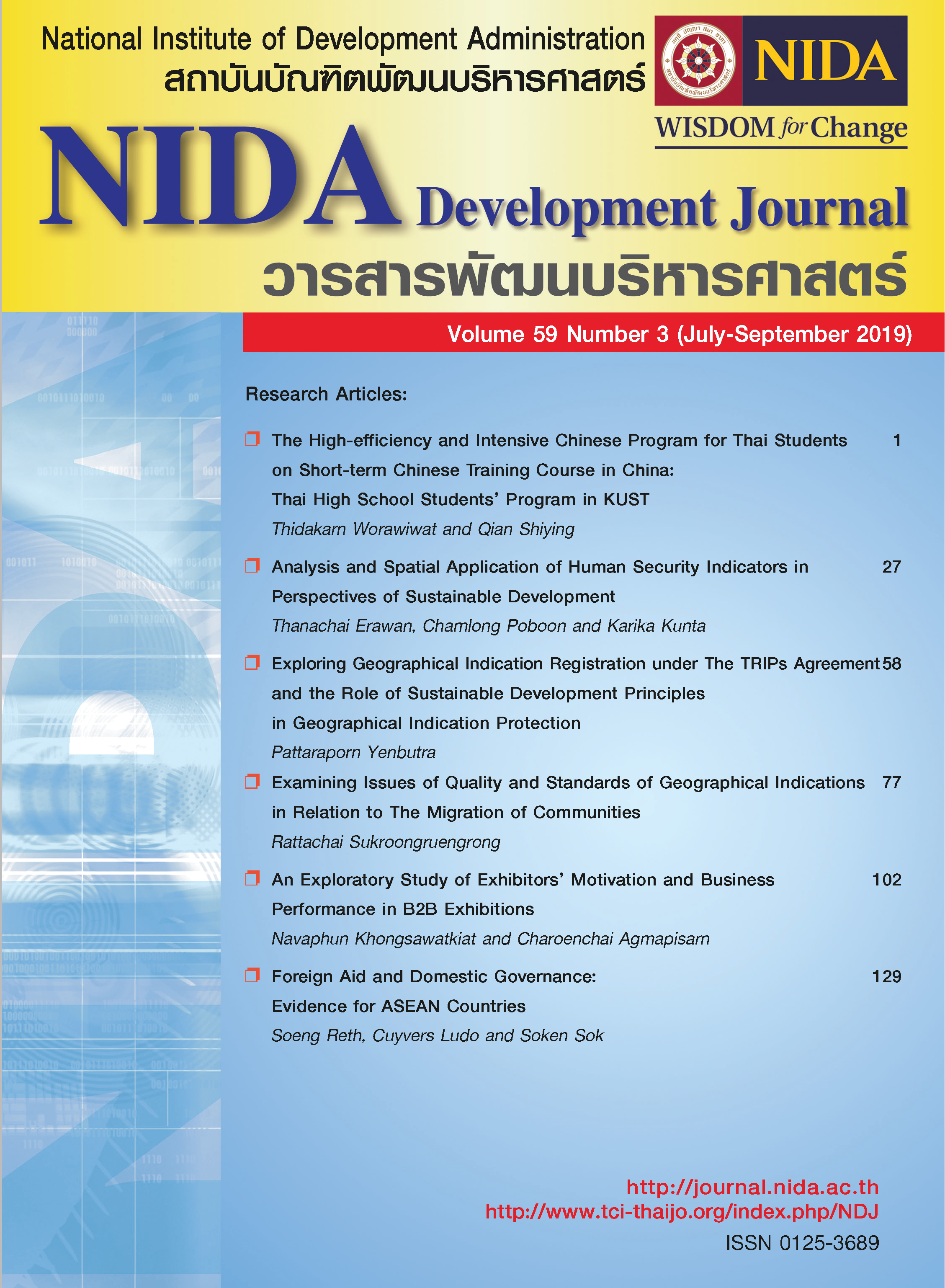
พิเคราะห์การจดทะเบียนสิ่งบ่งชี้ทางภูมิศาสตร์ภายใต้ข้อตกลง TRIPs และบทบาทของหลักการพัฒนาที่ยั่งยืนในการคุ้มครองสิ่งบ่งชี้ทางภูมิศาสตร์
คำสำคัญ:
สิ่งบ่งชี้ทางภูมิศาสตร์, ความตกลง TRIPs, หลักการพัฒนาที่ยั่งยืน, การขึ้นทะเบียน, คำพ้องรูปหรือเสียงบทคัดย่อ
ความตกลง TRIPs ไม่ได้ระบุไว้อย่างชัดเจนถึงหลักเกณฑ์การขึ้นทะเบียนและคุ้มครองสิ่งบ่งชี้ทางภูมิศาสตร์ในประเทศอื่นๆ ในการพิจารณาว่าความตกลง TRIPs คุ้มครองสิ่งบ่งชี้ทางภูมิศาสตร์ตามหลักการพัฒนาที่ยั่งยืนหรือไม่ จำเป็นต้องมีหลักเกณฑ์ที่ชัดเจน โดยหลักการนั้น การคุ้มครองสิ่งบ่งชี้ทางภูมิศาสตร์กำหนดให้ใช้กฎหมายระหว่างประเทศที่สอดคล้องกับการพัฒนาที่ยั่งยืน เพื่อแสดงถึงการสร้างสมดุลระหว่างเศรษฐกิจ สังคม และสิ่งแวดล้อม ภายใต้ความตกลง TRIPs และหลักการพัฒนาที่ยั่งยืน บทความนี้จะเปรียบเทียบขอบเขตและเกณฑ์ในการคุ้มครองสิ่งบ่งชี้ทางภูมิศาสตร์ พร้อมเสนอแนวทางที่เป็นประโยชน์สำหรับการปรับปรุงขอบเขตและเกณฑ์ระหว่างประเทศในการคุ้มครองสิ่งบ่งชี้ทางภูมิศาสตร์ โดยการเพิ่มหลักเกณฑ์หรือการตีความเพื่อคุ้มครองสิ่งบ่งชี้ทางภูมิศาสตร์ในประเทศต้นกำเนิด และการให้ข้อยกเว้นสำหรับการละเมิดสิ่งบ่งชี้ทางภูมิศาสตร์ในกรณีคำที่พ้องรูปหรือพ้องเสียงโดยที่คำเหล่านี้มีความหมายเหมือนกัน แต่คำนั้นแสดงถึงแหล่งกำเนิดทางภูมิศาสตร์ที่แตกต่างกัน
เอกสารอ้างอิง
Delphine Marie-Vivien et al. (2017). Are French Geographical Indications Losing Their Soul? Analyzing Recent Developments in the Governance of the Link to the Origin in France. World Development, 98, p.24. Retrieved February 24, 2017. From http://dx.doi.org/ 10.1016/ j.worlddev.2015.01.001.
Sudhir Ravindran and Arya Mathew. The Protection of Geographical Indication in India - Case Study on ‘Darjeeling Tea’. International property rights 58 index 2009 report, Retrieved August 1, 2017. from https://www.altacit.com/wp-content/uploads/2021/09/The-Protection-of-Geographical-Indication-in-India-Case-Study-on-Darjeeling-Tea.pdf
Vandecandelaere, Emilie et al. (2018). Food and Agriculture Organization of the United Nations. Strengthening sustainable food systems through geographical indications An analysis of economic impacts. Retrieved May 12, 2018 from https://www.fao.org/3/I8737EN/i8737 en.pdf
Chethana, A.N., Nagaraj, N., Chengappa, P., & Gracy, C.P. (2010). Geographical Indications for Kodagu Coffee – A Socio-economic Feasibility Analysis. Agricultural Economics Research Review, 23(1), Retrieved May 4, 2018 from http://ageconsearch.umn.edu/ bitstream/ 92157/2/11-AN-Chethana.
Barham, E. (2003). Translating terroir: the global challenge of French AOC labeling. Journal of Rural Studies, 19(1), 127–138. Retrieved May 3, 2018 from https://doi.org/10.1016/ s0743-0167(02)00052-9
Reviron, S., Thevenod-Mottet, E., & El-Benni, N. (2009). Geographical Indications: creation and distribution of economic value in developing countries. NCCR Trade Working Paper No 2009/14. Retrieved June 6, 2018 from https://www.researchgate.net/publication/ 259999235. Geographical_Indications_creation_and_distribution_of_economic_value_in_ developing_countries.
Monten, L. (2005). Geographical Indications of Origin: Should They Be Protected and Why? An Analysis of the Issue from the U.S. and EU Perspectives. Santa Clara High Technology Law Journal, 22(2), 315–349. Retrieved May 3, 2018 from https://core.ac.uk/download/ pdf/149256786.pdf
USPTO.GOV. 213 Right of Priority of Foreign Application [R-08.2017]. Retrieved May 23, 2018 from https://www.uspto.gov/web/offices/pac/mpep/s213.html
Blakeney, M. L. (2012). “Geographical Indications and TRIPS.” SSRN Electronic Journal, 7-34. Retrieved April 1, 2016 from https://doi.org/10.2139/ssrn.2177435
Making the Origin Count: The Colombian Experience. (2010, September 3). World Intellectual Property Organization (WIPO). Retrieved April 1, 2018 from https://www.wipo.int/ ipadvantage/ en/details.jsp?id=2617
Teuber, R. (2010). Geographical Indications of Origin as a Tool of Product Differentiation: The Case of Coffee. Journal of International Food & Agribusiness Marketing, 22(3–4), 277–298. Retrieved April 21, 2018 from https://doi.org/10.1080/08974431003641612
Sustainable agriculture for the future we want. European Commission. Retrieved December 4, 2016 from http://www.ec.europa.eu/agriculture/files/events/2012/rio-side-event/ brochure en.
ดาวน์โหลด
เผยแพร่แล้ว
รูปแบบการอ้างอิง
ฉบับ
ประเภทบทความ
สัญญาอนุญาต
ลิขสิทธิ์ (c) 2020 วารสารพัฒนบริหารศาสตร์

อนุญาตภายใต้เงื่อนไข Creative Commons Attribution-NonCommercial-NoDerivatives 4.0 International License.