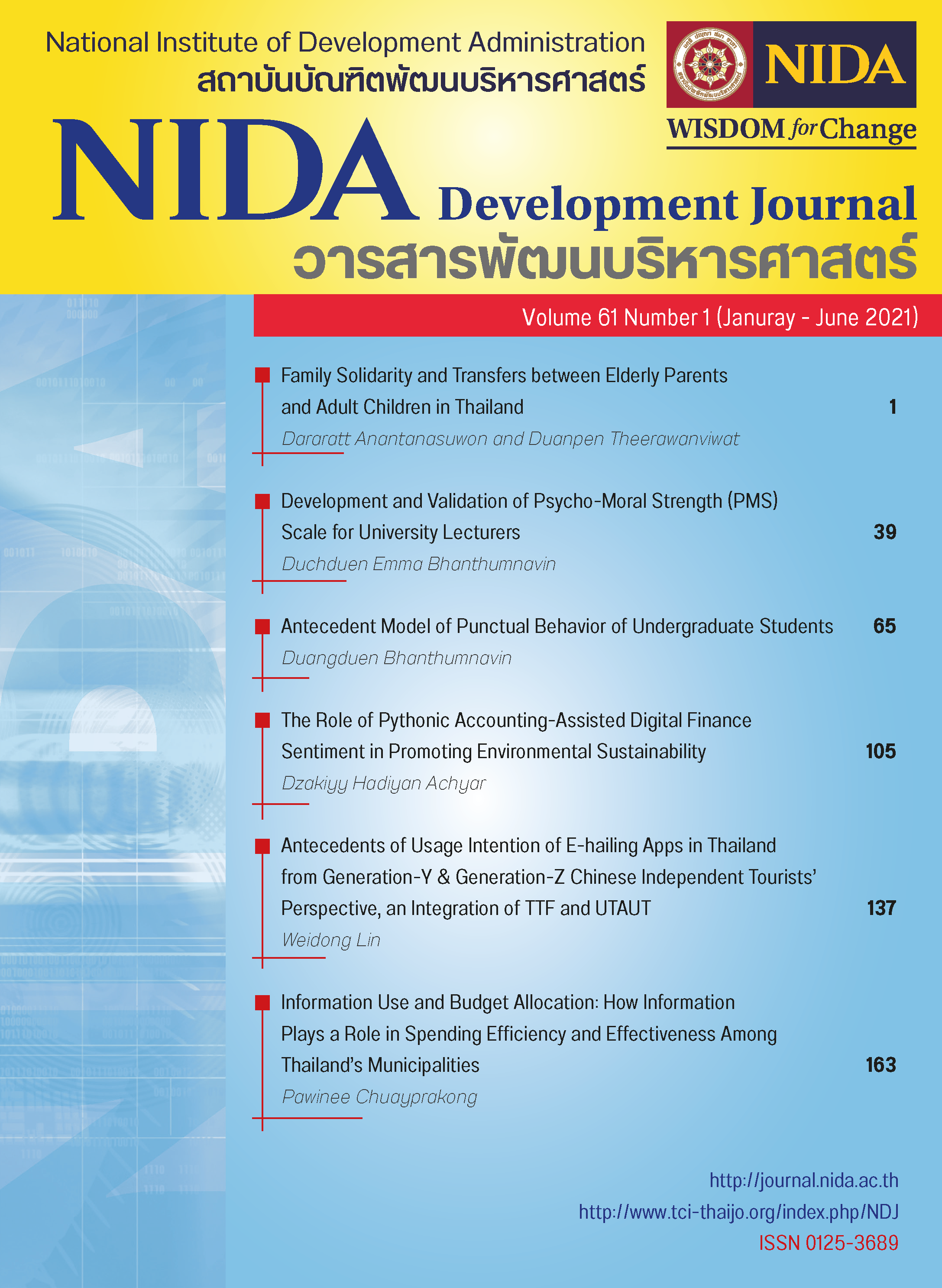
ความเข้มแข็งของครอบครัวและการเกื้อกูลกันระหว่างบิดามารดาสูงอายุและบุตรวัยผู้ใหญ่ในประเทศไทย
คำสำคัญ:
ความเป็นปึกแผ่นของครอบครัว, การเกื้อกูลระหว่างรุ่นวัย, ผู้สูงอายุ, ประเทศไทยบทคัดย่อ
บทความนี้มีวัตถุประสงค์สำคัญในการศึกษา 2 ประการ คือ (1) เพื่อศึกษาความเป็นปึกแผ่นของครอบครัวผู้สูงอายุไทยในปัจจุบัน โดยเฉพาะด้านที่ปรากฏให้เห็นเป็นรูปธรรม ได้แก่ ด้านโครงสร้างของครอบครัว ด้านความเชื่อมโยงสัมพันธ์กัน และด้านการปฏิบัติตามหน้าที่ และ (2) เพื่อวิเคราะห์จัดประเภท (Typology) ของการเกื้อกูลกันระหว่างผู้สูงอายุไทยกับบุตรวัยผู้ใหญ่จากมุมมองของผู้สูงอายุ โดยวิธี Latent Class Analysis (LCA) การศึกษาความเป็นปึกแผ่นและการวิเคราะห์ด้วย LCA จะเป็นการศึกษาเปรียบเทียบระหว่างกลุ่มอายุ ได้แก่ ผู้สูงอายุวัยต้น (อายุ 60-69 ปี) วัยกลาง (อายุ 70-79 ปี) และวัยปลาย (อายุ 80 ปีหรือสูงกว่า) สำหรับข้อมูลในการศึกษาได้นำมาจากข้อมูลจากการสำรวจระยะยาวด้วยตัวอย่างครัวเรือนซ้ำ รอบที่ 2 (2560) ของโครงการศึกษาสุขภาพ การสูงอายุ และการเกษียณในประเทศไทย เพื่อวิเคราะห์แบบข้อมูลภาคตัดขวาง
ผลการศึกษา: ผลการศึกษาความเป็นปึกแผ่นของครอบครัวใน 3 ด้าน พบว่า ความเป็นปึกแผ่นในแต่ละด้านที่ศึกษาอันหมายถึงความสัมพันธ์หรือการมีปฎิสัมพันธ์กับบุตรวัยผู้ใหญ่ในด้านต่างๆก็มีแนวโน้มที่จะเพิ่มมากขึ้นด้วย ไม่ว่าจะเป็นประเด็นของการพักอาศัยอยู่กับบุตร ความถี่ในการติดต่อพูดคุยกับบุตร หรือการมีบทบาทเป็น “ผู้รับ” ทรัพยากรความช่วยเหลือจากบุตรอย่างเดียว โดยตัวบ่งชี้ความเป็นปึกแผ่นเหล่านี้มีสัดส่วนที่สูงขึ้นในบิดามารดาสูงอายุวัยปลาย เมื่อเปรียบเทียบกับวัยต้นและวัยกลาง ซึ่งอาจจะตีความได้ว่าเมื่อบิดามารดามีอายุมากขึ้น สถานะของการพึ่งตนเองได้เปลี่ยนไปเป็นการพึ่งพาผู้อื่นโดยเฉพาะบุตรในแง่ของเศรษฐกิจ สังคม และสุขภาพ เนื่องจากความทรุดโทรมทางด้านร่างกายและจิตใจ จึงต้องการการเอาใจใส่ดูแลช่วยเหลือมากขึ้น
การวิเคราะห์ LAC จากมุมมองของผู้สูงอายุ ได้ผลแยกแยะการสนับสนุนระหว่างบิดามารดาสูงอายุและบุตรวัยผู้ใหญ่ ออกเป็น 4 ประเภท ได้แก่ “ห่างเหินจากลูก” “เห็นหน้าลูก” “แลกเปลี่ยนด้วยบริการ” และ “มีลูกกตัญญู” โดยสัดส่วนของผู้สูงอายุที่มีการสนับสนุนในแต่ละประเภทตามลำดับ ดังนี้ 41%, 6%, 29%, and 24% นอกจากนั้น ประเภทการสนับสนุนระหว่างบิดามารดาและบุตรในแต่ละกลุ่มอายุยังแตกต่างกัน และสามารถแสดงให้เห็นด้วยหลักฐานเชิงประจักษ์ถึงกระบวนการเปลี่ยนแปลงของปฏิสัมพันธ์ระหว่างรุ่นในช่วงชีวิตของคน โดยรวม ผลการศึกษา แสดงให้เห็นถึงบรรทัดฐานทางสังคมที่เกี่ยวข้องกับความกตัญญูต่อบุพการียังคงอยู่ในสังคมไทย แต่พฤติกรรมในการแสดงออกได้มีการเปลี่ยนแปลงจากรูปแบบเดิมที่การช่วยเหลือและสนับสนุนแก่บิดามารดาทั้งในรูปของเงินและสิ่งที่ไม่ใช่เงิน มาเป็นอย่างน้อยมีการติดต่อพูดคุยกับบิดามารดาอย่างสม่ำเสมอ หรือบิดามารดาแลกเปลี่ยนความช่วยเหลือในด้านที่ไม่ใช่เงิน ซึ่งเป็นการปรับเปลี่ยนพฤติกรรมให้เหมาะสมกับสภาพของสังคมที่เปลี่ยนไป และการเกื้อหนุนผู้สูงอายุจากครอบครัวมีแนวโน้มที่จะเป็นการดูแลที่มีระยะยาวขึ้น ผู้สูงอายุจึงอาจต้องเกี่ยวพันกับสมาชิกในครอบครัวหลายรุ่นด้วยกัน ดังนั้นข้อเสนอแนะเชิงนโยบายที่สำคัญ คือ การป้องกันไม่ให้มีปัญหาช่องว่างระหว่างรุ่นวัยในครอบครัว
เอกสารอ้างอิง
ปราโมทย์ ประสาทกุล และ ปัทมา ว่าพัฒนวงศ์ (2548) สถานการณ์ประชากรของประเทศไทย พ.ศ. 2548. ใน กฤตยา อาชวนิจกุล และ ปราโมทย์ ประสาทกุล (บรรณาธิการ), ประชากรและสังคม 2548 : ประชากรของประเทศไทย ณ พ.ศ. 2548. นครปฐม: สำนักพิมพ์ประชากรและสังคม.
สำนักงานคณะกรรมการพัฒนาเศรษฐกิจและสังคมแห่งชาติ (2558) ข้อมูลเศรษฐกิจและสังคม สถิติด้านประชากร จาก http://social.nesdb.go.th/SocialStat/StatSubDefault_Final.aspx?catid=1
Anantanasuwong, Dararatt, Dampen Theerawanviwat, Pachitjanut Siripanich, Preecha Vichitthamaros, Udomsak Seenprachawong, Ratiporn Tungfung, Arnond Sakworawich, Thongyai Iyavarakul, Tasanee Satimanon. (2018). Well-being of the Elderly in Thailand: Wave 2. Report No. 184017 to National Research Commission of Thailand. Bangkok, Thailand: Center for Aging Society Research, Research Center, National Institute of Development Administration (in Thai).
Bengtson, V.L. (2001). Beyond the nuclear family: The increasing importance of multigenerational bonds. Journal of Marriage and Family, 63, 1-16.
Bengtson, V.L. and Roberts, R.L. (1991). Intergenerational solidarity in aging families: An example of formal theory construction. Journal of Marriage and Family, 53, 856-870.
Knodel, J., Prachuabmoh, V. and Chayovan, N. (2013). The Changing Well-being of Thai Elderly: An Update from the 2011 Survey of Older Persons in Thailand. Report 13-793. University of Michigan, Institute for Social Research, Population Studies Center.
Knodel, J., Teerawichitchainan, Bussarawan, Prachuabmoh, V. and Pothisiri, Wiraporn. (2015). The Situation of Thailand’s Older Population: An Update based on the2014 Survey of Older Persons in Thailand. Report 15-847. University of Michigan, Institute for Social Research, Population Studies Center.
Lee, Ronald and Mason, Andrew. (2011). Population Aging and the Generational Economy: A Global Perspective. International Development Research Centre. Ottawa, Canada.
McChesney, K. Y., & Bengtson, V. L. (1988). Solidarity, integration, and cohesion in families: Concepts and theories. In D. J. Mangen, V. L. Bengtson, & P. H. Landry, Jr. (Eds.), Sage focus editions, Vol. 92. Measurement of intergenerational relations (pp. 15-30). Thousand Oaks, CA, US: Sage Publications, Inc.
Park, Keong-Suk, Phua, Voonchin, McNally, James, and Sun, Rongjun. (2005). Diversity and Structure of Intergenerational Relationships: Elderly Parent-Adult Child Relations in Korea. Journal Cross Cultural Gerontology.20:285-305.
Roberts, Robert E.L., Richards, Leslie, and Bengtson, Vern L. (1991). “Intergenerational Solidarity in Families: Untangling the ties That Bind.” Pp. 11-46. In Families: Intergenerational and Generational Connections. Susan P. Pfeifer and Marvin B. Sussman eds. New York: The Haworth Press.
Rossi, Alice S., and Peter H. Rossi (1990) Of Human Bonding: Parent-Child Relations Across the Life Course. Aldine de Gruyter. New York
Silverstein, M. and Bengtson, V.L. (1997). Intergenerational Solidarity and the Structure of Adult Child–Parent Relationships in American Families. American Journal of Sociology,103, No. 2, 429-460.
United Nations (2015). Transforming Our World: The 2030 Agenda for Sustainable Development. (A/RES/70/1). Resolution adopted by the General Assembly on 25 September 2015.
United Nations. (2017). Work of the Statistical Commission Pertaining to the 2030 Agenda for Sustainable Development (A/RES/71/313). Resolution adopted by the General Assembly on 6 July 2017.
https://en.wikipedia.org/wiki/Sustainable_Development_Goals#cite_note-:172-1
United Nations Development Programme. (2017). Ageing, Older Persons and the 2030 Agenda for Sustainable Development. New York, https://www.undp.org/publications/ageing-older-persons-and-2030-agenda-sustainable-development#modal-publication-download
Yi, Chin-chun and Lin, Ju-ping. (2009). Types of Relations between Adult Children and Elderly Parents in Taiwan: Mechanisms Accounting for Various Relational Types. Journal of Comparative Family Studies.40: 305-324.
World Health Organization. (2019). A Decade of Healthy Ageing 2020–2030. https://www.who.int/docs/default-source/decade-of-healthy-ageing/final-decade-proposal/decade-proposal-final-apr2020-en.pdf?sfvrsn=b4b75ebc_5
Zhao, Yaohui et. al. (2013). Challenges of Population Aging in China. Beijing: National School of Development, Peking University.
ดาวน์โหลด
เผยแพร่แล้ว
รูปแบบการอ้างอิง
ฉบับ
ประเภทบทความ
สัญญาอนุญาต
ลิขสิทธิ์ (c) 2023 วารสารพัฒนบริหารศาสตร์

อนุญาตภายใต้เงื่อนไข Creative Commons Attribution-NonCommercial-NoDerivatives 4.0 International License.