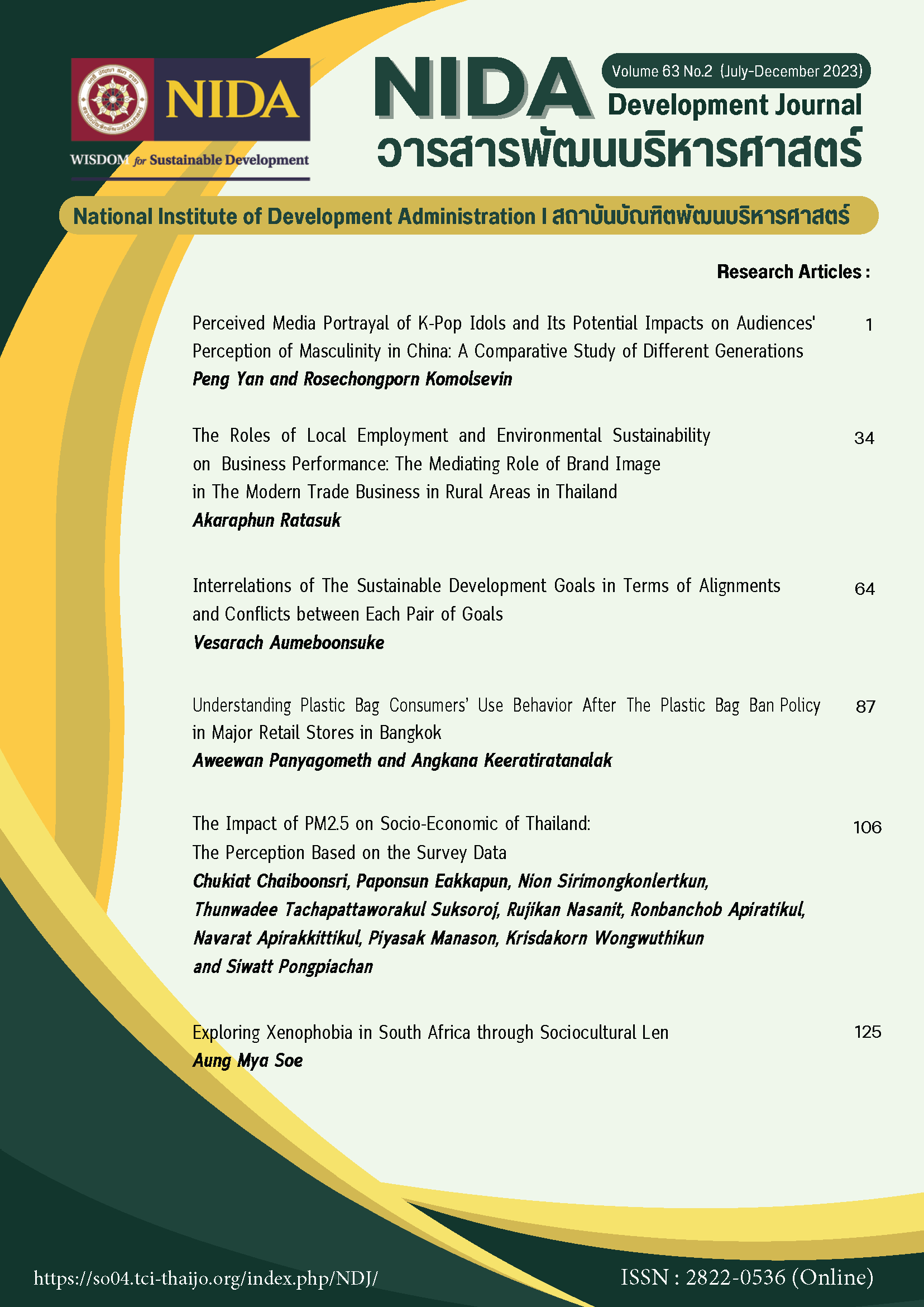
การรับรู้ภาพสื่อของไอดอลเคป็อปและผลกระทบที่อาจเกิดขึ้นต่อการรับรู้ของผู้ชมเกี่ยวกับความเป็นชายในจีน: การศึกษาเปรียบเทียบของคนรุ่นต่างๆ
DOI:
https://doi.org/10.14456/ndj.2023.1คำสำคัญ:
ไอดอลเคป๊อป, การรับรู้ภาพสื่อ, การรับรู้ถึงความเป็นชายบทคัดย่อ
การแพร่กระจายของวัฒนธรรมเคป๊อปได้จุดชนวนให้เกิดความขัดแย้งในประเทศจีนเกี่ยวกับผลกระทบที่มีต่อการรับรู้ถึงความเป็นชาย ดังนั้นรัฐบาลจีนจึงสั่งห้ามเนื้อหาเคป๊อปทั้งหมดในทีวีและโซเชียลมีเดีย งานวิจัยนี้มีจุดมุ่งหมายที่จะศึกษาภาพที่สื่อรับรู้เกี่ยวกับความเป็นชายของไอดอลเคป็อปในทีวี/ทีวีออนไลน์ และผลกระทบที่มีต่อการรับรู้ถึงความเป็นชายโดยสองรุ่น: Millennials และ Generation Z และเปรียบเทียบความแตกต่างระหว่างพวกเขา การศึกษานี้ใช้แนวทางเชิงปริมาณและสำรวจด้วยแบบสอบถามออนไลน์เนื่องจากโควิด-19 รวบรวมผลลัพธ์ที่ถูกต้องได้มากถึง 425 รายการจากผู้ตอบแบบสอบถามของทั้งกลุ่ม Millennials และ Generation Z ข้อมูลที่รวบรวมได้ถูกนำมาใช้เพื่อทดสอบสมมติฐานเกี่ยวกับ SPSS ทดสอบสมมติฐาน 1 ด้วยการวิเคราะห์การถดถอยเชิงเส้นและสมมติฐานที่ 2 ด้วยการทดสอบตัวอย่างอิสระ ผลการวิจัยแสดงให้เห็นความแตกต่างอย่างมีนัยสำคัญระหว่างคนรุ่นมิลเลนเนียลและเจเนอเรชั่น Z ในการรับรู้ถึงความเป็นชายภายใต้ผลกระทบของภาพที่ไอดอลเคป๊อปรับรู้ทางทีวี/ทีวีออนไลน์ในประเทศจีน Millennials เห็นด้วยอย่างยิ่งกับผลกระทบในขณะที่ Generation Z ไม่เห็นด้วย ผลการวิจัยนี้สามารถนำไปใช้ในการปรับปรุงกฎระเบียบเกี่ยวกับกิจกรรมการสื่อสารระหว่างวัฒนธรรมในประเทศจีน ขอแนะนำให้ดำเนินการศึกษาเปรียบเทียบอย่างต่อเนื่องเกี่ยวกับการรับรู้ถึงความเป็นชายระหว่างกลุ่มเป้าหมายปัจจุบันกับคนรุ่นใหม่ที่กำลังมาถึง เพื่อหาข้อสรุปที่ดีขึ้นเกี่ยวกับแนวโน้มทางวัฒนธรรมในประเทศจีน
เอกสารอ้างอิง
Blue Rain. (2001). 哈韩有哈韩的道理 [There are reasons for hahan]. 轻音乐全日韩./Cool Music, 18, 28.
Brannon, R., & Juni, S. (1984). A scale for measuring attitudes about masculinity. Psychological Documents, 14, 6 –7.
Cheng, X. (2021, May 9). Lu Han said makeup not limited to a specific gender. Netease Entertainment. Retrieved from https://www.163.com/ent/article/G9JIQJOJ00038FO9.html.
Cole, N. L. (2020, January 6). How the Ruling Class Maintains Power Using Ideas and Norms. ThoughtCo. https://www.thoughtco.com/cultural-hegemony-3026121
Dal, Y. J. (2013, March 1). Hallyu 2.0: The new korean wave in the creative industry. International Institute Journal. Retrieved from https://quod.lib.umich.edu/i/iij/11645653.0002.102/--hallyu-20-the-new-korean-wave-in-the-creative-industry?rgn=main%3Bview.
Dazui. (2001). 内地制造”韩流”第一人——司捷 [Si Jie: The first person who made “Hallyu” in the Mainland]. 轻音乐全日韩/Cool Music, 24, 20.
Doujiao. (2001). 我们为什么爱上流感? [Why we fall in love with the flu?] 轻音乐全日韩/Cool Music, 12, 16.
Hawkins, A. C. (2019, October 23). CIA turned our celebrities into ‘sissy pants’, says Chinese Academy of Social Sciences. World | The Times. https://www.thetimes.co.uk/article/cia-turned-our-celebrities-sissy-says-beijing-sl8p8klfr
Jourdan, A. J. L. (2017, March 17). Missile row drives Korean culture underground in China. Reuters. https://www.reuters.com/article/us-southkorea-china-culture-idUSKBN16O0I0
Li, L., & Kuang, C. (2021, June 11). Shifting sands: Masculinity in China: Marketing. Campaign Asia. Retrieved from https://www.campaignasia.com/article/shifting-sands-masculinity-in-china/469581.
Lifshitz, H. (2000). Conceptualization of Age and Aging by Adolescents, Adult and Elderly People with Mental Retardation. Education and Training in Mental Retardation and Developmental Disabilities, 35(4), 374–383. http://www.jstor.org/stable/23879861
May, T. (2021, September 6). China’s Weibo Suspends BTS, Blackpink and EXO Fan Accounts. The New York Times. https://www.nytimes.com/2021/09/06/business/china-bts-kpop-fans.html
Morin, N. (2020, May 12). K-pop's beautiful men are breaking the rules of masculinity, but can america handle it? What Male K-Pop Stars Teach Us About Masculinity. Retrieved from https://www.refinery29.com/en-us/2020/05/9674149/kpop-male-singers-masculinity.
NetEase Entertainment. (2012). 司捷:组合文化将和选秀市场分天下(全文) [Si Jie: Group culture and talent shows will divide the market (full text)]. Retrieved from http://ent.163.com/12/1228/15/8JQQLE2R00031H0O_all.html
Piao, G. (2011). 韩流的文化启示——兼论韩流对现代社会生活方式的影响及其文化根源[Cultural enlightenment of Korean wave -- Also on the influence of Korean wave on modern social life style and its cultural roots]. 国外社会科学(04),98-104. doi:CNKI:SUN:GWSH.0.2011-04-023.
Piao, G. (2016). 论中国人看待韩流的文化心理[On the Chinese People’s Cultural Mentality Towards the Korean Wave]. 当代韩国(04),76-86. doi:CNKI:SUN:DDHG.0.2016-04-007.
Shiau, H., & Chen, C. (2016). When Sissy Boys Become Mainstream: Narrating Asian Feminized Masculinities in the Global Age.
Sun, M., & Liew, K. K. (2019). Analog Hallyu: Historicizing K-pop formations in China. Global Media and China, 4(4), 419–436. https://doi.org/10.1177/2059436419881915
TNEC News Desk. (2021, July 28). K-drama to K-pop; will this Hallyu be the no. 1 reason for cultural manifestation. The North-Eastern Chronicle. Retrieved from https://northeasternchronicle.in/news/will-hallyu-be-the-no-1-reason-for-cultural-manifestation/.
Wang, F. (2017, December 14). “限韩令”下的韩流产业能否重回中国市场?[Can the Hallyu Industry Under the "Korea Restriction Order" Return to the Chinese Market]. BBC News 中文. https://www.bbc.com/zhongwen/simp/chinese-news-42319225
Yi, D. (2020, April 15). How K-pop changed the meaning of masculinity in South Korea. Allure. Retrieved from https://www.allure.com/story/k-pop-and-masculinity.
Zheng, X. (2008).“韩流”成因及对我国青少年的影响[Cause of "South Korean Tide" and Its Influence on Chinese Youth.]. 中国青年研究(02),97-99. doi:10.19633/j.cnki.11-2579/d.2008.02.022.
ดาวน์โหลด
เผยแพร่แล้ว
รูปแบบการอ้างอิง
ฉบับ
ประเภทบทความ
สัญญาอนุญาต
ลิขสิทธิ์ (c) 2023 วารสารพัฒนบริหารศาสตร์

อนุญาตภายใต้เงื่อนไข Creative Commons Attribution-NonCommercial-NoDerivatives 4.0 International License.