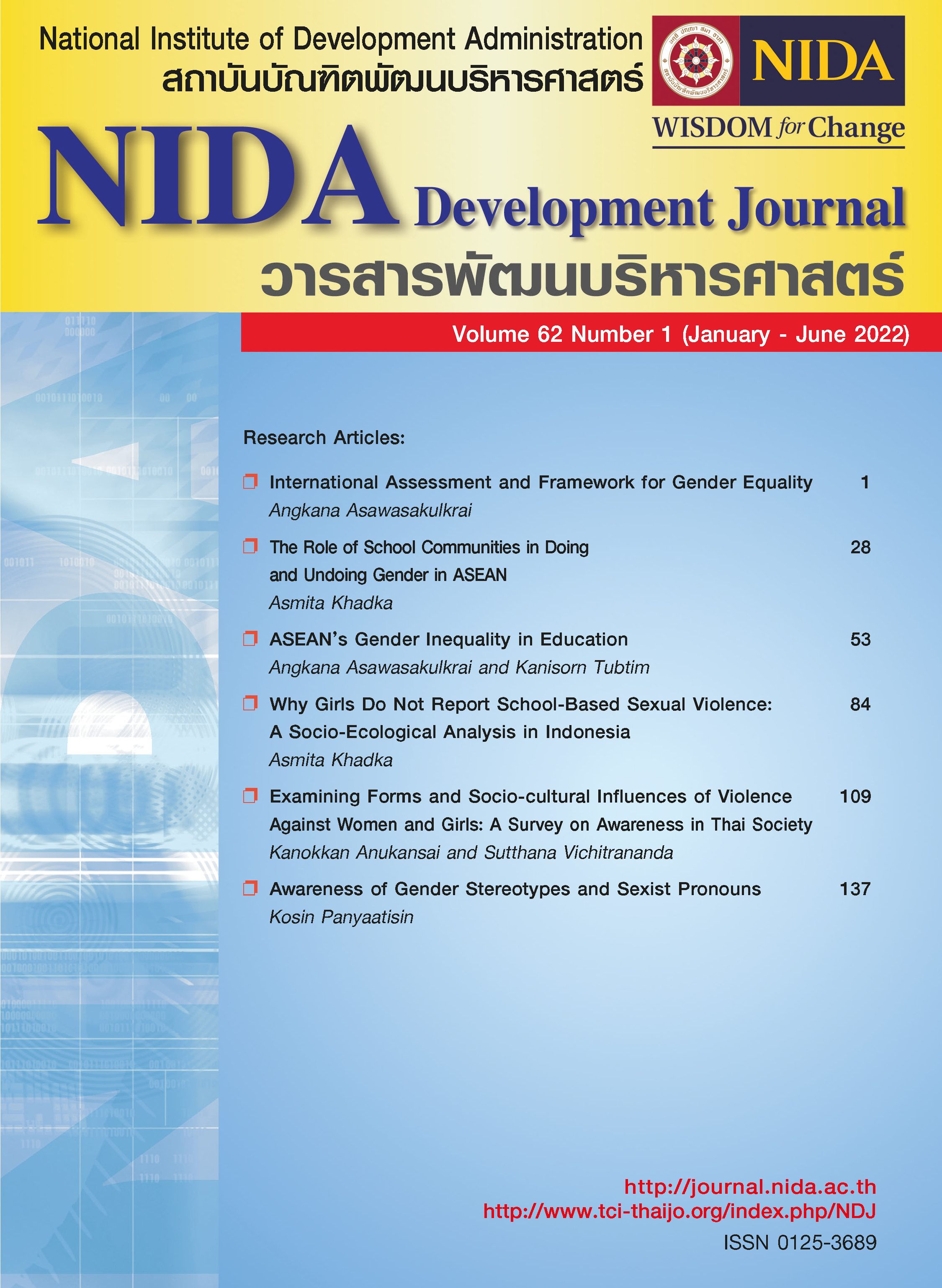
กรอบความคดิ และการประเมนิ ความเท่าเทยี มทางเพศ
คำสำคัญ:
ความเท่าเทียมทางเพศ, ความไม่เท่าเทียม, ช่องว่างระหว่างเพศ, การประเมิน , กรอบความคิดบทคัดย่อ
ถึงแม้ว่าโลกจะได้รับการพัฒนาไปอย่างมากในปัจจุบัน แต่ปัญหาความไม่เท่าเทียมทางเพศยัง คงปิดกั้นสิทธิมนุษยชนและโอกาสแก่ผู้หญิง ปัจจัยและประเด็นเหล่านี้ กีดกันและขัดขวางไม่ให้ผู้หญิงดำรงชีวิตได้อย่างปลอดภัยและเป็นธรรม และทำให้ประชากรเพศหญิงไม่สามารถประสบความสำเร็จในชีวิต และเป็นพลเมืองที่สร้างสรรค์ประโยชน์ให้แก่สังคมได้ ประเด็นเหล่านี้ประกอบด้วย ความยากจน การศึกษา ความรุนแรงทางเพศ ภาพพจน์และความเชื่อทางสังคม และการมีส่วนร่วมทางการเมือง ดังนั้น ประเทศและองค์กรระหว่างประเทศจึงได้มีการออกแบบและสร้างระบบการประเมิน กรอบความคิด ตัวชี้วัด และดรรชนีต่างๆ เพื่อใช้ในการประเมินสถานะความเท่าเทียมทางเพศ วิธีการวัดเหล่านี้ต่างมีวัตถุประสงค์ใกล้เคียงกันประกอบด้วย การประเมินสถานภาพความเท่าเทียมทางเพศ การพยากรณ์อนาคตของสถานะความเท่าเทียมทางเพศ หรือใช้เป็นระบบพื้นฐานในการดำเนินการนโยบายสร้างสังคมที่เท่าเทียมกัน งานวิจัยฉบับนี้จึงเป็นการศึกษากระบวนการ กรอบความคิด และระบบการประเมินต่างๆที่ได้รับยอมรับและใช้การอย่างกว้างขวางทั่วโลก ผลการศึกษาพบว่าระบบการประเมินอาจไม่ครอบคลุมเพียงพอและไม่ได้มีการประยุกต์ใช้ให้เหมาะสมกับสภาพแวดล้อมและปัจจัยท้องถิ่นในแต่ละพื้นที่ซึ่งมีความซับซ้อนและแตกต่างกันไป ถึงแม้ว่าระบบการประเมินและดรรชนีต่างๆจะมีประโยชน์และเป็นจุดเริ่มต้นของการสร้างความเท่าเทียมกันทางเพศ อย่างไรก็ดีระบบเหล่านี้ควรได้รับการศึกษา ปรับปรุง และปรับใช้ให้เหมาะสมกับแต่ละสถานการณ์ นอกจากนี้ การประเมินความเท่าเทียมกันในเชิงคุณภาพควรได้รับความสำคัญไม่ด้อยไปกว่ากัน เพื่อให้การสร้างความเท่าเทียมกันทางเพศเป็นไปอย่างครอบคลุม
เอกสารอ้างอิง
Afridi, M. (2018). Equity and Quality in an education public private partnership. Retrieved from www.oxfam.org/en/research/equity-and-quality-education-public-privatepartnership
Bamrah, A. (2014). 34 years after signing, the US still hasn’t ratified CEDAW. Retrieved from https://civilrights.org/edfund/resource/34-years-after-signing-united-states-still-hasntratified-cedaw/
Bartůskov., L., & Kubelkov., K. (2014). Main challenges in measuring gender inequality. In FIKUSZ’14 Symposium for Young Researchers (pp. 19-28).
Bayissa, F., Smits, J., & Ruben, R. (2018). The multidimensional nature of women's empowerment: beyond the economic approach. Journal of International Development, 30(4), 661-690.
Biermann, F., Kanie, N., & Kim, R. (2017). Global governance by goal-setting: the novel approach of the UN Sustainable Development Goals. Current Opinion in Environmental Sustainability, 26, 26-31.
Branisa, B., Klasen, S., & Ziegler, M. (2013). Gender inequality in social institutions and gendered development outcomes. World Development, 45, 252-268.
Branisa, B., Klasen, S., Ziegler, M., Drechsler, D., & Jütting, J. (2014). The institutional basis of gender inequality: The Social Institutions and Gender Index (SIGI). Feminist economics, 20(2), 29-64.
Center for Philanthropy and Civil Society, National Development Administration. (2021). Elimination of gender stereotypes and sexist language in educational materials in primary and secondary levels: phase 1 and 2. Retrieved from http://www.cpcs.nida.ac.th/home/index.php/component/sppagebuilder/page/21
Chalmers, J., Campbell, I., & Charlesworth, S. (2005). Part-time work and caring responsibilities in Australia: Towards an assessment of job quality. Labour & Industry: a journal of the social and economic relations of work, 15(3), 41-66.
Chaney, P. (2016). Mind the gap? Civil society policy engagement and the pursuit of gender justice: critical discourse analysis of the implementation of the Beijing Declaration and Platform for Action in Africa 2003–2015. Review of African Political Economy, 43(150), 608-629.
Consortium on Gender, Security and Human Rights. (2017). Feminist Critiques of the Sustainable Development Goals- Analysis and Bibliography. Retrieved from https://genderandsecurity.org/sites/default/files/Feminist_Critiques_of_the_SDGs_-_Analysis_and_Bibliography_-_CGSHR.pdf
Cornwall, A., & Edwards, J. (2015). Introduction: Beijing+ 20–where now for gender equality?. IDS Bulletin, 46(4), 1-8.
Eden, L., & Gupta, S. (2017). Culture and context matter: Gender in international business and management. Cross Cultural & Strategic Management.
Einarsd.ttir, .. (2020). All that Glitters is Not Gold: Shrinking and Bending Gender Equality in Rankings and Nation Branding, NORA. Nordic Journal of Feminist and Gender Research, 28(2), 140-152
Englehart, N., & Miller, M. (2014). The CEDAW effect: international law's impact on women's rights. Journal of Human Rights, 13(1), 22-47.
Esquivel, V. (2016). Power and the Sustainable Development Goals: a feminist analysis. Gender & Development, 24(1), 9-23.
Facio, A., & Morgan, M. (2009). Equity or equality for women. Understanding CEDAW’s equality principles, 1-38.
Guti.rrez-Mart.nez, I., Saifuddin, S. M., & Haq, R. (2021). The United Nations Gender Inequality Index. In Handbook on Diversity and Inclusion Indices (pp. 83-100). Edward Elgar Publishing.
Hausmann, R., Tyson, L., & Zahidi, S. (2012). The global gender gap report 2012. Geneva: World Economic Forum.
Hellum, A. & Aasen, H. (2013). Women’s Human Rights. CEDAW in International, Regional and National Law. New York: Cambridge University Press.
International Labour Organization. (2022). The gender gap in employment: what’s holding women back? Retrieved from https://www.ilo.org/infostories/en-GB/Stories/Employment/barriers-women#global-gap
Kanie, N., Griggs, D., Young, O., Waddell, S., Shrivastava, P., Haas, P. M., ... & Kőr.si, (2019). Rules to goals: emergence of new governance strategies for sustainable development. Sustainability Science, 14(6), 1745-1749.
Klasen, S. (2017). Gender, institutions, and economic development. GrOW Work. Pap. Ser. No. GWP-2017-04, McGill Univ., Montreal.
Liebowitz, D., & Zwingel, S. (2014). Gender equality oversimplified: Using CEDAW to counter the measurement obsession. International Studies Review, 16(3), 362-389.
MacFeely, S., Barnat, N., Anu Peltola, A. (2019). Comparing Global Gender Inequality Indices: What can they tell us about development? Work Session on Gender Statistics. United Nations Economic Commission for Europe, Working Paper 16.
McKinsey Global Institute. (2018). The power of parity: advancing women equality in Asia Pacific. Retrieved from https://www.burmalibrary.org/sites/burmalibrary.org/files/obl/docs21/Society%20and%20Culture/Pansy-Tun-Thein-2015-Gender_Equality_and_Cultural_Norms_in_Myanmar-en.pdf
Mullins, L. (2018). CEDAW: The challenges of enshrining women’s equality in international law. Public integrity, 20(3), 257-272.
Narayan, U. (1997). Restoring history and politics to third world traditions, in Narayan, U. (ed.), Dislocating cultures: identities, traditions and third world feminism. London: Routledge, pp. 43-80, 195-203.
Och, M. (2018). The local diffusion of international human rights norms–understanding the cities for CEDAW campaign. International Feminist Journal of Politics, 20(3), 425-443.
OECD (2012), Closing the gender gap: act now, OECD Publishing, Paris.
OECD (2019), SIGI 2019 Global Report: Transforming Challenges into Opportunities, Social Institutions and Gender Index, OECD Publishing, Paris.
Parisi, L. (2009). The numbers do (n't) always ADD up: Dilemmas in using quantitative research methods in feminist IR scholarship. Politics & Gender, 5(3), 410-419.
Permanyer, I. (2013). A critical assessment of the UNDP’s gender inequality index. Feminist Economics, 19(2), 1-32.
Rai, S. (2003). Mainstreaming gender, democratizing the state. Manchester University Press.
Razavi, S. (2016). The 2030 Agenda: challenges of implementation to attain gender equality and women's rights. Gender & Development, 24(1), 25-41.
Risse, T., Ropp, S., & Sikkink, K. (Eds.). (2013). The persistent power of human rights: From commitment to compliance (Vol. 126). Cambridge University Press.
Runyan, A., & Sanders, R. (2021). Prospects for Realizing International Women’s Rights Law Through Local Governance: the Case of Cities for CEDAW. Human Rights Review, 22(3), 303-325.
Sander, G., & Keller, N. (2021). McKinsey Gender Parity Report. In Handbook on Diversity and Inclusion Indices (pp. 164-175). Edward Elgar Publishing.
Schedler, A. (2012). The measurer’s dilemma: Coordination failures in cross-national political data collection. Comparative Political Studies, 45(2), 237-266.
Thein, P. (2015). Gender equality and cultural norms in Myanmar. In International Conference on Burma/Myanmar Studies. Retrieved from https://www.burmalibrary.org/sites/burmalibrary.org/files/obl/docs21/Society%20and%20Culture/Pansy-Tun-Thein-2015-Gender_Equality_and_Cultural_Norms_in_Myanmar-en.pdf
Ulrich, J. (1999). Confronting gender-based violence with international instruments: Is a solution to the pandemic within reach. Ind. J. Global Legal Stud., 7, 629.
UN Women & UN DESA. (2021). Progress on the Sustainable Development Goals-The Gender Snapshot 2022. Retrieved on 23 October 2022 from https://www.unwomen.org/sites/default/files/2022-09/Progress-on-the-sustainabledevelopment-goals-the-gender-snapshot-2022-en_0.pdf
UN Women. (1979). Convention on the elimination of all forms of discrimination against women (CEDAW). Retrieved from https://www.un.org/womenwatch/daw/cedaw/
UN Women. (2000). Progress of the World's Women 2000. Biennial Report, United Nations Development Fund for Women, New York.
UN Women. (2015). Beijing Declaration and Platform for Action, Beijing +5 Political Declaration and Outcome. Retrieved from https://www.unwomen.org/en/digitallibrary/publications/2015/01/beijing-declaration
UN Women. (2018). Facts and figures: economic empowerment. Retrieved from https://www.unwomen.org/en/what-we-do/economic-empowerment/facts-and-figures
UN Women. (2021). Four facts you need to know about gender and poverty today. Retrieved from https://data.unwomen.org/features/four-facts-you-need-know-about-gender-andpoverty-today
UN Women. (2022). Poverty deepens for women and girls, according to latest projections. Retrieved from https://data.unwomen.org/features/poverty-deepens-women-and-girlsaccording- latest-projections
UNESCAP & UNU-IAS. (2018). Partnering for Sustainable Development Guidelines for Multi-stakeholder Partnerships to Implement the 2030 Agenda in Asia and the Pacific. Retrieved on 22 October 2022 from https://www.unescap.org/sites/default/files/MSP%20Guidelines.pdf
UNICEF. (2020). Equal rights and opportunities for girls and boys help all children fulfil their potential. Retrieved from https://www.unicef.org/gender-equality
United Nations Development Programme. (2014). FAQ-Gender Inequality Index. Retrieved on 23 October 2022 from https://www.undp.org/sites/g/files/zskgke326/files/migration/tr/HDR2014-FAQ-GIIEN.pdf
United Nations Development Programme. (2022). Gender Inequality Index (GII). Retrieved on 23 October 2022 from https://hdr.undp.org/data-center/thematic- compositeindices/gender-inequality-index#/indicies/GII
World Bank. (2021). Global Female Population (% of total population). Retrieved from https://data.worldbank.org/indicator/SP.POP.TOTL.FE.ZS
World Economic Forum. (2022). Global Gender Gap Report 2022 Insight Report July 2022. Retrieved from http://reports.weforum.org/global-gender-gap-report-2022
ดาวน์โหลด
เผยแพร่แล้ว
รูปแบบการอ้างอิง
ฉบับ
ประเภทบทความ
สัญญาอนุญาต
ลิขสิทธิ์ (c) 2023 วารสารพัฒนบริหารศาสตร์

อนุญาตภายใต้เงื่อนไข Creative Commons Attribution-NonCommercial-NoDerivatives 4.0 International License.