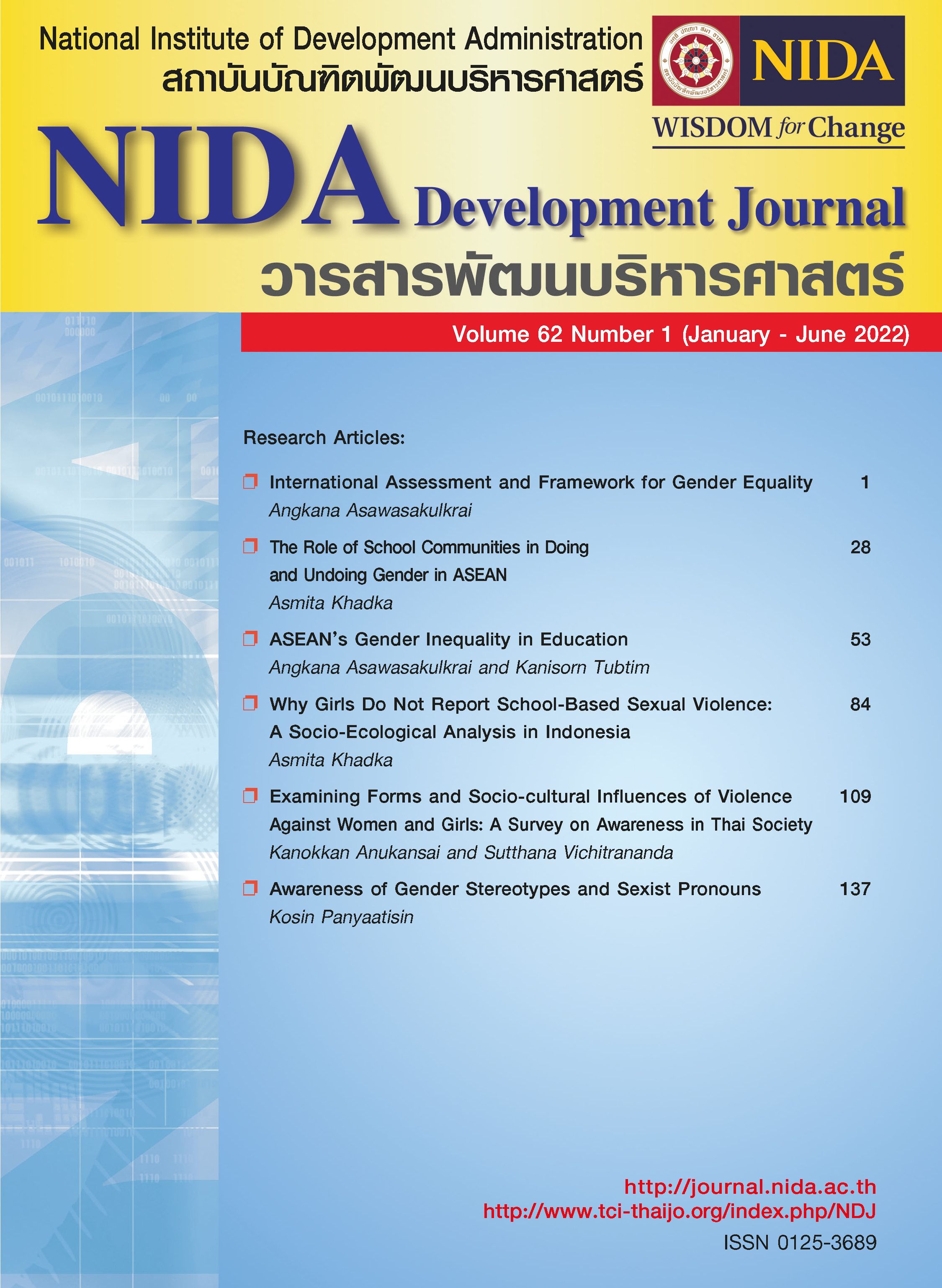
ความตระหนักรู้ถึงการเหมารวมทางเพศและบุรุษสรรพนามเหยียดเพศ
คำสำคัญ:
อคติ, ความเท่าเทียม, ตำราเรียน, บุรุษสรรพนาม, การเหมารวมทางเพศบทคัดย่อ
เป็นที่ทราบกันดีว่าความไม่เท่าเทียมทางเพศได้หยั่งรากลึกในทุกสังคม มนุษย์ล้วนปฏิบัติต่อกันผ่านการขัดเกลาทางสังคมโดยใช้ภาษาเป็นเครื่องมือ เมื่อครั้งเยาว์วัยเราต่างถูกปลูกฝังว่าความเป็นหญิงชายนั้นแสนแตกต่างกัน ด้วยเหตุนี้ผู้หญิงและผู้ชายก็ควรได้รับการปฏิบัติที่แตกต่างกันโดยปริยาย อย่างไรก็ตามลักษณะตายตัวแบบเหมารวมอันไร้เหตุผลนี้กำหนดให้ผู้หญิงไม่อาจแสดงศักยภาพสูงสุดของตนได้ ภาษาในตำราเรียนก็เป็นเครื่องมือกีดกันอย่างหนึ่ง เราอาจมิได้ระแวดระวังเลยว่าภาษาเป็นช่องทางถ่ายทอดมโนทัศน์ที่ผิดมากมายต่อไปยังเยาวชน ด้วยสาเหตุดังกล่าวงานวิจัยนี้มีวัตถุประสงค์เพื่อตรวจสอบการใช้ภาษาอังกฤษในตำราเรียนที่อาจมีข้อความและประเภททางไวยากรณ์ที่แสดงการเหมารวมและความไม่เท่าเทียมทางเพศ และมุ่งสำรวจว่าผู้เรียนตระหนักรู้ถึงประเด็นเหล่านี้มากน้อยเพียงใด นอกจากนี้ยังสัมภาษณ์ผู้สอนเกี่ยวกับความเห็นว่าการใช้ภาษาในตำราดังกล่าวมีผลกระทบต่อผู้เรียนหรือไม่ ผลการวิจัยพบว่าทั้งในแบบสอบถาม เนื้อหาในตำราและการสัมภาษณ์ ผู้เรียนตระหนักถึงการเหมารวมและความไม่เท่าเทียมทางเพศในขณะที่ผู้สอนเห็นว่าอาจไม่ได้เป็นประเด็นหลักที่เกี่ยวข้องกับการเรียนการสอนมากนัก
เอกสารอ้างอิง
Bem, S. L. (1974). The measurement of psychological androgyny. J. Consulting Clin. Psychol. 42, 155–162. doi: 10.1037/h0036215
Center for Philanthropy and Civil Society. (2021). Gender equality in education: An ASEAN sourcebook. Center for Philanthropy and Civil Society, National Institute for Development Administration. TPN Press.
Center for Philanthropy and Civil Society. (2019). Best Practices: The elimination of gender stereotypes and sexist language in education materials in primary and secondary levels. Center for Philanthropy and Civil Society, National Institute for Development Administration, Bangkok, Thailand.
Concordă, E. (2018). Gender stereotypes in school textbooks. Revista Românească pentru Educaţie Multidimensională, 10(4), 65-81. https://web.s.ebscohost.com/ehost/pdfviewer/pdfviewer?vid=0&sid=b203a4f5-596e-4607-9438-fdf523e7a881%40redis
Deaux, K., & Lafrance, M. (1998). Gender. In D. T. Gilbert, S. T. Fiske, & G. Lindzey (Eds.), The handbook of social psychology (pp. 788–827). McGraw-Hill.
Devine, P. G., & Sharp, L. B. (2009). Automaticity and control in stereotyping and prejudice. In Handbook of prejudice, stereotyping, and discrimination, T. D. Nelson (Ed.), pp. 61–87. New York: Psychol. Press
Eagly, A. H. (1997). Sex differences in social behavior: comparing social role theory and evolutionary psychology. Am. Psychol. 52, 1380–1383. doi: 10.1037/0003-066X.52.12.1380.b
European Institute for Gender Equality (2015, October 19). Gender Equality Index 2015 - Measuring gender equality in the European Union 2005-2012.https://eige.europa.eu/publications/gender-equality-index-2015-measuring-gender-equality-european-union-2005-2012-report.
Fiske, S. T., Bersoff, D. N., Borgida, E., Deaux, K., & Heilman, M. E. (1991).
Social science research on trial: Use of sex stereotyping research in Price Waterhouse v. Hopkins. American Psychologist, 46(10), 1049.
Garg, N., Schiebinger, L., Jurafsky, D., & Zou, J. (2018). Word embeddings quantify 100 years of gender and ethnic stereotypes. Proceedings of the National Academy of Sciences, 115(16), E3635-E3644.
Gederman, Dina (2019). How gender stereotypes kill a woman’s self-confidence. https://hbswk.hbs.edu/item/how-gender-stereotypes-less-than-br-greater-than-kill-a-woman-s-less-than-br-greater-than-self-confidence
Ghazaryan, G. (2022, December 25). A man’s world? Gender stereotypes and underrepresentation of women in textbooks. EVN Report. https://evnreport.com/raw-unfiltered/a-man-s-world-gender-stereotypes-and-underrepresentation-of-women-in-textbooks/
Heilman, M. E. (2012). Gender stereotypes and workplace bias. Research in Organizational Behavior, 32, 113-135.
Jasmani, M. F. I. M., Yasin, M. S. M., Hamid, B. A., Keong, Y. C., Othman, Z., & Jaludin, A. (2011). Verbs and gender: The hidden agenda of a multicultural society. 3L, Language, Linguistics, Literature, 17.
Lee, J. F., & Collins, P. (2008). Gender voices in Hong Kong English textbooks—Some past and current practices. Sex Roles, 59(1), 127-137.
Noble, H., & Heale, R. (2019). Triangulation in research, with examples. Evidence-Based Nursing, 22(3), 67-68.
Sniezek, J. A., & Jazwinski, C. H. (1986). Gender bias in English: In search of fair language. Journal of Applied Social Psychology, 16(7), 642-662.
Spence, J. T., & Buckner, C. E. (2000). Instrumental and expressive traits, trait stereotypes, and sexist attitudes what do they signify?. Psychology of Women Quarterly, 24(1), 44-62.
United Nations. (2022, November 11). Sustainable development goal 5: Gender equality. https://sdgs.un.org/goals/goal5
United Nations. (2020, July 19). Gender stereotyping: OHCHR and women’s human rights and gender equality. https://www.ohchr.org/en/women/gender-stereotyping
Widdowson, H. G. (2000). On the limitations of linguistics applied. Applied Linguistics, 21(1), 3-25.
Wood, W., & Eagly, A. H. (2015). Two traditions of research on gender identity. Sex Roles, 73(11), 461-473.
ดาวน์โหลด
เผยแพร่แล้ว
รูปแบบการอ้างอิง
ฉบับ
ประเภทบทความ
สัญญาอนุญาต
ลิขสิทธิ์ (c) 2023 วารสารพัฒนบริหารศาสตร์

อนุญาตภายใต้เงื่อนไข Creative Commons Attribution-NonCommercial-NoDerivatives 4.0 International License.