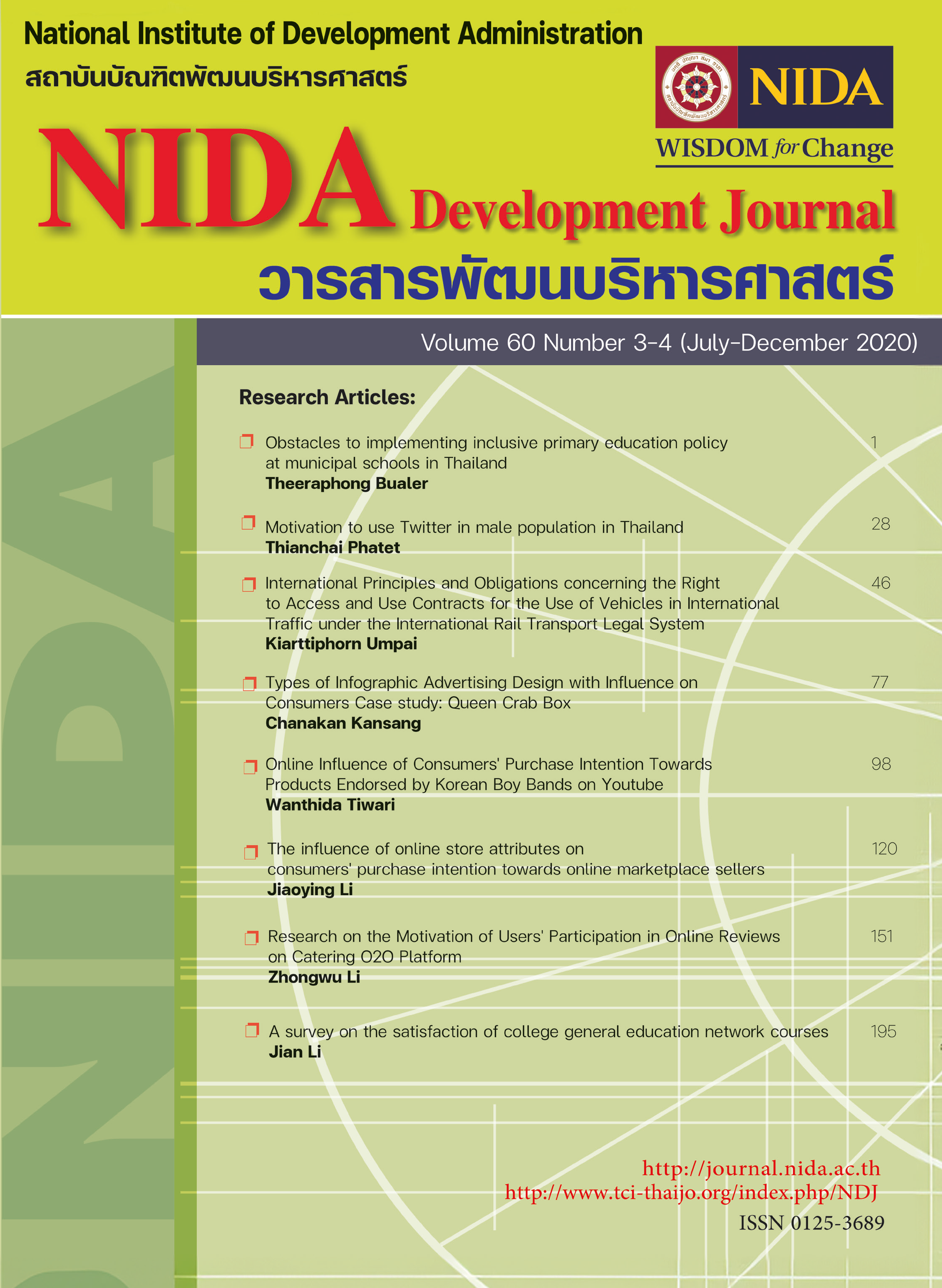
อุปสรรคการนำนโยบายการศึกษาร่วมระดับประถมศึกษาไปสู่การปฏิบัติในโรงเรียนเทศบาลในประเทศไทย
คำสำคัญ:
นโยบายการศึกษาร่วม, นโยบายส่งเสริมสถานภาพคนพิการ, องค์กรปกครองส่วนท้องถิ่นและความพิการบทคัดย่อ
บทความนี้นำเสนอผลงานวิจัยเชิงคุณภาพที่วิเคราะห์อุปสรรคที่มีต่อการนำนโยบายการศึกษาร่วมไปสู่การปฏิบัติสำหรับนักเรียนที่มีความบกพร่องในการเรียนรู้ในโรงเรียนเทศบาลในประเทศไทย ผลการศึกษาได้มาจากการสัมภาษณ์ตัวต่อตัวกับผู้ให้ข้อมูลหลักและผู้ปกครองชี้ให้เห็นว่าความเข้าใจที่คลาดเคลื่อนต่อระบบการศึกษาร่วมในโรงเรียน ทัศนคติด้านลบของครู และการมีส่วนร่วมของผู้ปกครองที่น้อยเกินไปเป็นอุปสรรคที่จำกัดโอกาสในเรียนรู้ของนักเรียนกลุ่มดังกล่าว นักวิจัยเสนอแนะให้นายกเทศมนตรีแสดงบทบาทผู้นำในการจัดสรรทรัพยากรที่เพียงพอเพื่อส่งเสริมทัศนคติทางบวกต่อการศึกษาร่วมในระดับโรงเรียนประถมศึกษาในสังกัด และสำรวจแนวทางเลือกอื่น ๆ เพื่อส่งเสริมการมีส่วนร่วมของผู้ปกครองให้มากขึ้น
เอกสารอ้างอิง
Ainscow, M. (2006). Developing inclusive education systems: what are the levers for change? Journal of Educational Change, 6(2), 109-124. doi.org/10.1007/s10833-005-1298-4
Ainscow, M., Farrell, P. & Tweddle, D. (2000). Developing policies for inclusive education: A study of the role of local education authorities. International Journal of Inclusive Education. 4(3), 211-229. doi.org/10.1080/13603110050059150
Avramidis, E. & Norwich, B. (2002). Teachers’ attitudes toward integration/ inclusion: a review of the literature. European Journal of Special Needs Education, 17(2), 129-147. doi.org/10.1080/08856250210129056
Bentley-Williams, R. & Morgan, J. (2013). Inclusive Education: Pre-service Teachers’ Reflexive learning on Diversity and Their Challenging Role. Asia-Pacific Journal of Teacher Education, 41(2), 173-185. doi.org/10.1080/1359866X.2013.777024
Brownell, M., Sindelar, P., Kiely, M. & Danielson, L. (2010). Special Education Teacher Quality and Preparation: Exposing Foundations, Constructing a New Model. Exceptional Children, 76(3), 357-377. doi.org/10.1177/001440291007600307
Christenson S.L. (2003). The family-school partnership: An opportunity to promote the learning competence of all students. School Psychology Quarterly, 18(4), 454-482. doi.org/10.1521/scpq.18.4.454.26995
Clough, P. & Nutbrown, C. (2004). Special Education Needs and Inclusion: Multiple Perspectives of Preschool Educators in the UK. Journal of Early Childhood Research, 2(2), 191-202. doi.org/10.1177/1476718X04043015
Creswell, J.W. (2007). Qualitative enquiry and research design: Choosing among five approaches. 2nd ed. Thousand Oaks. CA: SAGE.
de Beco, G. (2014). The Right to Inclusive Education according to article 24 of the UNCRPD: Background, Requirements and (remaining) questions. Netherlands Quarterly of Human Rights, 33/3: 263-287. doi.org/10.1177/016934411403200304
de Boer, A., Jan Pijl, S. & Minnaert. A. (2011). Regular primary schoolteachers’ attitudes toward inclusive education: a review of the literature. International Journal of Inclusive Education, 15(3), 331-353. doi.org/10.1080/13603110903030089
Deng, M. & Poon-MacBrayer, K. (2012). Reforms and Challenges in the Era of Inclusive Education: The Case of China. British Journal of Special Education, 39(3), 117-122. doi.org/10.1111/j.1467-8578.2012.00551.x
Deng, M. & Guo, L. (2007). Local special education administrators’ understanding of inclusive education in China. International Journal of Educational Development, 27(6), 697-707. doi.org/10.1016/j.ijedudev.2007.02.005
Emam, M. & Farrell, P. (2009). Tensions experienced by teachers and their views of support for pupils with autism spectrum disorders in mainstream schools. European Journal of Special Needs Education, 24(4), 407-422. doi.org/10.1080/08856250903223070
Fan, X. & Chen, M. (2001). Parent involvement and students’ academic achievement: A meta-analysis. Educational Psychological Review, 13(1), 1-22. doi.org/10.1023/A:100904881
Farrell, P., Dyson, A., Polat, F., Hutcheson, G. & Gallannaugh, F. (2007). Inclusion and achievement in mainstream schools. European Journal of Special Needs Education, 22(2), 131-145. doi.org/10.1080/08856250701267808
Florian, L. & Linklater, H. (2010). Preparing teachers for inclusive education: using inclusive pedagogy to enhance teaching and learning for all. Cambridge Journal of Education, 40(4), 369 -386. doi.org/10.1080/0305764X.2010.526588
Florian, L. (2014). What Counts as Evidence of Inclusive Education? European Journal of Special Needs Education, 29(3), 286-294. doi.org/10.1080/08856257.2014.933551
Florian, L. (2015). Inclusive Pedagogy: A transformative approach to individual differences but can it help reduce educational inequalities? Scottish Educational Review, 47(1), 5-14. doi: 10.1080/13540602.2012.709732
Forlin, C. & Chambers, D. (2011). Teacher preparation for inclusive education: increasing knowledge but raising concerns. Asia – Pacific Journal of Teacher Education, 39(1): 17 – 32. doi.org/10.1080/1359866X.2010.540850
Giorgi, A., Giorgi, B. & Morley, J. (2017). The Sage Handbook of Qualitative Research in Psychology, 2nd Edition, Edited by Carla Willig and Wendy Rogers, Chapter 11: 176-192 SAGE: London.
Hardy, I. & Woodcock, S. (2015). Inclusive Education Policies: Discourses of Differences, Diversity and Deficit. International Journal of Inclusive Education, 19(2), 141-164. doi.org/10.1080/13603116.2014.908965
Haug, P. (2010). Approaches to Empirical Research on Inclusive Education. Scandinavian Journal of Disability Research, 12(3), 199-209. doi.org/10.1080/15017410903385052
Haug, P. (2017). Understanding inclusive education: Ideals and reality. Scandinavian Journal of Disability Research, 19(3), 206 -217. doi.org/10.1080/15017419.2016.1224778
Hornby, G. & Lafaele, R. (2011). Barriers to parental involvement in education: An explanatory model. Educational Review, 63(1), 37-52. doi.org/10.1080/00131911.2010.488049
Kamenopoulou, L. & Dukpa, D. (2017). Karma and human rights: Bhutanese teachers’ perspectives on inclusion and disability. International Journal of Inclusive Education, 22(3), 323-338. doi.org/10.1080/13603116.2017.1365274
Kantavong, P., Nethanomsak, T. & Luang-ungkool, N. (2012). Inclusive Education in Thailand after 1999 National Education Act: A Review of a Pre-Service Teacher Education System. Procedia - Social and Behavioral Sciences, 69, 1043-1051. doi.org/10.1016/j.sbspro.2012.12.031
Kantavong, P. (2018). Understanding inclusive education practices in schools under local government jurisdiction: a study of Khon Kaen Municipality in Thailand. International Journal of Inclusive Education, 22(7), 767-786. doi.org/10.1080/13603116.2017.1412509
Kavale, K. & Forness, S. (2000). History, Rhetoric, and Reality. Analysis of the inclusion Debate. Remedial and Special Education, 21(5), 279-296. doi.org/10.1177/074193250002100505
Laverty S.M. (2003). Hermeneutic phenomenology and phenomenology: a comparison of historical and methodological considerations. International Journal of Qualitative Methods, 2(3), 21-35. doi.org/10.1177/160940690300200303
Lindsay, G. (2007). Educational Psychology and the effectiveness of inclusive education/ mainstreaming. British Journal of Education Psychology, 77(1), 1-24. doi.org/10.1348/000709906X156881
MacFarlane, K. & Woolfson, L.M. (2013). Teacher attitudes and behavior toward the inclusion of children with social, emotional and behavioral difficulties in mainstream schools: An application of the theory of planned behavior. Teaching and Teacher Education, 29(2013), 46-52. doi.org/10.1016/j.tate.2012.08.006
Miles, S. & Singal, N. (2010). The Education for All and Inclusive Education Debate: Conflict, Contradiction or Opportunity? International Journal of Inclusive Education, 14(1), 1-15. doi.org/10.1080/13603110802265125
Mitchell, D. (2014). What really works in special and inclusive education: using evidence-based teaching strategies. 2nd ed. London: Routledge.
Moustakas, C. (1994). Phenomenological research methods. Thousand Oaks. CA: SAGE.
Norwich, B. (2014). Recognising Value Tensions that Underlie Problems in Inclusive Education. Cambridge Journal of Education, 44 (4), 495-510. doi.org/10.1080/0305764X.2014.963027
OECD (1999). Inclusive Education at Work: Students with Disabilities in Mainstream Schools. Paris: OECD.
Rodriguez, R., Blatz, E. & Elbaum, B. (2014). Parents’ views of schools’ involvement efforts. Exceptional Children Journal, 81(1), 79-95. doi.org/10.1177/0014402914532232
Ruijs, N. (2017). The impact of special needs students on classmate performance. Economics of Education Review, 58, 15-31. doi.org/10.1016/j.econedurev.2017.03.002
Sailor, W. (2016). Equity as a Basis for inclusive education system change. Australian Journal of Special Education, 41(1), 1-17. doi.org/10.1017/jse.2016.12
Savolainen, H., Engelbrecht, P., Nel, M. & Malinen, O. (2012). Understanding teachers’ attitudes and self-efficacy in inclusive education: implications for pre-service and in-service teacher education. European Journal of Special Needs Education, 27(1), 51-68. doi.org/10.1080/08856257.2011.613603
Sharma, U., Forlin, C. & Loreman, T. (2008). Impact of training on pre‐service teachers' attitudes and concerns about inclusive education and sentiments about persons with disabilities. Disability & Society, 23(7), 773-785. doi.org/10.1080/09687590802469271
Slee, R. (2011). The irregular school: exclusion, schooling and inclusive education. London: Routledge.
Sukbunpant, S., Arthur-Kelly, M. & Dempsey, I. (2013). Thai preschool teachers' views about inclusive education for young children with disabilities. International Journal of Inclusive Education, 17(10), 1106-1118. doi.org/10.1080/13603116.2012.741146
Terzi, L. (2014). Reframing inclusive education: educational equality as capability equality. Cambridge Journal of Education, 44(4), 479-793. doi.org/10.1080/0305764X.2014.960911
UNESCO. (2017/8). Global Education Monitoring Report/Accountability in education: Meeting our commitments. Paris: UNESCO.
UNICEF. (2016). Toward Inclusive Education: the impact of disability on school attendance in developing countries. Office of Research: Innocenti Working Paper, WP-2016-03-/May 2016
UNICEF. (2017). Annual Results Report (Education). Retrieved from http://unicef.org/publicpartnerships/files/2017_UNICEF_ARR_Education_ADVANCE_COPY.pdf.
United Nations. (2007). The Right to Education of Persons with Disabilities. Human Rights Council 4th session item 2 of the agenda. UN A/ HRC/4/29 (19 February 2007).
Vagle M. (2018). Crafting phenomenological research. London: Routledge Taylor and Francis Group.
Vasileiadis, I. & Doikou-Avlidou, M. (2018). Enhancing social interaction of pupils with intellectual disabilities with their general education peers: the outcomes of an intervention programme. Journal of Research in Special Educational Needs, 18(4), 267-277. doi.org/10.1111/1471-3802.12410
Vaughn, J., Schumm, J., Jallad, B., Slusher, J. & Saumell L. (1996). Teachers’ views of inclusion. Learning Disabilities Research and Practice, 11, 96-106.
Vislie, L. (2003). From Integration to Inclusion: Focusing Global Trends and Changes in the Western European Societies. European Journal of Special Needs Education, 18(1), 17-35. doi.org/10.1080/0885625082000042294
Vorapanya, S. & Dunlap. D. (2014). Inclusive education in Thailand: practices and challenges. International Journal of Inclusive Education, 18(10), 1014-1028. doi.org/10.1080/13603116.2012.693400
World Health Organization. (2011). World Report on Disability. WHO: Geneva. Retrieved from https://www.who.int/disabilities/world_report/2011/report/en
ดาวน์โหลด
เผยแพร่แล้ว
รูปแบบการอ้างอิง
ฉบับ
ประเภทบทความ
สัญญาอนุญาต
ลิขสิทธิ์ (c) 2023 วารสารพัฒนบริหารศาสตร์

อนุญาตภายใต้เงื่อนไข Creative Commons Attribution-NonCommercial-NoDerivatives 4.0 International License.