
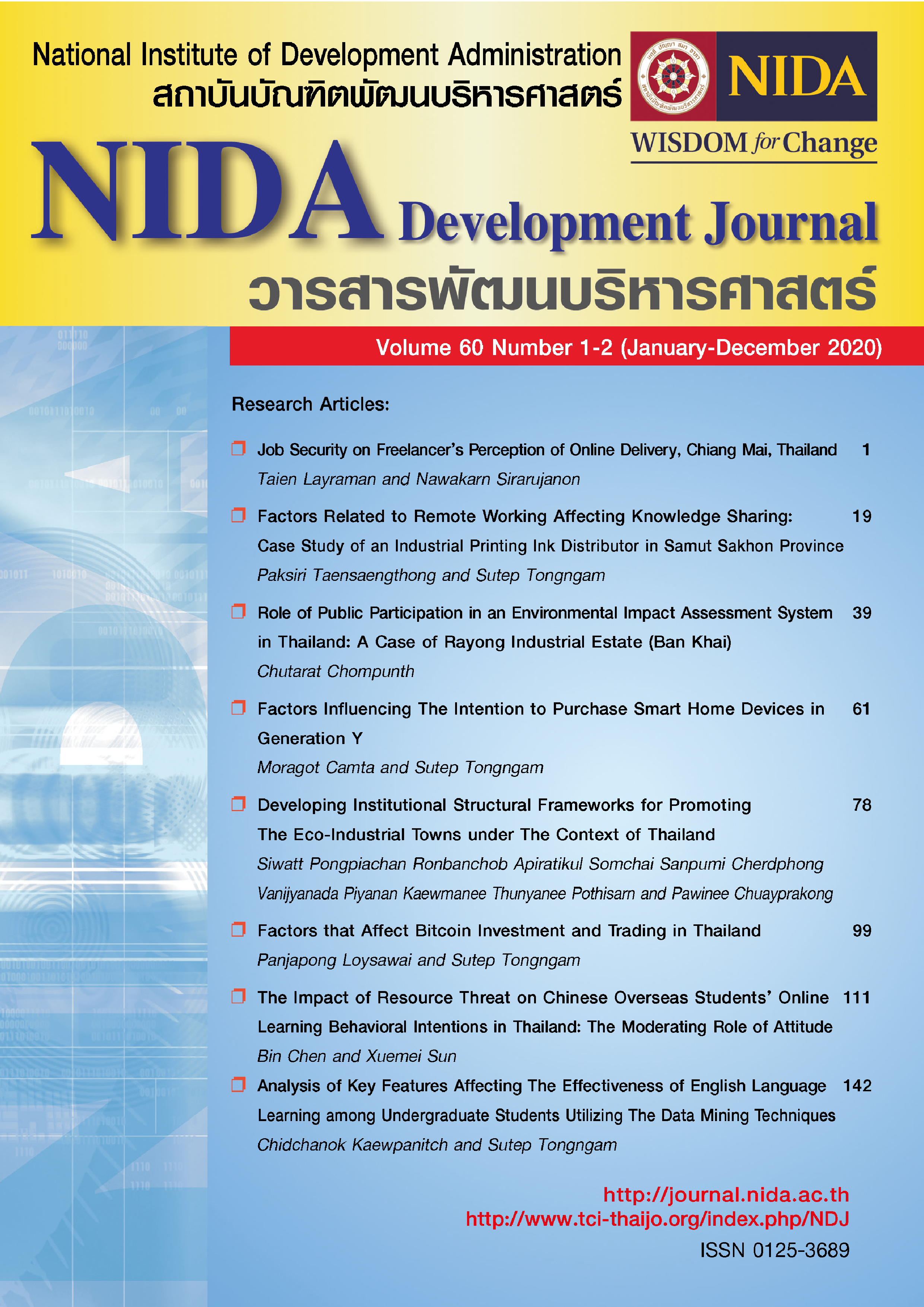
The Impact of Resource Threat on Chinese Overseas Students' Online Learning Behavioral Intentions in Thailand: The Moderating Role of Attitude
คำสำคัญ:
COR Theory, Social Impact, Behavioral Intention, Moderating Effect of Attitudeบทคัดย่อ
เอกสารอ้างอิง
Ahorsu, D. K., Lin, C.-Y., Imani, V., Saffari, M., Griffiths, M. D., & Pakpour, A. H. (2020). The Fear of COVID-19 Scale: Development and initial validation. International Journal of Mental Health and Addiction. https://doi.org/10.1007/s11469-020-00270-8
Azizan, S. N., Lee, A. S. H., Crosling, G., Atherton, G., Arulanandam, B. V., Lee, C. E., & Rahim, R. B. A. (2022). Online Learning and COVID-19 in Higher Education: The Value of IT Models in Assessing Students' Satisfaction. International Journal of Emerging Technologies in Learning, 17(3), 245-278. https://doi.org/10.3991/ijet.v17i03.24871
Basilaia, G., & Kvavadze, D. (2020). Transition to Online Education in Schools during a SARS-CoV-2 Coronavirus (COVID-19) Pandemic in Georgia. Pedagogical Research, 5(4). https://doi.org/10.29333/pr/7937
Brislin, R. W. (1970). Back-Translation for Cross-Cultural Research. Journal of Cross-Cultural Psychology, 1(3), 185-216. https://doi.org/10.1177/135910457000100301
Cao, J., Yang, T., Lai, I. K. W., & Wu, J. (2021, Jan 20). Is online education more welcomed during COVID-19? An empirical study of social impact theory on online tutoring platforms. International Journal of Electrical Engineering & Education. https://doi.org/Artn10.1177/0020720920984001
Cao, W., Fang, Z., Hou, G., Han, M., Xu, X., Dong, J., & Zheng, J. (2020, 2020/05/01/). The psychological impact of the COVID-19 epidemic on college students in China. Psychiatry Research, 287, 112934. https://doi.org/https://doi.org/10.1016/j.psychres.2020.112934
de Jong Gierveld, J., Van Tilburg, T., & Dykstra, P. A. (2006). Loneliness and social isolation. Cambridge handbook of personal relationships, 485-500.
Devisakti, A., & Ramayah, T. (2019). E-Learning Usage Outcomes among University Learners: A Pilot Study. Journal of Education and e-Learning Research, 6(3), 149-155. https://doi.org/10.20448/journal.509.2019.63.149.155
Fishbein, M., & Ajzen, I. (1977). Belief, attitude, intention, and behavior: An introduction to theory and research. Philosophy and Rhetoric, 10(2).
Fornell, C., & Larcker, D. F. (1981). Evaluating Structural Equation Models with Unobservable Variables and Measurement Error. Journal of Marketing Research.
García Botero, G., Questier, F., Cincinnato, S., He, T., & Zhu, C. (2018). Acceptance and usage of mobile assisted language learning by higher education students. Journal of Computing in Higher Education, 30(3), 426-451. https://doi.org/10.1007/s12528-018-9177-1
Hair, J. F., Jr., W. C. B., Babin, B. J., & Anderson, R. E. (2019). Multivariate Data Analysis. CENGAGE. (EIGHTH EDITION)
Hair, J. F., Risher, J. J., Sarstedt, M., & Ringle, C. M. (2019). When to use and how to report the results of PLS-SEM. European business review, 31(1), 2-24. https://doi.org/10.1108/EBR-11-2018-0203
Hamid, M. R. A., Sami, W., & Sidek1, M. H. M. (2017). Discriminant Validity Assessment: Use of Fornell &Larcker criterion versus HTMT Criterion. Journal of Physics: Conference Series. https://doi.org/10.1088/1742-6596/890/1/012163
Hasan, N., & Bao, Y. (2020, 2020/11/01/). Impact of “e-Learning crack-up” perception on psychological distress among college students during COVID-19 pandemic: A mediating role of “fear of academic year loss”. Children and Youth Services Review, 118, 105355. https://doi.org/https://doi.org/10.1016/j.childyouth.2020.105355
Henseler, J., Hubona, G., & Ray, P. A. (2016). Using PLS path modeling in new technology research: updated guidelines. Industrial Management & Data Systems. https://doi.org/10.1108/IMDS-09-2015-0382
Henseler, J., Ringle, C. M., & Sarstedt, M. (2014). A new criterion for assessing discriminant validity in variance-based structural equation modeling. Journal of the Academy of Marketing Science, 43(1), 115-135. https://doi.org/10.1007/s11747-014-0403-8
Henseler, J., Ringle, C. M., & Sinkovics, R. R. (2009). The use of partial least squares path modeling in international marketing. In New Challenges to International Marketing (pp. 277-319). https://doi.org/10.1108/s1474-7979(2009)0000020014
Hobfoll, S. E. (1988). The ecology of stress. Taylor & Francis.
Hobfoll, S. E. (1989). Conservation of resources: A new attempt at conceptualizing stress. American Psychologist, 44(3), 513. https://doi.org/10.1037/0003-066X.44.3.513
Hobfoll, S. E. (2002, 2002/12/01). Social and Psychological Resources and Adaptation. Review of General Psychology, 6(4), 307-324. https://doi.org/10.1037/1089-2680.6.4.307
Hwang, T.-J., Rabheru, K., Peisah, C., Reichman, W., & Ikeda, M. (2020). Loneliness and social isolation during the COVID-19 pandemic. International psychogeriatrics, 32(10), 1217-1220. https://doi.org/10.1017/S1041610220000988
Jongpil Cheon , S. L., Steven M. Crooks , Jaeki Song (2012). An investigation of mobile learning readiness in higher education based on the theory of planned behavior. Computers & Education. https://doi.org/10.1016/j.compedu.2012.04.015
Kelman, H. C. (1958). Compliance, identification, and internalization three processes of attitude change. Journal of conflict resolution, 2(1), 51-60.
Kock, N. (2015). Common method bias in PLS-SEM: A full collinearity assessment approach. International Journal of e-Collaboration (ijec), 11(4), 1-10. https://doi.org/10.4018/ijec.2015100101
Latane, B. (1981). The Psychology of Social Impact. American Psychologist.
Latane, B. (1996). Dynamic Social Impact The Creation of culture by communication.pdf. Journal of Communication.
Mbah, R. E., & Wasum, D. F. (2022). Russian-Ukraine 2022 War: A review of the economic impact of Russian-Ukraine crisis on the USA, UK, Canada, and Europe. Advances in Social Sciences Research Journal, 9(3), 144-153. https://doi.org/10.14738/assrj.93.12005
Mertens, G., Gerritsen, L., Duijndam, S., Salemink, E., & Engelhard, I. M. (2020). Fear of the coronavirus (COVID-19): Predictors in an online study conducted in March 2020. Journal of anxiety disorders, 74, 102258. https://doi.org/10.1016/j.janxdis.2020.102258
Ngampornchai, A., & Adams, J. (2016, Oct 10). Students' acceptance and readiness for E-learning in Northeastern Thailand. International Journal of Educational Technology in Higher Education, 13. https://doi.org/ARTN 34 10.1186/s41239-016-0034-x
Or, C., & Chapman, E. (2022, Jan 10). Development and validation of an instrument to measure online assessment acceptance in higher education. British Journal of Educational Technology. https://doi.org/10.1111/bjet.13180
Ping Qiao, X. Z., Yangzhi Guo , Ying Sun and Chuan Qin. (2021). The Development and Adoption of Online Learning in Pre- and Post-COVID-19: Combination of Technological System Evolution Theory and Unified Theory of Acceptance and Use of Technology. Journal of Risk and Financial Management. https://doi.org/10.3390/jrfm14040162
Raza, S. A., Qazi, W., Khan, K. A., & Salam, J. (2021, Apr). Social Isolation and Acceptance of the Learning Management System (LMS) in the time of COVID-19 Pandemic: An Expansion of the UTAUT Model. Journal of Educational Computing Research, 59(2), 183-208. https://doi.org/10.1177/0735633120960421
Rui, S., Keiman, W., Jiaxi, L., Kinlong, L., Youmin, Z., & Xue, Y. (2021). How COVID-19 stress related to schooling and online learning affects adolescent depression and Internet gaming disorder: Testing Conservation of Resources theory with sex difference. Journal of behavioral addictions. https://doi.org/10.1556/2006.2021.00069
Sabah, N. M. (2016). Exploring students' awareness and perceptions: Influencing factors and individual differences driving m-learning adoption. Computers in Human Behavior, 65, 522-533. https://doi.org/10.1016/j.chb.2016.09.009
Sakka, Y. M. H. (2022, Feb 23). Students' Acceptance of Distance Learning as a Result of COVID-19 Impact on Higher Education in Jordan. Education Research International, 2022. https://doi.org/10.1155/2022/7697947
Sitar‐Tăut, D. A. (2021). Mobile learning acceptance in social distancing during the COVID‐19 outbreak: The mediation effect of hedonic motivation. Human Behavior and Emerging Technologies, 3(3), 366-378. https://doi.org/10.1002/hbe2.261
Spector, P. E. (2019, 2019/04/01). Do Not Cross Me: Optimizing the Use of Cross-Sectional Designs. Journal of Business and Psychology, 34(2), 125-137. https://doi.org/10.1007/s10869-018-09613-8
Stevan E. Hobfoll, J. H., 2 Jean-Pierre Neveu,3 and Mina Westman4. (2018). Conservation of Resources in the Organizational Context: The Reality of Resources and Their Consequences. Annual Review of Organizational Psychology and Organizational Behavior. https://doi.org/10.1146/annurev-orgpsych-032117-104640
Sun, X., & Ma, Y. (2022). How The Perceived Threat of Covid-19 Aggravates Chinese Employees’ Emotional Exhaustion and Turnover Intention in Thailand: The Moderating Role of Affective Commitment. Creative Business and Sustainability Journal (CBSJ).
Tenenhaus, M., Vinzi, V. E., Chatelin, Y.-M., & Lauro, C. (2005, 2005/01/01/). PLS path modeling. Computational Statistics & Data Analysis, 48(1), 159-205. https://doi.org/10.1016/j.csda.2004.03.005
Thomas, T., Singh, L., & Gaffar, K. (2013). The utility of the UTAUT model in explaining mobile learning adoption in higher education in Guyana. International Journal of Education and Development using ICT, 9(3).
Urbach, N., & Ahlemann, F. (2010). Structural Equation Modeling in Information Systems Research Using Partial Least Squares. Journal of information technology theory and application.
Venkatesh, V., Morris, M. G., Davis, G. B., & Davis, F. D. (2003). User acceptance of information technology: Toward a unified view. MIS Quarterly, 27, 425-478. https://doi.org/10.2307/30036540
Viswanath Venkatesh, James Y. L. Thong, Frank K. Y. Chan, & Brown, P. J.-H. H. S. A. (2011). Extending the two-stage information systems continuance model: incorporating UTAUT predictors and the role of context. Information Systems Journal. https://doi.org/10.1111/j.1365-2575.2011.00373.x
Wong, K. K.-K. (2013). Partial least squares structural equation modeling (PLS-SEM) techniques using SmartPLS. Marketing Bulletin, 24(1), 1-32.
Yunus, M. M., Ang, W. S., & Hashim, H. (2021, Mar). Factors Affecting Teaching English as a Second Language (TESL) Postgraduate Students' Behavioural Intention for Online Learning during the COVID-19 Pandemic. Sustainability, 13(6). https://doi.org/10.3390/su13063524
ดาวน์โหลด
เผยแพร่แล้ว
รูปแบบการอ้างอิง
ฉบับ
ประเภทบทความ
สัญญาอนุญาต
ลิขสิทธิ์ (c) 2024 วารสารพัฒนบริหารศาสตร์

อนุญาตภายใต้เงื่อนไข Creative Commons Attribution-NonCommercial-NoDerivatives 4.0 International License.