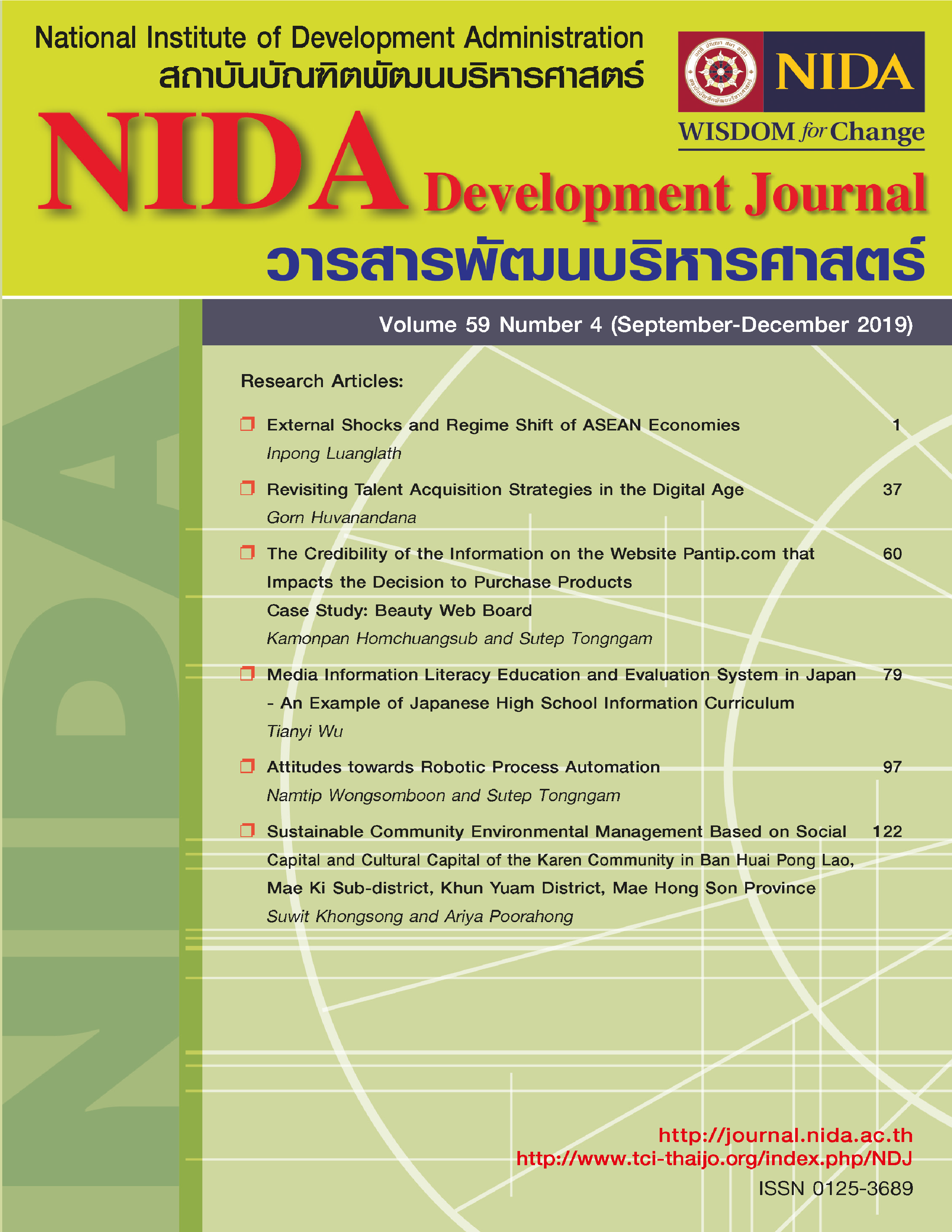
การทบทวนกลยุทธ์เพื่อสรรหาคนเก่งในยุคดิจิทัล
คำสำคัญ:
การว่าจ้างและการคัดเลือก, การจัดการคนเก่ง, การสรรหาคนเก่ง, ยุคดิจิทัล, กลยุทธ์, แบรนด์นายจ้างบทคัดย่อ
ยุคดิจิทัลได้ปฏิวัติวิธีการจัดหา นำเสนอโอกาสและความท้าทายใหม่ ๆ ให้กับองค์กรในการดึงดูดและคัดเลือกคนเก่ง(Talent) บทความนี้นำเสนอการได้มาซึ่งบุคลากรผู้มีความสามารถสูงในยุคดิจิทัล ซึ่งมุ่งเน้นไปที่การบรรจบกันของเทคโนโลยี กลยุทธ์การสรรหา และประสบการณ์ของผู้สมัคร โดยการสังเคราะห์วรรณกรรมที่เกี่ยวข้องรวมทั้งแนวปฏิบัติที่ดีขององค์กร โดยเน้นแนวโน้มที่เกิดขึ้นใหม่และประเด็นต่างๆ ในการได้มาซึ่งคนเก่งเหล่านี้ โดยอภิปรายผลกระทบการเปลี่ยนแปลงของเทคโนโลยีดิจิทัลต่อการสรรหาบุคลากร โดยจะสำรวจว่าองค์กรใช้ประโยชน์จากเทคโนโลยีต่างๆ เช่น ปัญญาประดิษฐ์ และการวิเคราะห์ข้อมูลขนาดใหญ่เพื่อปรับปรุงกระบวนการสรรหา ปรับปรุงการประเมินผู้สมัคร และการตัดสินใจ ซึ่งก็ยังพบข้อกังวลเกี่ยวกับประเด็นทางจริยธรรม เช่น อคติและความโปร่งใสที่เกี่ยวข้องกับเทคโนโลยีเหล่านี้ นอกจากนี้ยังเน้นย้ำความสำคัญของการสร้างภาพลักษณ์และแบรนด์นายจ้างที่แข็งแกร่งโดยใช้ประโยชน์จากแพลตฟอร์มดิจิทัลเพื่อดึงดูดและดึงดูดผู้สมัคร ความท้าทายและโอกาสในการสร้างแบรนด์ของนายจ้างในยุคดิจิทัลนั้น รวมถึง ความสำคัญของการเล่าเรื่องราว ความสอดคล้องและสม่ำเสมอในการสื่อภาพลักษณ์ของแบรนด์นายจ้าง และผลกระทบของสื่อโซเชียลมีเดียที่มีต่อการรับรู้ของผู้สมัคร ความหลากหลายของผู้สมัครและการคัดสรรอย่างครอบคลุมนับเป็นประเด็นที่มีความสำคัญอย่างยิ่งเช่นกัน บทความชี้ให้เห็นถึงอคติที่อาจฝังอยู่ในเครื่องมือที่ใช้ในการสรรหาและคัดเลือกด้วยเทคโนโลยีอัลกอริทึมที่แสดงให้เห็นถึงความจำเป็นในการประยุกต์ใช้เทคโนโลยีเพื่อให้ได้มาซึ่งกระบวนการในการคัดเลือกที่มีความชอบธรรม นอกจากนี้ยังทบทวนบทบาทของแพลตฟอร์มดิจิทัลในการขยายฐานการเข้าถึงกลุ่มคนเก่งผู้มีความสามารถหลากหลาย พร้อมเสนอกลยุทธ์ในการลดอคติและแนวทางในการส่งเสริมโอกาสอย่างเท่าเทียมและเป็นธรรม บทความนี้ยังพิจารณาผลกระทบของการระบาดใหญ่ของโรคโควิด-19 ต่อการได้มาซึ่งบุคลากรคนเก่ง โดยพิจารณาถึงการเปลี่ยนแปลงสู่การจ้างงานนอกสถานที่ทำงาน แนวปฏิบัติในการดำเนินการปฐมนิเทศงานออนไลน์ และความท้าทายในการธำรงรักษาวัฒนธรรมขององค์กรและประสบการณ์ของผู้สมัครในระบบออนไลน์ การศึกษานี้สะท้อนความจำเป็นในการศึกษาและวิจัยเพิ่มเติมเกี่ยวกับผลกระทบระยะยาวของการแพร่ระบาดต่อกลยุทธ์การจัดหาคนเก่งผู้มีความสามารถ รวมถึงโอกาสและความท้าทายที่องค์กรต้องเผชิญเพื่อเพิ่มประสิทธิภาพของกลยุทธ์การสรรหาและคัดเลือกคนเก่ง โดยเสนอประเด็นเพื่อเสริมองค์ความรู้ อาทิ การพัฒนาขีดความสามารถเพื่อยกระดับประสบการณ์ของผู้สมัคร การส่งเสริมแนวปฏิบัติที่ดีในการสรรหาบุคลากรอย่างครอบคลุมและเป็นธรรมในยุคดิจิทัล การประเมินผลกระทบด้านจริยธรรมบนแนวปฏิบัติที่ขับเคลื่อนด้วยเทคโนโลยี และการตรวจสอบบทบาทของปัญญาประดิษฐ์ในการประเมินผู้สมัคร
เอกสารอ้างอิง
Allen, T. D., Golden, T. D., & Shockley, K. M. (2013). How effective is telecommuting?
Assessing the status of our scientific findings. Psychological Science in the Public Interest, 16(2), 40-68.
Ambler, T., & Barrow, S. (1996). The employer brand. Journal of Brand Management, 4(3),
-206.
Autor, D. (2009). Studies of labor market intermediation: Introduction. In D. Autor (Ed.), Studies
of labor market intermediation (pp. 1-26). University of Chicago Press.
Backhaus, K., & Tikoo, S. (2004). Conceptualizing and researching employer branding. Career
Development International, 9(5), 501-517.
Bagues, M., & Sylos Labini, M. (2009). Do online talent intermediaries matter? The impact of
Alma Laurea on the university-to-work transition. In D. Autor (Ed.), Studies of labor market intermediation (pp. 127-154). University of Chicago Press.
Barber, A. E. (1998). Recruiting employees: Individual and organizational perspectives.
Thousand Oaks, CA: Sage Publications.
Barrow, S., & Mosley, R. (2005). The employer brand: Bringing the best of brand management
to people at work. Hoboken, NJ: John Wiley & Sons.
Bayo-Moriones, A., & Ortin-Angel, P. (2006). Internal promotions versus external recruitment in
industrial plants in Spain. Industrial and Labor Relations Review, 59, 451-470.
Becker, G. S. (1962). Investment in human capital: A theoretical analysis. Journal of Political
Economy, 70(5), 9-49.
Becker, G. S. (1993). Human capital; a theoretical and empirical analysis with special reference
to education. University of Chicago Press.
Bidwell, M. (2013). What happened to long term employment? The role of worker power and
environmental turbulence in explaining declines in worker tenure. Organization Science, 24, 1061-1082.
Bidwell, M. (2017). Managing talent flows through internal and external labor markets. In D. G.
Collings, K. Mellahi, & W. F. Cascio (Eds.), The Oxford handbook of talent management (pp. 281-298). Oxford University Press.
Bidwell, M., & Briscoe, F. (2010). The dynamics of interorganizational careers. Organization
Science, 21, 1034-1053.
Bidwell, M., & Mollick, E. (2015). Shifts and ladders: comparing the role of internal and
external mobility in managerial careers. Organization Science, 26, 1629-1645.
Bonet, R., & Hamori, M. (2017). Talent intermediaries in talent acquisition. In D. G. Collings, K.
Mellahi, & W. F. Cascio (Eds.), The Oxford handbook of talent management (pp. 249-
. Oxford University Press.
Breaugh, J., & Starke, M. (2000). Research on employee recruitment: So many studies, so many
remaining questions. Journal of Management, 26, 405-434.
Brooks, S. (2007). Getting a hand hiring top talent. Restaurant Business, 106(10), 22-26.
Cable, D. M., & Turban, D. B. (2001). Establishing the dimensions, sources, and value of job
seekers' employer knowledge during recruitment. Research in Personnel and Human Resources Management, 20, 115-162.
Cappelli, P. (1999). The new deal at work: Managing the market-driven workforce.
Harvard Business School Press.
Cappelli, P. (2001). Making the Most of On-Line Recruiting. Harvard Business Review, 79, 139-
Cappelli, P. (2008). Talent management for the twenty-first century. Harvard Business Review,
(3), 74-81.
Cappelli, P. (2009). A supply chain model for talent management. People and Strategy, 32(3), 4-
Cappelli, P., & Keller, J. R. (2017). The historical context of talent management markets. In D.
G. Collings, K. Mellahi, & W. F. Cascio (Eds.), The Oxford handbook of talent
management (pp. 23-41). Oxford University Press.
Cascio, W., & Graham, B. (2016). New strategic role for HR: Leading the employer branding
process. Organization Management Journal, 13, 182-192.
Cascio, W. F., & Montealegre, R. (2016). How technology is changing work and organizations.
Annual Review of Organizational Psychology and Organizational Behavior, 3, 349-375.
Chan, W. (1996). External recruitment versus internal promotion. Journal of Labor Economics,
, 555-570.
Chapman, D., & Webster, J. (2003). The use of technologies in the recruiting, screening, and
selection processes for job candidates. International Journal of Selection and Assessment, 11, 113-120.
Davies, G., Chun, R., da Silva, R. V., & Roper, S. (2011). Corporate reputation and recruitment:
How employer branding impacts potential applicants' choices. Journal of Business Ethics, 101(1), 45-61.
Dineen, B. R., & Allen, D. G. (2013). Internet recruiting. In C. L. Cooper & S. Cartwright (Eds.),
The Oxford Handbook of Personnel Psychology (pp. 555-572). Oxford University Press.
Ding, C. G., Li, Y., & Song, Z. L. (2015). An investigation of the relationship between
person–organization fit and employee attitudes in professional services firms. Human Resource Development Quarterly, 26(3), 303-326.
Dobrev, S. (2005). Career mobility and job flocking. Social Sciences Research, 34(4), 800-820.
Doe, J. (2018). Leveraging Digital Technologies in Talent Recruitment: Challenges and
Opportunities. Journal of Human Resources Management, 25(2), 45-62.
Doeringer, P., & Piore, M. (1971). Internal labor markets and manpower analysis. Heath.
Dokko, G., & Jiang, W. (2017). Managing talent across organizations: The portability of
individual performance. In D. G. Collings, K. Mellahi, & W. F. Cascio (Eds.), The
Oxford handbook of talent management (pp. 115-133). Oxford University Press.
Edwards, M. R., Scott, J. C., Raju, N. S., & Raju, M. S. (2006). Employer brand image:
Implications for recruitment and retention. Journal of Brand Management, 14(3), 143-157.
Faliagka, E., Anagnostopoulos, D., & Siachou, E. (2012). Intelligent decision support for
recruitment processes using data mining methods. Expert Systems with Applications, 39(1), 1103-1112.
Finlay, W., & Coverdill, J. (1999). The search game: Organizational conflicts and the use of
headhunters. Sociological Quarterly, 40, 11-30.
Garner, T. (2005). Interfirm competition for human resources: Evidence from the software
industry. Academy of Management Journal, 48, 237-256.
Holtom, B. C., Mitchell, T. R., Lee, T. W., & Eberly, M. B. (2008). Turnover and retention
research: A glance at the past, a closer review of the present, and a venture into the future. The Academy of Management Annals, 2(1), 231-274.
Huselid, M. A., Becker, B. E., & Beatty, R. W. (2005). The workforce scorecard: Managing
human capital to execute strategy. Harvard Business Press.
King, Z., Burke, S., & Pemberton, J. (2005). The “bounded” career: An empirical study of
human capital, career mobility, and employment outcomes in a mediated labor market. Human Relations, 58, 981-1007.
Khurana, R. (2002). Searching for a corporate savior: The irrational quest for charismatic
CEOs. Princeton University Press.
Laumer, S., Eckhardt, A., & Weitzel, T. (2012). Online assessments in personnel selection: A
review and look to the future. Journal of Business Economics, 82(3), 441-484.
Logan, J. (1996). Opportunity and choice in socially structured markets. American Journal of
Sociology, 102, 114-160.
Marchal, G., Cappeliez, S., & Ferauge, P. (2007). Recruitment and the Internet: A content
analysis of Belgian companies' websites. Computers in Human Behavior, 23(6), 2542-2556.
McGrath, H. (2012). Recruitment and selection practices in medium-sized software development
companies. European Journal of Training and Development, 36(7), 705-720.
Miner, A. (1987). Idiosyncratic jobs in formalized organizations. Administrative Science
Quarterly, 32, 327-351.
Osterman, P. (1987). Choice of employment systems in internal labor markets. Industrial
Relations, 26, 46-67.
Park, Y., & Gursoy, D. (2017). Generation effects on work engagement among US hotel
employees: The role of work-life balance and job characteristics. International Journal of Hospitality Management, 66, 45-55.
Parry, E., & Wilson, H. (2009). Factors influencing the adoption of online recruitment. Personnel
Review, 38(6), 655-673.
Peck, C. (2013). Recruitment in the digital age: The effects of social media on recruitment and
selection practices. International Journal of Selection and Assessment, 21(3), 276-284.
Pfeffer, J., & Cohen, Y. (1984). Determinants of internal labor markets in organizations.
Administrative Science Quarterly, 29, 550-572.
Pinfield, L. (1995). The operation of internal labor markets: Staffing practices and vacancy
chains. Springer.
Rao, H., & Drazin, R. (2002). Overcoming resource constraints on product innovation by
recruiting talent from rivals: A study of the mutual fund industry, 1986-94. Academy of
Management Journal, 45, 491-507.
Rhoades, L., Eisenberger, R., & Armeli, S. (2001). Affective commitment to the organization:
The contribution of perceived organizational support. Journal of Applied Psychology, 86(5), 825-836.
Sartain, L., & Schumann, M. (2006). Brand from the inside: Eight essentials to emotionally
connect your employees to your business. San Francisco, CA: Jossey-Bass.
Shulman, B., & Chiang, G. (2007). When to use an executive search firm and how to get the
most out of the relationship. Employment Relations Today, 34, 13-19.
Spilderman, S., & Lunde, T. (1991). Features of educational attainment and job promotion
prospects. American Journal of Psychology, 97, 689-720.
Stone, D. L., Deadrick, D. L., Lukaszewski, K. M., & Johnson, R. (2015). The influence of
technology on the future of human resource management. Human Resource Management Review, 25(2), 216-231.
Stone, D., Lukaszewski, K., Stone-Romero, E., & Johnson, T. (2013). Factors affecting the
effectiveness and acceptance of electronic selection systems. Human Resources Management Review, 23, 50-70.
Tansky, J. W., Cohen, D. J., & Tansky, M. B. (2015). Enhancing recruitment and retention: The
role of perceived corporate social responsibility. Journal of Applied Social Psychology, 45(2), 82-91.
ดาวน์โหลด
เผยแพร่แล้ว
รูปแบบการอ้างอิง
ฉบับ
ประเภทบทความ
สัญญาอนุญาต
ลิขสิทธิ์ (c) 2024 วารสารพัฒนบริหารศาสตร์

อนุญาตภายใต้เงื่อนไข Creative Commons Attribution-NonCommercial-NoDerivatives 4.0 International License.