
การเริงระบำด้วยอัลกอริทึม: แผนที่ผลกระทบของปัญญาประดิษฐ์ที่มีต่ออนาคตของแรงงาน (2568 ถึงปี 2588)
DOI:
https://doi.org/10.14456/ndj.2026.5คำสำคัญ:
การเปลี่ยนแปลงกำลังคน, พลวัตมนุษย์–ปัญญาประดิษฐ์, ตลาดแรงงาน, นโยบายจากฐานข้อมูล, การบรรเทาผลกระทบเทคโนโลยีบทคัดย่อ
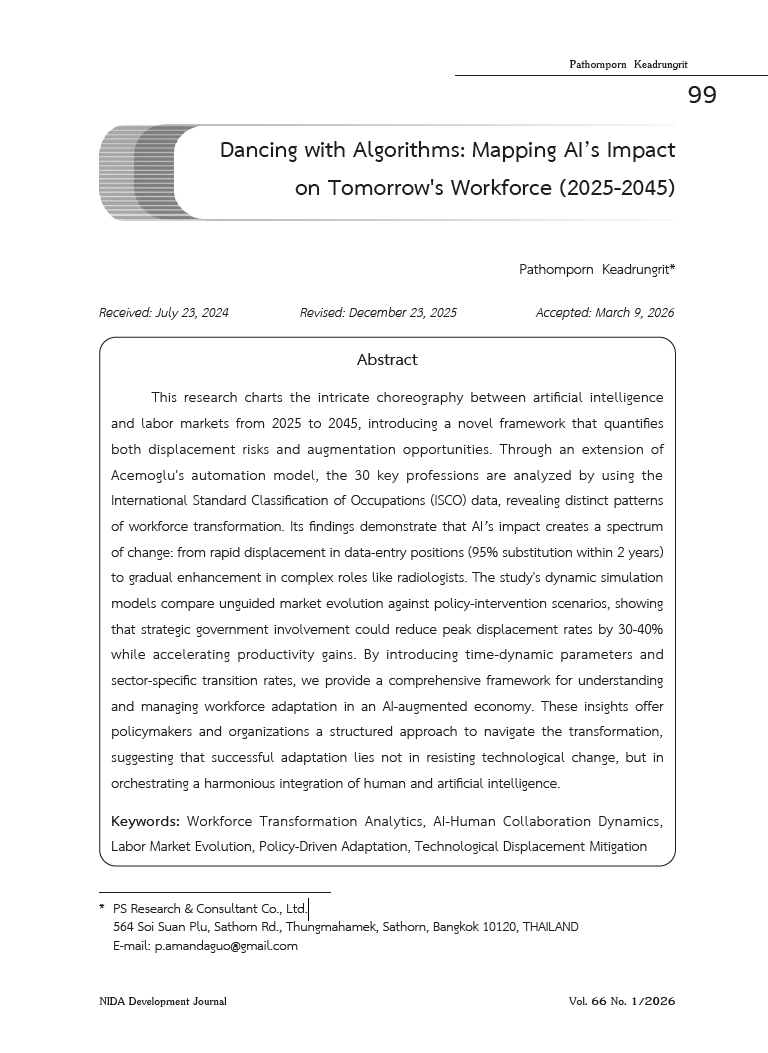
งานวิจัยนี้ศึกษาพลวัตระหว่างปัญญาประดิษฐ์และตลาดแรงงานระหว่าง พ.ศ. 2568-2588 โดยพัฒนา กรอบการวิเคราะห์ใหม่เพื่อประเมินทั้งความเสี่ยงจากการทดแทนและโอกาสจากการเสริมสร้างผลิตภาพ แบบจำลองเชิงพลวัตนี้ประยุกต์จากกรอบทฤษฎีงานอัตโนมัติของอะเซมาโกลูและเรสเตรโป และวิเคราะห์ อาชีพ 30 สาขา จากการจำแนกอาชีพอ้างอิงมาตรฐานสากล ISCO-08
ผลการศึกษาพบว่า อาชีพที่มีงานซ้ำซ้อนและมีความซับซ้อนต่ำ เช่น พนักงานป้อนข้อมูล มีความเสี่ยงสูง ที่จะถูกทดแทนด้วยปัญญาประดิษฐ์อย่างรวดเร็ว ขณะที่อาชีพที่ต้องใช้ทักษะซับซ้อน เช่น ผู้ช่วยรังสีแพทย์ มีแนวโน้มได้รับประโยชน์จากการเป็นส่วนเสริม (complement) มากกว่าการถูกทดแทน ผลการจำลองเปรียบเทียบ สถานการณ์ระหว่างการปล่อยให้ตลาดปรับตัวเองกับสถานการณ์ที่มีนโยบายรัฐแทรกแซงพบว่า การดำเนิน นโยบายเชิงรุกสามารถลดอัตราการสูญเสียงานในช่วงสูงสุดได้ร้อยละ 30-40 และเร่งการเติบโตของผลิตภาพ ได้อย่างมีนัยสำคัญ
งานวิจัยนี้เสนอกรอบแนวคิดและเครื่องมือสนับสนุนการตัดสินใจสำหรับผู้กำหนดนโยบาย ในการวางแผนพัฒนากำลังคนและออกแบบนโยบายสนับสนุนการเปลี่ยนผ่านอาชีพ โดยเน้นการส่งเสริม การทำงานร่วมกันระหว่างมนุษย์และปัญญาประดิษฐ์มากกว่าการถูกทดแทน
เอกสารอ้างอิง
Acemoglu, D., & Restrepo, P. (2018). The race between man and machine: Implications of technology for growth, factor shares, and employment. American Economic Review, 108(6), 1488-1542. https://doi.org/10.1257/aer.20160696
Acemoglu, D., & Restrepo, P. (2019). Automation and new tasks: How technology displaces and reinstates labor. Journal of Economic Perspectives, 33(2), 3-30. https://doi.org/10.1257/jep.33.2.3
Acemoglu, D., & Restrepo, P. (2020). The wrong kind of AI? Artificial intelligence and the future of labor demand. Cambridge Journal of Regions, Economy and Society, 13(1), 25-35. https://doi.org/10.1093/cjres/rsz022
Acemoglu, D., & Robinson, J. A. (2019). The narrow corridor: States, societies, and the fate of liberty. Penguin Press.
Autor, D. H. (2015). Why are there still so many jobs? The history and future of workplace automation. Journal of Economic Perspectives, 29(3), 3-30. https://doi.org/10.1257/jep.29.3.3
Autor, D. H., & Dorn, D. (2013). The growth of low-skill service jobs and the polarization of the US labor market. American Economic Review, 103(5), 1553-1597.https://doi.org/10.1257/aer.103.5.1553
Brynjolfsson, E., Mitchell, T., & Rock, D. (2018). What can machines learn, and what does it mean for occupations and the economy? AEA Papers and Proceedings, 108, 43-47. https://doi.org/10.1257/pandp.20181019
Deming, D. J. (2017). The growing importance of social skills in the labor market. The Quarterly Journal of Economics, 132(4), 1593-1640. https://doi.org/10.1093/qje/qjx022
Frank, M. R., Autor, D., Bessen, J. E., Brynjolfsson, E., Cebrian, M., Deming, D. J., Feldman, M., Groh, M., Lobo, J., Moro, E., Wang, D., Youn, H., & Rahwan, I. (2019). Toward understanding the impact of artificial intelligence on labor. Proceedings of the National Academy of Sciences, 116(14), 6531-6539. https://doi.org/10.1073/pnas.1900949116
Goldin, C., & Katz, L. F. (2008). The race between education and technology. Harvard University Press.
Korinek, A., & Stiglitz, J. E. (2017). Artificial intelligence and its implications for income distribution and unemployment (NBER Working Paper No. 24174). National Bureau of Economic Research. https://www.nber.org/papers/w28474
Nedelkoska, L., & Quintini, G. (2018). Automation, skills use and training (OECD Social, Employment and Migration Working Papers No. 202). OECD Publishing. https://doi.org/10.1787/2e2f4eea-en
Schumpeter, J. A. (1942). Capitalism, socialism and democracy. Harper & Brothers.
Webb, M. (2019). The impact of artificial intelligence on the labor market. SSRN Electronic Journal. https://doi.org/10.2139/ssrn.3482150
ดาวน์โหลด
เผยแพร่แล้ว
รูปแบบการอ้างอิง
ฉบับ
ประเภทบทความ
สัญญาอนุญาต
ลิขสิทธิ์ (c) 2026 วารสารพัฒนบริหารศาสตร์

อนุญาตภายใต้เงื่อนไข Creative Commons Attribution-NonCommercial-NoDerivatives 4.0 International License.