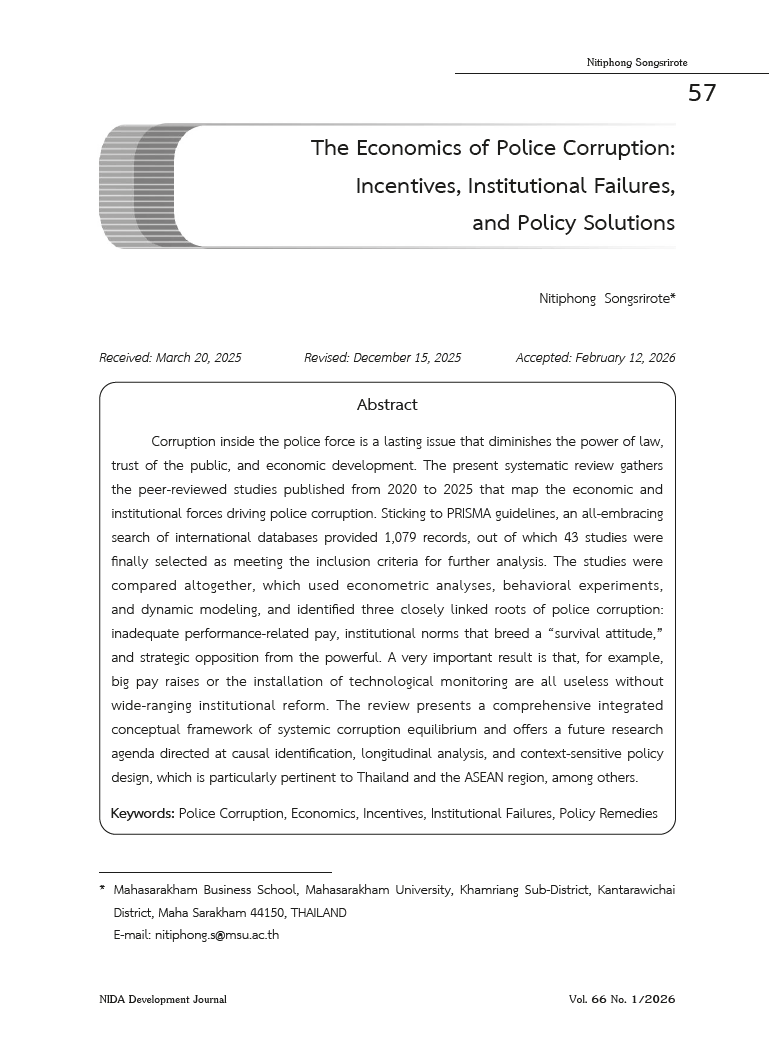
เศรษฐศาสตร์ของคอรัปชั่นตำรวจ : แรงจูงใจ ความล้มเหลวของสถาบัน และนโยบายแก้ไข
DOI:
https://doi.org/10.14456/ndj.2026.3คำสำคัญ:
คอรัปชั่นตำรวจ, เศรษฐศาสตร์, แรงจูงใจ, ความล้มเหลวของสถาบัน, นโยบายแก้ไขบทคัดย่อ
ระบบคอรัปชั่นในสถาบันตำรวจเป็นปัญหาค้างคาที่ลดความศักดิ์สิทธิ์ของกฎหมาย ความไว้วางใจจาก ภาคประชาชนและการพัฒนาทางเศรษฐกิจ การทบทวนวรรณกรรมอย่างเป็นระบบนี้ รวมบรวมบทความ การศึกษาที่ผ่านการประเมินโดยผู้ทรงคุณวุฒิ ซึ่งตีพิมพ์ระหว่างปี พ.ศ. 2563 ถึง พ.ศ. 2568 ที่สร้างแผนที่ ของแรงผลักดันจากระบบสถาบันและเศรษฐกิจที่ก่อให้เกิดคอรัปชั่นขึ้น ทั้งนี้ ใช้แนวปฏิบัติของพริสม่า (PRIMSMA) ซึ่งเป็นการค้นหาแบบครอบคลุม จากฐานข้อมูลนานาชาติ ซึ่งแสดงผลงานทั้งหมด 1,079 ชิ้น โดยที่มีผลงาน 43 ชิ้น ผ่านเกณฑ์การคัดเลือกที่จะต้องมีการวิเคราะห์ขั้นต่อไป เมื่อนำการศึกษาดังกล่าว มาทำการเปรียบเทียบกัน โดยใช้การวิเคราะห์แบบเศรษฐมิติ การทดลองเชิงพฤติกรรม และการจัดทำโมเดล พบว่า การคอรัปชั่นของตำรวจมีรากหยั่งลึงที่ผูกกันสามประการ คือ การปฏิบัติหน้าที่ไม่เต็มกำลังเกี่ยวกับ ค่าตอบแทน บรรทัดฐานสถาบันที่ปลูกฝัง “ทัศนคติการอยู่รอด” และกลยุทธ์การต่อต้านจากผู้มีอำนาจ ตัวอย่างผลการศึกษาที่สำคัญคือ การปรับค่าจ้างหรือติดตั้งเครื่องเฝ้าสังเกตุการนั้นไร้ประโยชน์ หากปราศจาก การปฏิรูปสถาบันในองค์รวม การทบทวนวรรณกรรมนี้นำเสนอกรอบแนวคิดบูรณาการแบบสมบูรณ์ของ ความสมดุลการคอรัปชั่นอย่างเป็นระบบ และนำเสนอวาระการวิจัยในอนาคต ด้วยวิธีการระบุความสัมพันธ์ เชิงสาเหตุ การวิเคราะห์งานศึกษาตามยาว และการออกแบบนโยบายที่ตอบสนองต่อบริบท ซึ่งมีความเกี่ยวข้อง อย่างยิ่งต่อประเทศไทยและภูมิภาคอาเซียนรวมทั้งบรรดาประเทศอื่น ๆ
เอกสารอ้างอิง
Addo, K. (2022). An exploratory study of police corruption in Ghana: Why does it exist?. International Criminology, 3, 52-62. https://doi.org/10.1007/s43576-022-00078-7
Aldana, A., Larralde, H., & Aldana, M. (2022). Modeling the role of police corruption in the reduction of organized crime: Mexico as a case study. Scientific Reports, 12, Article 21251. https://doi.org/10.1038/s41598-022-23630-x
Amagnya, M. (2024). Rural–urban dynamics of police corruption: Views of Ghanaian police officers. International Criminology, 4, 1-15. https://doi.org/10.1007/s43576-024-00130-8
Amagnya, M., Akinlabi, O., & Bello, P. (2024). Police officers’ assessments of factors that contribute to police corruption in Ghana. Policing: An International Journal, 47(4), 548-564. https://doi.org/10.1108/pijpsm-04-2024-0061
Armand, A., Coutts, A., Vicente, P., & Vilela, I. (2023). Measuring corruption in the field using behavioral games. Journal of Public Economics, 218, Article 104799. https://doi.org/10.1016/j.jpubeco.2022.104799
Balogun, A. (2022). Examining the interplay of perceived organizational justice and psychological contract breach on police corruption in Nigeria. Policing: A Journal of Policy and Practice, 17(2), Article paac103. https://doi.org/10.1093/police/paac103
Becker, G. S. (1968). Crime and punishment: An economic approach. Journal of Political Economy, 76(2), 169-217. https://doi.org/10.1086/259394
Bleakley, P. (2020). The cult of corruption: Reframing organizational frameworks of police corruption from a cultic perspective. Deviant Behavior, 42(5), 565-577. https://doi.org/10.1080/01639625.2020.1741775
Bleakley, P. (2023). Methods of inquiry: Police corruption, historical anti-corruption experiences and implications for contemporary practices. International Journal for Crime, Justice and Social Democracy, 12(1), 1-14. https://doi.org/10.5204/ijcjsd.2745
Bolkvadze, K. (2025). Corrupt or repressive? How political competition incentivizes hybrid regimes to subvert police in distinct ways. Governance, 38(1), 1-20. https://doi.org/10.1111/gove.70030
Brierley, S. (2020). Unprincipled principals: Co-opted bureaucrats and corruption in Ghana. American Journal of Political Science, 64(2), 209-222. https://doi.org/10.1111/ajps.12495
Brookshaw, B. (2024). Addressing corruption in the police service. In B. Brookshaw (Ed.), Addressing corruption in the police service: The thick blue line (pp. 145-168). Palgrave Macmillan. https://doi.org/10.1007/978-3-031-75068-7
Chaiwat, T., & Yomnak, T. (2023). Criminal behaviour on detection and penalty: An experimental evidence from drug market game. Journal of Financial Crime, 31(1), 135-145. https://doi.org/10.1108/jfc-04-2023-0091
Cislaghi, B., & Heise, L. (2020). Gender norms and social norms: Differences, similarities, and why they matter in prevention science. Sociology of Health & Illness, 42(2), 407-422. https://doi.org/10.1111/1467-9566.13008
D’Emidio, R. (2025). Policing corruption or corrupted policing? Social norms and policing in Ghana. European Journal of Social Psychology, 55, 440-456 https://doi.org/10.1002/ejsp.3137
De Blasio, G., D'Ignazio, A., & Letta, M. (2022). Gotham city: Predicting 'corrupted' municipalities with machine learning. Technological Forecasting and Social Change, 175, Article 122016. https://doi.org/10.1016/j.techfore.2022.122016
Delalić, S., & Sojkić, S. (2023). Corruption in law enforcement agencies in Bosnia and Herzegovina: The causes and consequences. EMC Review - Časopis za ekonomiju - APEIRON, 13(2), 475-491. https://doi.org/10.7251/EMC2302475D
Doucette, J. (2023). The deep roots of modern democracy: Geography an the diffusion of political institutions. Perspectives on Politics, 21(2), 752-753. https://doi.org/10.1017/S1537592723000166
Gillanders, R., & van der Werff, L. (2020). Corruption experiences and attitudes to political, interpersonal, and domestic violence. Governance, 35(1), 167-185. https://doi.org/10.1111/gove.12570
Gillanders, R., Ouedraogo, I., Maïga, W., & Aja-Eke, D. (2024). Police corruption and crime: Evidence from Africa. Governance, 37(3), 1015-1034. https://doi.org/10.1111/gove.12822
Gilsinan, J., Fisher, J., Islam, M., Ordower, H., & Shahin, W. (2023). The contagion of corruption: A model for understanding systemic ethical failures. Journal of Financial Crime, 30(5), 1208-1219. https://doi.org/10.1108/JFC-02-2023-0021
González, Y. (2022). Reforming to avoid reform: Strategic policy substitution and the reform gap in policing. Perspectives on Politics, 21(1), 59-77. https://doi.org/10.1017/S1537592722000135
Hannington, S., & Baba, A. M. (2025). Modeling the dynamics of corruption in police and judiciary systems using fractional order differential equations and the Laplace-Adomian transform method. International Journal of Science for Global Sustainability, 11(1), 207-217. https://doi.org/10.57233/ijsgs.v11i1.803
Harris, D., & Katusiimeh, M. (2020). Public administration and corruption: A comparative case study of the police services in Ghana and Uganda. In A. Graycar (Ed.), Handbook on corruption, ethics and integrity in public administration (pp. 255-273). Edward Elgar Publishing. https://doi.org/10.4337/9781789900910.00027
Heinzeroth, R. (2021). A socioeconomic edge effect: Rational crime in small areas of sharp socioeconomic contrast. Journal of Research in Crime and Delinquency, 58(2), 123-150. https://doi.org/10.1177/0022427820945009
Holmes, L. (2020). Police corruption. Oxford Research Encyclopedia of Criminology and Criminal Justice. https://doi.org/10.1093/acrefore/9780190264079.013.633
Holmes, L. (2021). Comparing police corruption: Bulgaria, Germany, Russia and Singapore. Routledge. https://doi.org/10.4324/9781003156871
Hossain, A., & Kryzanowski, L. (2021). Political corruption and cost of equity. Business & Society, 60(8), 2060-2098. https://doi.org/10.1177/0007650320928502
Hussain, R., Nawab, H., Bilal, H., & Ishaq, M. (2021). Analysis of various factors contributing to police corruption in Khyber Pakhtunkhwa. Journal of Business & Tourism, 6(1), 231-240. https://doi.org/10.34260/jbt.v6i1.191
Khan, S., Ahmed, A., & Ahmed, K. (2021). Enhancing police integrity by exploring causes of police corruption. Management Science Letters, 11, 1949-1958. https://doi.org/10.5267/j.msl.2021.1.006
Liu, L., & Chen, X. (2022). Effects of interconnections among corruption, institutional punishment, and economic factors on the evolution of cooperation. Applied Mathematics and Computation, 425, Article 127069. https://doi.org/10.1016/j.amc.2022.127069
Malik, N., & Qureshi, T. (2020). A study of economic, cultural, and political causes of police corruption in Pakistan. Policing: A Journal of Policy and Practice, 15(2), 1146-1160. https://doi.org/10.1093/police/paaa016
Masugu, R., Bor, E., & Mwaeke, P. (2023). Security implication of mutual police and societal corruption in Nairobi County, Kenya. International Journal of Research and Innovation in Social Science, 7(9), 663-672. https://doi.org/10.47772/ijriss.2023.70956
Mutahi, N., Micheni, M., & Lake, M. (2023). The godfather provides: Enduring corruption and organizational hierarchy in the Kenyan police service. Governance, 36(2), 401-419. https://doi.org/10.1111/gove.12672
Nalla, M. K., & Nam, Y. (2020). Corruption and trust in police: Investigating the moderating effect of procedural justice. International Journal of Offender Therapy and Comparative Criminology, 65(6-7), 715-740. https://doi.org/10.1177/0306624X20928019
Osasona, T. (2020). The political economy of police corruption in Nigeria. International Journal of Law and Political Sciences, 14(8), 591-596.
Ponce, A., Somuano, M., & Velarde, R. (2022). Meet the victim: Police corruption, violence, and political mobilization. Governance, 35(3), 887-907. https://doi.org/10.1111/gove.12629
Ponce-Díaz, C., Aiquipa-Tello, J., Pacheco-Luza, E., & Pezúa-Vasquez, R. (2024). Tests assessing corrupt behaviour from a psychological perspective. European Journal of Psychological Assessment, 42(1), 34-47. https://doi.org/10.1027/1015-5759/a000833
Quinteros, M., Villena, M., & Villena, M. (2021). An evolutionary game theoretic model of whistleblowing behavior in organizations. IMA Journal of Management Mathematics, 33(2), 289-314. https://doi.org/10.1093/imaman/dpab015
Shodunke, A. O. (2024). Protection or predation? Examining COVID-19 policing and the nuances of police corruption in Nigeria. Policing and Society, 34(5), 467-484. https://doi.org/10.1080/10439463.2023.2285790
Simaremare, R., & Claudia, M. (2025). Survival ethics and lack of institutional oversight: How economic and familial pressures drive power abuse in the Indonesian police. Journal of Scientific Insights, 2(3), 253-269. https://doi.org/10.69930/jsi.v2i3.410
ดาวน์โหลด
เผยแพร่แล้ว
รูปแบบการอ้างอิง
ฉบับ
ประเภทบทความ
สัญญาอนุญาต
ลิขสิทธิ์ (c) 2026 วารสารพัฒนบริหารศาสตร์

อนุญาตภายใต้เงื่อนไข Creative Commons Attribution-NonCommercial-NoDerivatives 4.0 International License.