
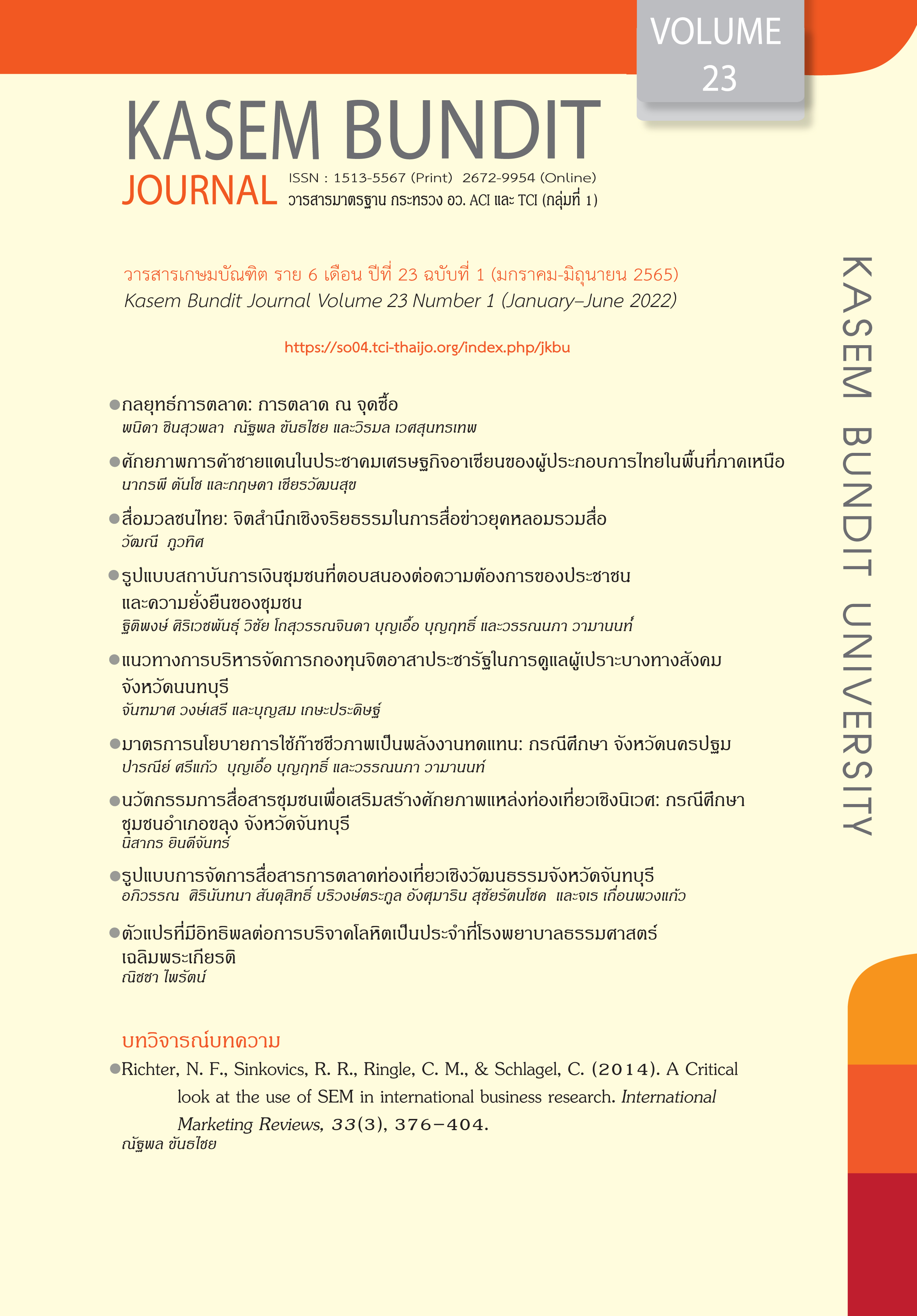
- สื่อมวลชนไทย: จิตสำนึกเชิงจริยธรรมในการสื่อข่าวยุคหลอมรวมสื่อ
คำสำคัญ:
จิตสำนึกเชิงจริยธรรม การสื่อข่าว ยุคหลอมรวมสื่อ สื่อมวลชนไทยบทคัดย่อ
วัตถุประสงค์ เพื่อศึกษาและเปรียบเทียบจิตสำนึกเชิงจริยธรรมของสื่อมวลชนผู้ที่เข้าร่วมและไม่เข้าร่วมการอบรมทางวิชาชีพต่อการสื่อข่าวยุคหลอมรวมสื่อ วิธีการวิจัย ใช้ระเบียบวิธีวิจัยเชิงผสมผสาน โดยคัดเลือกแบบหลายขั้นตอนและเฉพาะเจาะจง กลุ่มตัวอย่างเป็นสื่อมวลชน จำนวน 200 คน เครื่องมือการวิจัยเป็นแบบสอบถามและแบบสัมภาษณ์ วิเคราะห์ข้อมูลด้วยสถิติเชิงพรรณนาและสถิติเชิงอ้างอิงโดยใช้การทดสอบค่าที ผลการวิจัย ตัวแปรการเข้าร่วมอบรมวิชาชีพสื่อมวลชน มีอิทธิพลต่อจิตสำนึกเชิงจริยธรรมการสื่อข่าวยุคหลอมรวมสื่อ โดยผู้ที่เข้าร่วมการอบรมทางวิชาชีพมีจิตสำนึกเชิงจริยธรรมในการสื่อข่าวระดับปานกลาง ส่วนผู้ที่ไม่ได้เข้าร่วมอบรมวิชาชีพมีจิตสำนึกในการสื่อข่าวระดับน้อย การให้เหตุผลเชิงจริยธรรมการสื่อข่าวยุคหลอมรวมสื่อขึ้นอยู่กับสถานการณ์ นัยทางทฤษฎี/นโยบาย ผู้สื่อข่าวต้องนำเสนอข้อเท็จจริงที่ถูกต้องเพื่อไม่ให้เกิดความเข้าใจผิด เมื่อเกิดความผิดพลาดต้องรีบแก้ไขทันทีเพราะเป็นความรับผิดชอบของสื่อมวลชน รวมทั้งการคัดเลือกและประเมินผลข้อมูลควรต้องคำนึงถึงสิทธิส่วนบุคคลของผู้กระทำผิดและครอบครัวผู้เสียหาย
เอกสารอ้างอิง
Blatt, M. M., & Kohlberg, L. (1975). The effect of classroom moral upon children’s level of moral judgment. Journal of Moral Education, 4(2), 129-161.
Bocrchert, D. M., & Stewart. (1986). Exploring ethics. Collier Macmillan.
Boonsomsuk, B., Boonsomchart, A., & Pikulparungroch, A. (2558). Ethical criteria of Thai media. Isara Media Review, 4(7), 7-22.
Chanthrawattanakul, S. D. (2555). Convergence journalism: Principles and concept. Double Click Press.
Cleary, J. (2006). From the classroom to newsroom: Professional development in broadcasting journalism. Journalism and Mass Communication Educator, 61(3), 254-266.
Gloor, P. A., Heckman, C., & Makedon, F. (2018). Ethical issues in collaborative innovation networks.
http://ccs.mit.edu/pgloor%20papers/COIN4Ethicomp.pdf.
Haidt, J. (2001). The emotional dog and its rational tail: A social intuitionist approach to moral judgment. Psychological Review, 108(4), 814-834.
Hassasiripoch, B. (2542). Consciousness. NIDA Faculty Senate Journal, 4(1), 71-73.
Hill, T. E. Jr. (2013). Virtue, rules and justice: Kantian aspirations. Philosophy in Review, 33(4), 298-300.
Iamsaard, L. (2561). Adaptation of regional media in the media convergence. http://ms.psru.ac.th/comm_integrat/admin/file/(Convergence).pdf
Immanuel, K. (2018). Immanuel Kant's fundamental principles of the metaphysic of morals.
https://study.com/academy /lesson/immanuel-kants-fundamental-principles-of-the-metaphysic-of-morals.html.
Kaewthep, K., & Chaikunpol, N. (2555). News media guide. Karnpim Limited Partnership.
Kohlberg, L., & Elfenbein, D. (1975). The development of moral judgment concerning capital punishment. American Journal of Orthopsychiatry, 45(4), 614-640.
Kolodzy, J. (2013). Practicing convergence journalism: An introduction to cross media storytelling. Routledge.
Kuntonbut, C. (2549). International Business Administration (9th ed.) Chulalongkorn University Press.
Lambeth, E. B. (1992). Committed journalism: An ethic for the profession (2nd ed.). Indiana University Press.
Logan, K. R. (2010). Understanding news media: Extending Marshall McLuhan. Peter Lang Publishing, Inc.
Makedon, A. (2009). Ethical perspectivism and practical perspectives in the classroom. Philosophical Study of Education, 2(1), 56-71.
McQuail, D. (2010). McQuail’s mass communication theory. (6th ed.). Sage Publications.
Pathak, R., & Imperiali, B. (1997). A dual affinity tag on the 64-k Da Nlt1p subunit allows the rapid characterization of mutant yeast oligosaccharyl transferase complexes. Arch Biochem Biophys, 338(1), 1-6.
Pavlik, J. (1999). Journalism and new media. Columbia.
Phuban, B. (2549). Alternative: An application of puppet playing video model to develop the second grade student’s public mind. [Unpublished master’s thesis]. Srinakharinwirot University.
Potter, R. B. (1965). The structure of certain American Christian responses to the nuclear dilemma, 1958-1963 [Unpublished doctoral dissertation]. Harvard University.
Ramaprasad, J., Lin, Y., & Garrison, B. (2012). Ethical use of new technologies: Where do Indian journalists stand? Asian Journal of Communication, 22(1), 98-114.
Rujithamrongkul, K. (2558). The influence of consciousness, moral, rightness and satisfaction of instructors and students at in business administration line. Academic Journal Bangkokthonburi University, 4(2), 70-90.
Terdthamkun, A. (2547). Nalistic awareness of professional ethics in Thai newspapers. [Unpublished master’s thesis]. Thammasat University.
The National Press Council of Thailand. (2560). Regulations on ethics of professional
newspapers.http://www.presscounsil.or.th/th2/content/view/4/8
Uwanno, B. (2015). The future Thai media after the new constitution.
http://www.presscouncil.or.th/highlight/
Yonelinas, A. P. (2001). Consciousness, control and confidence: The 3 CS of recognition memory. Journal of Experimental Psychology, 130(3), 360-379.
Yoon, S. (2555). The future of news. Se-ed Education Public Company Limited.
ดาวน์โหลด
เผยแพร่แล้ว
รูปแบบการอ้างอิง
ฉบับ
ประเภทบทความ
สัญญาอนุญาต
ลิขสิทธิ์ (c) 2022 วารสารเกษมบัณฑิต

อนุญาตภายใต้เงื่อนไข Creative Commons Attribution-NonCommercial-NoDerivatives 4.0 International License.
Any views or opinions expressed in this issue of the Kasem Bundit University Journal are those of the authors alone and do not necessarily reflect the views or opinions of Kasem Bundit University or the editors.




