
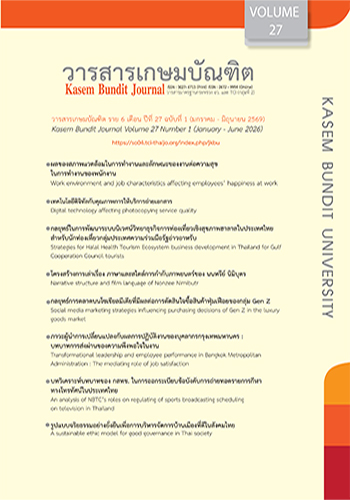
ภาวะผู้นำการเปลี่ยนแปลงกับผลการปฏิบัติงานของบุคลากรกรุงเทพมหานคร: บทบาทการส่งผ่านของความพึงพอใจในงาน
คำสำคัญ:
ภาวะผู้นำการเปลี่ยนแปลง, ความพึงพอใจในงาน, ผลการปฏิบัติงานของบุคลากรบทคัดย่อ
วัตถุประสงค์ เพื่อวิเคราะห์อิทธิพลทางตรงและทางอ้อมผ่านความพึงพอใจในงานของภาวะผู้นำการเปลี่ยนแปลงที่ส่งผลต่อการปฏิบัติงานของบุคลากรกรุงเทพมหานคร วิธีการวิจัย การวิจัยเชิงสำรวจจากตัวอย่าง ด้วยการเก็บรวบรวมข้อมูลจากบุคลากรที่ปฏิบัติงานอยู่ในสำนักงานเขตกรุงเทพมหานครจำนวน 400 คน โดยใช้วิธีการสุ่มแบบหลายขั้นตอน เครื่องมือที่ใช้ในการวิจัย ได้แก่ แบบสอบถามที่ผ่านการทดสอบความเชื่อถือได้ด้วยวิธีอัลฟ่าของครอนบาค (0.942) การวิเคราะห์ข้อมูลโดยใช้โมเดลสมการโครงสร้าง ผลการวิจัย ภาวะผู้นำการเปลี่ยนแปลงมีอิทธิพลทั้งทางตรงและทางอ้อมแบบบางส่วนผ่านความพึงพอใจในงานต่อไปยังผลการปฏิบัติงานของบุคลากร นัยทางทฤษฎี/นโยบาย นักวิชาการส่วนใหญ่ให้ความสำคัญของภาวะผู้นำการเปลี่ยนแปลงต่อผลการปฏิบัติงานของบุคลากรในการขับเคลื่อนสู่เป้าหมายขององค์การ แต่จากผลงานวิจัยพบว่าความพึงพอใจในงานสามารถนำไปสู่ผลการปฏิบัติงานที่สูงกว่า ของบุคลากร ดังนั้นองค์การควรให้ความสำคัญต่อเงื่อนไขและนโยบายในการทำงาน เมื่อพนักงานได้รับภาระงานที่เหมาะสมกับความต้องการของตนและค่าตอบแทนที่เพียงพอและยุติธรรม ให้เกิดความพึงพอใจในงานและทำให้เกิดผลการปฏิบัติงานที่มีประสิทธิภาพและประสิทธิผลในที่สุด อย่างไรก็ดีการสร้างผลการปฏิบัติงานของบุคลากรให้เป็นเลิศ จำเป็นต้องมีการพัฒนาภาวะผู้นำการเปลี่ยนแปลงควบคู่กับความพึงพอใจในงานของบุคคากรเพื่อสร้างความเติบโตให้แก่องค์การไปพร้อม ๆ กัน
เอกสารอ้างอิง
Barling, J., Kelloway, E. K., & Iverson, R. D. (2003). High-quality work, job satisfaction, and occupational injuries. Journal of Applied Psychology, 276-283.
Bass, B. L. (2019). What is Leadership. In M. R. Kibbe & H. Chen (Eds.). Leadership in Surgery (pp. 1-10). Springer.
Bass, B. M., & Riggio, R. E. (2006). Transformational leadership (2nd ed.). Lawrence Erlbaum Associates Publishers.
Gorsuch, R. L. (1983). Factor Analysis (2nd ed.). Erlbaum.
Hair, J. F., Black, W. C., Babin, B. J., Anderson, R. E., & Tatham, R. L. (2006). Multivariate data analysis (vol. 6). Pearson.
Hogg, B. (2015) 10 Characteristics of Transformational leaders. Linkedin.
Ijigu, A. W. (2015). The effect of selected human resource management practices on employees’ job satisfaction in Ethiopian public banks. Emerging Markets Journal, 5(1), 1-16.
Jackson, A. R., Alberti, J. L., & Snipes, R. L. (2014). An examination of the impact of gender on leadership style and employee job satisfaction in the modern workplace. Journal of Organizational Culture, Communications conflict, 18, 141153.
Kreitner, R., & Kinicki, A. (2007). Organizational Behavior (7th ed.). McGraw-Hill Inc.
Peter K. C. L., Cheng, T. C. E., Yeung, C. L. A., & Lai, K. h. (2011) An empirical study of Transformational leadership, team performance and service quality in retail banks, Omega, 39, 690-701.
Porter, L. W., & McLaughlin, G. B. (2006). Leadership and the organizational context: Like the weather? The Leadership Quarterly, 17(6), 559–576.
Peterson, R. S., Smith, D. B., Martorana, P. V., & Owens, P. D. (2003). The impact of chief executive officer personality on top management team dynamics: One mechanism by which leadership affects organizational performance. Journal of Applied Psychology, 88(5), 795.
Irwan, A., Mahfudnurnajamuddin M., Nujum, S., & Mangkona, S. (2020). The Effect of Leadership Style, Work Motivation and Organizational Culture on Employee Performance Mediated by Job Satisfaction. International Journal of Multicultural and Multireligious Understanding, 7(8), 642-657. DOI: http://dx.doi.org/10.18415/ijmmu.v7i8.2007
Rivai, V., & Sagala, E. J. (2015). Management Sumber Daya Manusia. Raja Grafindo Persada.
Saiyadain, M. S. (2003). Organizational Behaviour. Tata McGraw-Hill Education.
Setyawati, R., Mahfud, T., Mulyani, Y., & Kholifah, N. (2022). the influence of teaching quality, social support, and career self-efficacy on the career adaptability skills: Evidence from a polytechnic in Indonesia. Integration of Education, 1(106), 27-41.
Sofyandi, H. (2013). Manajemen Sumber Daya Manusia. Graha Ilmu.
Tareq, G. A. O. (2016). The impact of transformational leadership style on organizational performance: Evidence from Jordan. International Journal of Human Resources Studies, 6(2), 89-102. https://doi.org/10.5296/ijhrs.v6i2.9427.
Wu, X., Li, Y., & Huang, Y. (2021). The impact of transformational leadership on employee performance: The mediating role of job satisfaction. Journal of Business and Management, 9(3), 112-125.
Yang, Y. F. (2016). Examining competing models of transformational leadership, leadership trust, change commitment, and job satisfaction. Psychological Reports.
ดาวน์โหลด
เผยแพร่แล้ว
รูปแบบการอ้างอิง
ฉบับ
ประเภทบทความ
สัญญาอนุญาต
ลิขสิทธิ์ (c) 2026 วารสารเกษมบัณฑิต

อนุญาตภายใต้เงื่อนไข Creative Commons Attribution-NonCommercial-NoDerivatives 4.0 International License.
Any views or opinions expressed in this issue of the Kasem Bundit University Journal are those of the authors alone and do not necessarily reflect the views or opinions of Kasem Bundit University or the editors.




