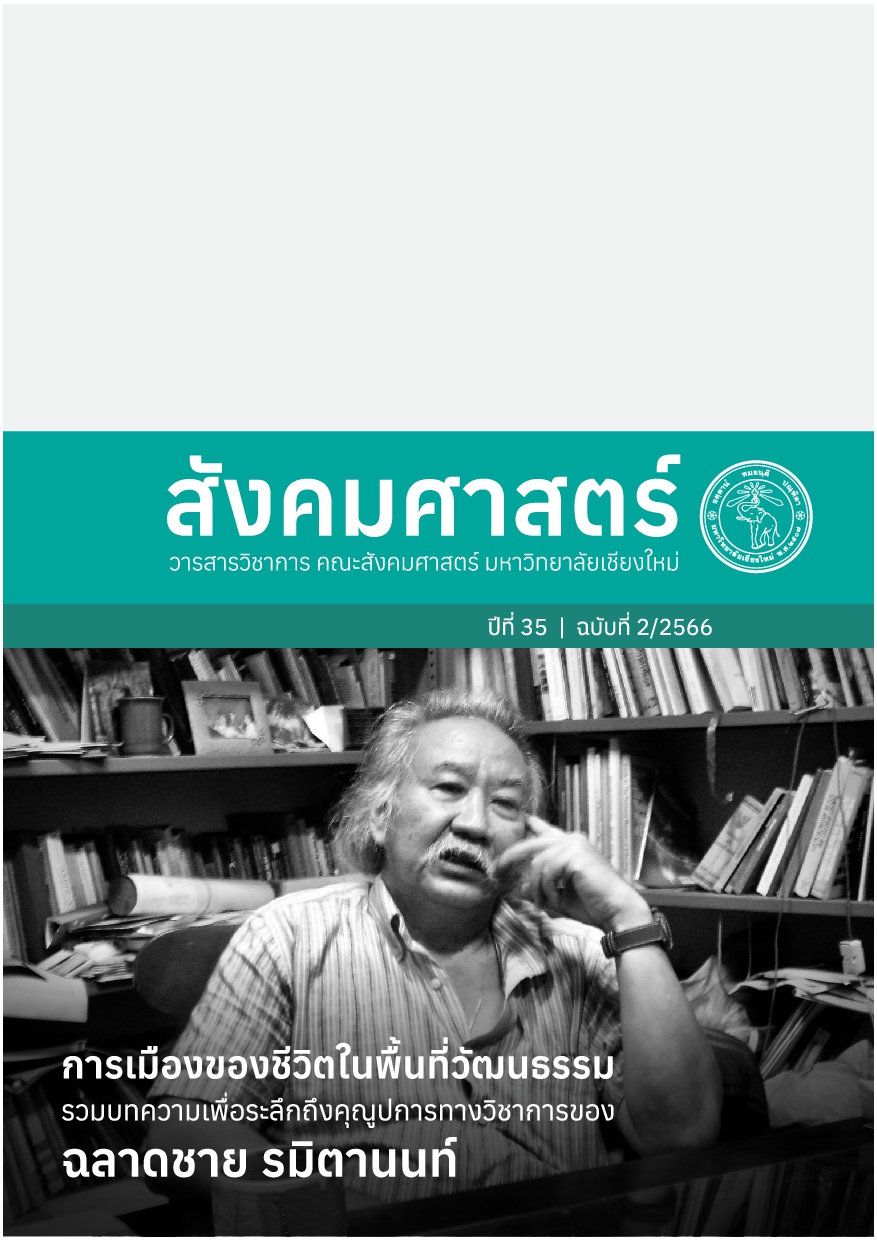
Phi Chao Nai Revisited: In Memory of Ajarn Shalardchai Ramidhanond
Article Sidebar
Main Article Content
Abstract
This paper considers major points raised in Shaladchai Ramidhanond’s Phi Chao Nai (1984) in order to clarify the ways by which it is located in the ‘functionalist’ analysis dominant in anthropology during the twentieth century. Subsequently, I take an attention to new dimensions of study focused on such concepts as ‘enchantment เสน่ห์’ and ‘affective contact สัมผัสทางอารมณ์’ in order to shed light on the interactions within the body of the spirit medium and between the spirit medium and clients or followers in the spirit cult. In this way, the paper tries to follow the way in which the study of spirit mediumship in Northern Thailand has greatly transformed its theoretical focuses since Shalardchai’s pioneering work
Article Details

This work is licensed under a Creative Commons Attribution-NonCommercial-NoDerivatives 4.0 International License.
All written articles published on Journal of Social Sciences is its author’s opinion which is not belonged to Faculty of Social Sciences, Chiang Mai University or is not in a responsibility of the journal’s editorial committee’s members.
References
Anan Ganjanapan. 1984. “The Idiom of phii ka: Peasant Conception of Class Differentiation in Northern Thailand.” Mankind 14 (4): 325–329.
Anan Ganjanapan. 1992. “Northern Thai Rituals and Beliefs: The Reproduction of Morality.” Proceedings of the First International Symposium to Present the Results of Projects Funded under the Toyota Foundation’s International Grant Program.
Anuman Rajadhon, Phya. 1953 (1985). “The phi”. In Popular Buddhism in Siam and Other Essays on Thai Studies, 99–126. Bangkok: Thai Inter-Religious Commission for Development.
Barth, Fredrik. 1992. “Towards Greater Naturalism in Conceptualizing Societies.” In Conceptualizing Society, edited by Adam Kuper, 17–33. London: Routledge.
Boddy, Janice. 1994. “Spirit Possession Revisited: Beyond Instrumentality.” Annual Review of Anthropology 23: 407–434.
Bourdieu, Pierre. 1977. Outline of a Theory of Practice. Cambridge: Cambridge University Press.
Cohen, Paul. 1984. “Are the Spirit Cults of Northern Thailand Descent Groups?” Mankind 14 (4): 293–299.
Comaroff, Jean. 1994. “Defying Disenchantment”. In Asian Visions of Authority, edited by C. F. Keyes, L. Kendall and H. Hardacre, 301–314. Honolulu: University of Hawaii Press.
Fukuura Kazuo. 2011. “A Ritual Community: The Religious Practices of Spirit Mediums Who Worship the Spirit of the Chiang Mai City Pillar.” Sojourn: Journal of Social Issues in Southeast Asia 26 (1): 105–127.
Irvine, Walter. 1984. “Decline of Village Spirit Cults and Growth of Urban Spirit Mediumship: The Persistence of Spirit Beliefs, the Position of Women and Modernisation.” Mankind 14 (4): 315–324.
Johnson, Andrew. 2011. “Re-centering the City: Spirits, Local Wisdom, and Urban Design at the Three Kings Monument of Chiang Mai.” Journal of Southeast Asian Studies 42 (3): 511–531.
Morris, Rosalind. 2000. In the Place of Origins: Modernity and its Mediums in Northern Thailand. Durham and London: Duke University Press.
Muecke, Marjorie A. 1992. “Monks and Mediums: Religious Syncretism in Northern Thailand.” Journal of the Siam Society 80 (2): 97–104.
Pattana Kitiarsa. 2003. “You May Not Believe, But Never Offend the Spirits”. In Global Goes Local: Popular Culture in Asia, edited by Timothy Craig and Richard King, 160–176. Honolulu: University of Hawaii Press.
Sa-nguan Chotisukharat. 1969. Prapheni thai phak nuea (Northern Thai customs). Bangkok: Odeon Store.
Shalardchai Ramitanondh. 1980 (2523). Rabop jit samnuek kap khwam yakchon nai chonnabot thai (The system of consciousness and poverty in the countryside of Thailand). Sangkhomsat (Journal of Social Sciences, Chiang Mai University) 4 (1): 68–86.
Shalardchai Ramitanondh. 1984 (2527). Phi Chao Nai (The high-ranking tutelary spirits). Chiang Mai: Sun Nangsue Chiang Mai.
Tanabe Shigeharu. 1991. “Spirits, Power and the Discourse of Female Gender: The phi meng Cult of Northern Thailand.” In Thai Constructions of Knowledge, edited by Manas Chitakasem and Andrew Turton, 183–212. London: School of Oriental and African Studies.
Tanabe Shigeharu. 2002. “The Person in Transformation: Body, Mind, and Cultural Appropriation.” In Cultural Crisis and Social Memory: Modernity and Identity in Thailand and Laos, edited by Tanabe Shigeharu and Charles F. Keyes, 43–67. London: Routledge.
Tanabe Shigeharu. 2008. “Ritual and Belief Systems: Anan Ganjanapan’s Anthropological Political Economy.” In ‘Kham phromdaen khwamru heang sankhomsat thai, 60 pi Anan Ganjanapan’, Sangkhomsat (Journal of Social Sciences, Chiang Mai University, Special issue) 20 (2): 95–114.
Tanabe Shigeharu. 2012. Phithikam lae pathibatkan nai sangkhom chao na phak nuea khong prathet thai (Ritual and practice in the peasant society of Northern Thailand), edited by Kwanchewan Buadaeng and Apinya Fuengfusakul. Chiang Mai: Centre for Ethnic Studies and Development, Chiang Mai University.
Tanabe Shigeharu. 2013a. Seirei no jinruigaku: kita tai ni okeru kyodosei no poritikusu (Anthropology of Spirits: Politics of Communality in Northern Thailand). Tokyo: Iwanami Shoten. (In Japanese)
Tanabe Shigeharu. 2013b. “Spirit Mediumship and Affective Contact in Thailand.” In Essays on Thailand’s Economy and Society for Professor Chatthip Nartsupha at 72, edited by Pasuk Phongpaichit and Chris Baker, 175–192. Bangkok: Sangsan.
Tanabe Shigeharu. 2019. “An Animic Regime Subjugated: The Pu Sae Ña Sae Spirit Cult in Chiang Mai.” Bulletin of the National Museum of Ethnology (Osaka) 43 (2): 391–442.
Wijeyewardene, Gehan. 1986. Place and Emotion in Northern Thai Ritual Behavior. Bangkok: Pandora.
Yos Santasombat. 2009. “Spirit Cults and Mediumship: Changing Gender and Power Relations in Northern Thailand.” In Asian Religious and Ritual Fields in Comparison: Cases from Thailand, China, and Japan (Kanazawa University Japan-China Intangible Cultural Heritage Project Report, Vol. 3, 43–63. Kanazawa: Kanazawa University.
