
Development of a Mathematical Model for Financial Planning of Salaried Employees: An Analysis Based on Working Age Groups
Article Sidebar
Main Article Content
Abstract
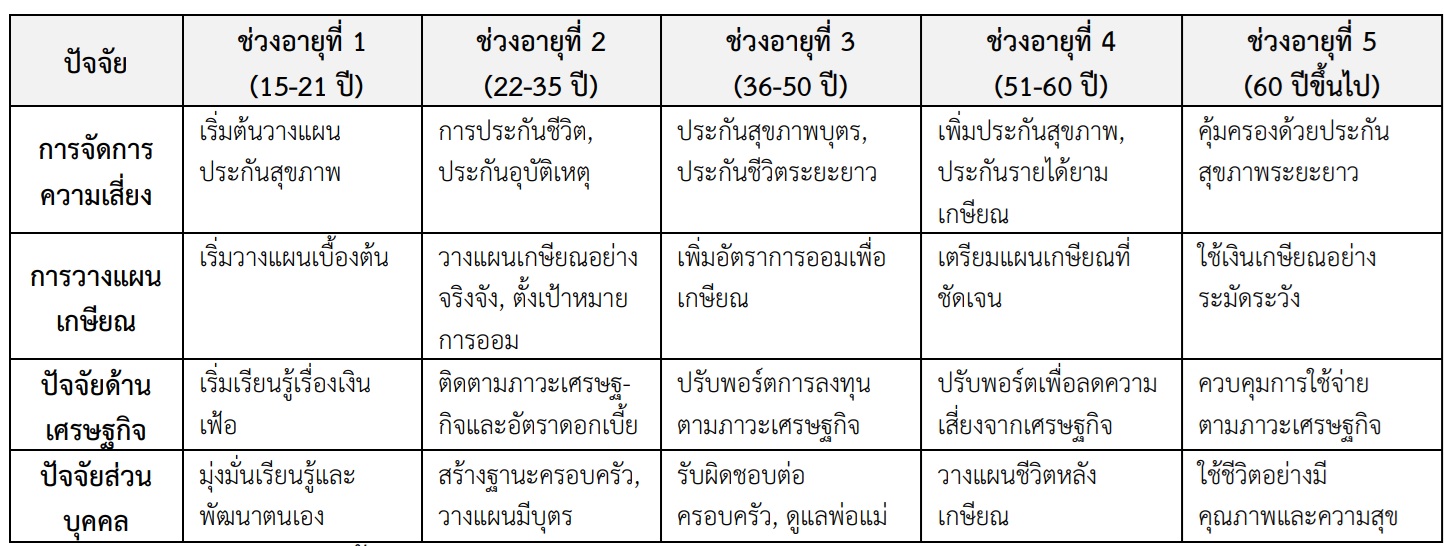
This research aims to develop a mathematical model for financial planning for salaried employees, analyzing various stages of the working age. The goal is to enable individuals with regular income to manage and plan their finances appropriately for each age group. The research divides the working age into five stages: the preparation phase for entering the workforce (ages 15-21), early career stage (ages 22-30), family-building and stability phase (ages 31-40), serious wealth accumulation stage (ages 41-50), and retirement preparation phase (ages 51-60)
The model is developed using mathematical equations and quantitative analysis to address the needs for savings, investment, and risk management in each age group. The results indicate that the developed model effectively assists in budgeting, savings, and investment planning, emphasizing the importance of financial discipline from the beginning of a career, investment strategies aligned with age-related risk levels, and secure retirement planning. This model can be applied to financial planning for salaried employees, helping them achieve both short-term and long-term financial goals. The study recommends utilizing this model for financial advisory services to salaried employees in Thailand, aiming to enhance financial well-being and long-term security.
Article Details
References
ประภาพร กิจดำรงธรรม และ ศิริกุล ตุลาสมบัติ. 2566. การวางแผนการเงินส่วนบุคคลในแต่ละช่วงอายุด้วยเทคนิค
การสร้างภาพ Personal financial planning for each span of age with projective Technique. วารสารศิลปะศาสตร์ราชมงคลสุวรรณภูมิ. 5(2): 288-303.
ฬุลิยา ธีระธัญศิริกุล. 2563. เทคนิคการจัดการการเงินส่วนบุคคลในภาวะวิกฤติ Personal finance management
techniques in crisis. วารสารศิลปะศาสตร์และวิทยาการจัดการ, 7(2): 150-163.
Lusardi, A., and O. S. Mitchell. 2014. The economic importance of financial literacy: Theory and evidence. Journal of Economic Literature, 52(1): 5-44.
Thaler, R. H., and S. Benartzi. 2004. Save more tomorrow™: Using behavioral economics to increase employee saving. Journal of Political Economy, 112(S1): S164-S187.
World Bank. 2020. Financial inclusion and resilience: How BRAC's ultra-poor graduation program
is helping women adapt to climate change. Washington, DC: World Bank Group Available: https://www.brac.net/program/wp-content/uploads/2021/05/rflessons-learned_10-25-17.pdf. Accessed Sep.8, 2024.
