Comparison of the Antimicrobial Activity of Crude Extracts from Siam Weed Leaf (Chromolaena odorata) and Pomegranate Peel (Punica granatum) Against Staphylococcus aureus
Article Sidebar
Main Article Content
Abstract
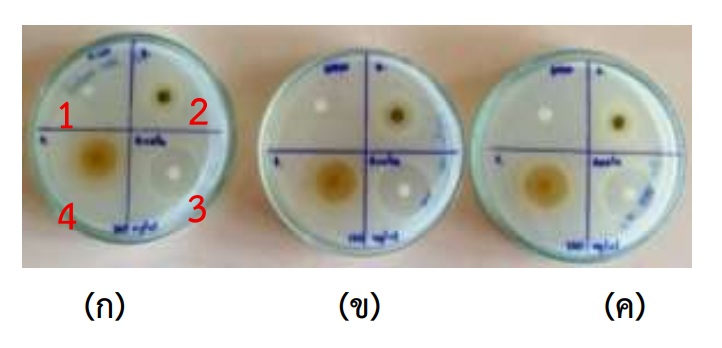
This experimental study compared the antimicrobial efficacy of crude extracts from Siam weed leaf (Chromolaena odorata) and pomegranate peel (Punica granatum) against six clinical isolates of Staphylococcus aureus obtained from local-breed cats with pyoderma. Staphylococcus aureus is a prevalent clinical pathogen that can lead to fatal invasive infections in felines. The crude extracts were prepared using 95% ethanol maceration at 35 °C for 24 hours. Antimicrobial susceptibility was evaluated in triplicate using the agar disc diffusion method. Additionally, the Minimum Inhibitory Concentration (MIC) and Minimum Bactericidal Concentration (MBC)were determined via the broth microdilution method and streak plate technique, respectively. The extraction yield was notably higher for pomegranate peel (34.00% w/w) compared to Siam weed leaf (10.38% w/w). At concentrations of 250 and 500 mg/ml, both extracts exhibited inhibitory effects against Staphylococcus aureus.At 500 mg/ml, the pomegranate peel extract produced a significantly larger mean zone of inhibition (14.33 ± 0.91 mm) than the Siam weed leaf extract (7.00 ± 0.69 mm). However, both extracts demonstrated lower efficacy than the standard antibiotic, Gentamicin (18.28 ± 0.75 mm) [F(2, 51) = 951.19, p < .001]. A post hoc Tukey HSD test confirmed that the pomegranate peel extract was significantly more effective than the Siam weed leaf extract (p < .001). Furthermore, the pomegranate peel extract showed superior bactericidal potency, with an MIC of 3.90 mg/ml and an MBC of 7.81 mg/ml, whereas the Siam weed leaf extract yielded an MIC of 7.81 mg/ml and an MBC of 62.50 mg/ml. In conclusion, the pomegranate peel crude extract possesses high potential as a natural antimicrobial agent against Staphylococcus aureus and warrants further development as an alternative therapeutic option for feline pyoderma.
Article Details
References
Betoni, J. E. C., Mantovani, R. P., Barbosa, L. N., Di Stasi, L. C., & Fernandes Junior, A. (2006). Synergism between plant extract and antimicrobial drugs used on Staphylococcus aureus diseases.Memórias do Instituto Oswaldo Cruz, 101(4), 387–390. https://doi.org/10.1590/s0074-02762006000400007
Cavana, P., Robino, P., Stella, M. C., Bellato, A., Crosaz, O., Fiora, S. R., & Nebbia, P. (2022). Staphylococci isolated from cats in Italy with superficial pyoderma and allergic dermatitis: Characterisation of isolates and their resistance to antimicrobials. Veterinary Dermatology, 34(1), 14-21. https://doi.org/10.1111/vde.13127
Costa, S. S., Ribeiro, R., Serrano, M., Oliveira, K., Ferreira, C., Leal, M., Pomba, C., & Couto, I. (2022).
Staphylococcus aureus causing skin and soft tissue infections in companion animals:
Antimicrobial resistance profiles and clonal lineages Antibiotics, 11(5), 599. https://doi.org/10.3390/antibiotics11050599
Cowan, M. M. (1999). Plant products as antimicrobial agents. Clin Microbiol Rev. 1999 Oct;12(4):564-82. doi: 10.1128/CMR.12.4.564. PMID: 10515903; PMCID: PMC88925.
Forsythe, P. (2015). Feline pyoderma. In World Small Animal Veterinary Association World Congress Proceedings. URL: https://www.vin.com/doc/?id=7259268
Hanphanphoom, S., & Krajangsang, S. (2016). Antimicrobial activity of Chromolaena odorata extracts against bacterial human skin infections. Modern Applied Science, 10(2), 159. https://doi.org/10.5539/mas.v10n2p159
Howell, A. B., & D'Souza, D. H. (2013). The pomegranate: Effects on bacteria and viruses that influence human health. Evidence-Based Complementary and Alternative Medicine, 2013, 606212. https://doi.org/10.1155/2013/606212
Imarenezor, E. P. K., Ebuara, F. U., Abhadionmhen, O. A., Brown, S. T. C., & Isaac, K. (2020). Antimicrobial effects of Chromolaena odorata leaves on Staphylococcus aureus and Streptococcus spp. isolates from urine of patients attending general hospital, Wukari, North East Nigeria. Global Scientific Journal, 8(9), 1183–1195.
Khairullah, A., Sudjarwo, S., Effendi, M., Ramandinianto, S., Gelolodo, M., Widodo, A., Riwu, K., &
Kurniawati, D. (2023). Pet animals as reservoirs for spreading methicillin-resistant Staphylococcus aureus to human health. Journal of Advanced Veterinary and Animal Research, 10(1), 1-10. https://doi.org/10.5455/javar.2023.j641
Kharchoufi, S., Licciardello, F., Siracusa, L., Muratore, G., Hamdi, M., & Restuccia, C. (2018).
Antimicrobial and antioxidant features of ‘Gabsi’ pomegranate peel extracts. Industrial Crops and Products, 111, 345-352. https://doi.org/10.1016/j.indcrop.2017.10.037
Koh, J. J., Qiu, S., Zou, H., Lakshminarayanan, R., Li, J., Zhou, X., Tang, C., Saraswathi, P., Verma,
C., Tan, D. T. H., Tan, A. L., Liu, S., & Beuerman, R. W. (2013). Rapid bactericidal action of alpha-mangostin against MRSA as an outcome of membrane targeting. Biochimica et Biophysica Acta (BBA) - Biomembranes, 1828(2), 834-844. https://doi.org/10.1016/j.bbamem.2012.09.004
Moura, J. B., Vargas, A. C., Gouveia, G. V., Gouveia, J. J. S., Ramos-Júnior, J. C., Botton, S. A.,
Pereira, E. C., & Costa, M. M. (2017). In vitro antimicrobial activity of the organic extract of Cladonia substellata Vainio and usnic acid against Staphylococcus spp. obtained from cats and dogs. Pesquisa Veterinária Brasileira, 37(4), 368–378. https://doi.org/10.1590/s0100-736x2017000400010
Narongpun, P., Chanchaithong, P., Yamagishi, J., Thapa, J., Nakajima, C., & Suzuki, Y. (2023).
Whole-genome investigation of zoonotic transmission of livestock-associated methicillin-resistant Staphylococcus aureus clonal complex 398 isolated from pigs and humans in Thailand. Antibiotics, 12(12), 1745. https://doi.org/10.3390/antibiotics12121745
Saleh, M. M., & Ibrahim, O. M. S. (2026). New gel formulation for treating wounds infected with
common bacteria isolated from feline wounds in rats. Open Veterinary Journal, 16(1), 175–188. https://doi.org/10.5455/OVJ.2026.v16.i1.17
Scaglione, E., Sateriale, D., Mantova, G., Di Rosario, M., Continisio, L., Vitiello, M., Pagliarulo, C., Colicchio, R., Pagliuca, C., & Salvatore, P. (2024). Antimicrobial efficacy of Punica granatum Lythraceae peel extract against pathogens belonging to the ESKAPE group. Frontiers in Microbiology, 15, Article 1383027. https://doi.org/10.3389/fmicb.2024.1383027
Spiliopoulou, I., & Petinaki, E. (2015). Methicillin-resistant Staphylococcus aureus colonization
and infection risks from companion animals: Current perspectives. Veterinary Medicine: Research and Reports, 6, 373-382. https://doi.org/10.2147/vmrr.s91313
Vogelnest, L. J. (2012). Feline superficial pyoderma: a retrospective study of 52 cases (2001–
. Veterinary Dermatology, 23(5), 448–e86. https://doi.org/10.1111/j.1365-3164.2012.01085.x
