
Improving Academic Achievement in Calculus 2, Specifically on Integration Techniques Using Trigonometric Functions, through Problem-Based Learning
Article Sidebar
Main Article Content
Abstract
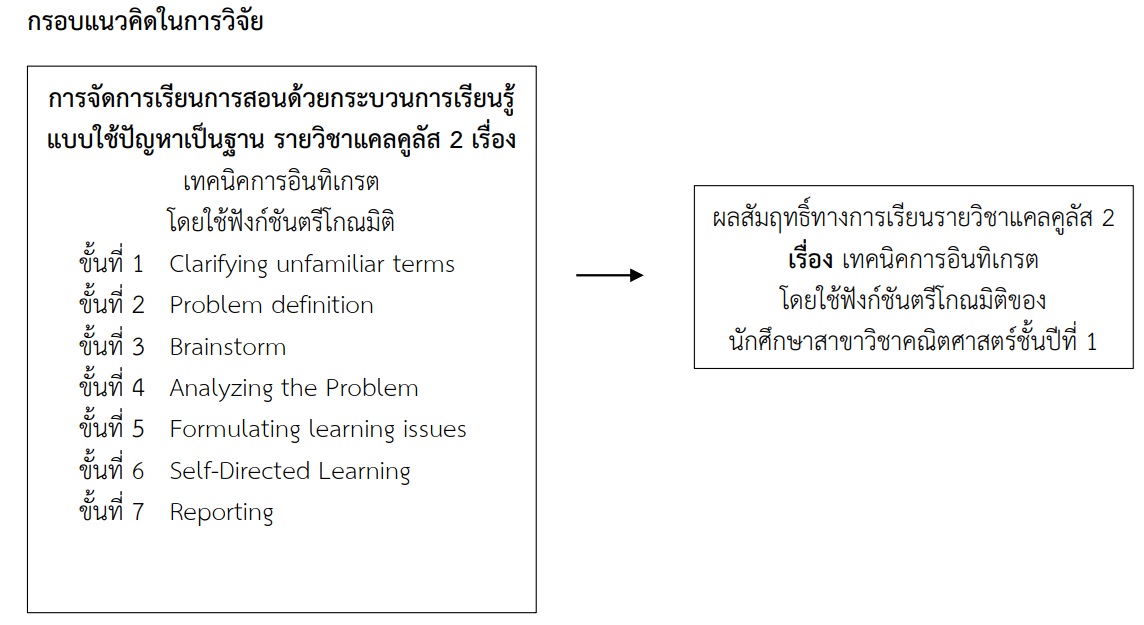
This research aimed to compare the learning achievement in Calculus 2, specifically on Integration Techniques using Trigonometric Functions, of first-year mathematics students using Problem-Based Learning (PBL) before and after instruction. The sample consisted of purposively selected 40 first-year mathematics students enrolled in Calculus 2 in the second semester of the 2025 academic year at the Faculty of Science and Technology, Rajabhat Thepsatri University.
The research instruments included: 1) a lesson plan for Calculus 2, on Integration Techniques using Trigonometric Functions, using Problem-Based Learning; and 2) a test to measure learning achievement in Integration Techniques using Trigonometric Functions. The statistical analyses included mean, standard deviation, percentage, and t-test.
The research findings showed that first-year mathematics students from the Faculty of Science and Technology at Rajabhat Thepsatri University... Students who learned using the Problem-Based Learning (PBL) method achieved an average pre-test score of 26.75% on the topic of integration techniques using trigonometric functions, and an average post-test score of 84.9%. This demonstrates that problem-based learning resulted in significantly higher post-test scores compared to pre-test scores.
Article Details
References
เอกสารอ้างอิง
จิกามาศ สุขเกษม. (2563). การพัฒนาทักษะการอ่านภาษาอังกฤษโดยการจัดการเรียนรู้โดยใช้ปัญหาเป็นฐาน สำหรับนักศึกษาชั้น ปีที่ 1 คณะวิศวกรรมศาสตร์และเทคโนโลยีอุตสาหกรรม มหาวิทยาลัยศิลปากร. วิทยานิพนธ์ปริญญามหาบัณฑิตมหาวิทยาลัยศิลปากร.
ดร.ไพศาล สุวรรณน้อย. (2559). การเรียนรู้โดยใช้ปัญหาเป็นฐาน (Problem-based learning: PBL). สถาบันพัฒนา ทรัพยากรมนุษย์ ฝ่ายวิชาการ มหาวิทยาลัยขอนแก่น. สืบค้น เมษายน 21, 2569 จาก https://ph.kku.ac .th/thai/images/file/km/pbl-he-58-1.pdf
ทวุธ วงค์วงค์. (2565). การจัดการเรียนรู้แบบใช้ปัญหาเป็นฐาน และการจัดการเรียนรู้แบบ KWDL Plus บูรณาการการคิดเชิงอภิปัญญา : มิติใหม่ของการเรียนรู้แก้โจทย์ปัญหาคณิตศาสตร์. วารสารนิสิตวัง, 24(1), 42–54.
ณัชชา อ่อนสัมพันธุ์, สุนีตา โฆษิตชัยวัฒน์. (2563). ผลการจัดการเรียนรู้แบบปัญหาเป็นฐานที่มีต่อทักษะการพูด ภาษาอังกฤษเพื่อการสื่อสารสำหรับนักศึกษาระดับปริญญาบัณฑิต. วารสารการบริหาการศึกษมหาวิทยาลัย
ศิลปากร, 11(1), 34-50.
นภาพร พุฒิวณิชย์, สุรศักดิ์ พุฒิวณิชย์, และอริสา จิตต์วิบูลย์. (2563). แนวทางการจัดการเรียนรู้โดยใช้ PBLสำหรับ นักศึกษาพยาบาล. วารสารเครือข่ายวิทยาลัยพยาบาลและการสาธารณสุขภาคใต้ 2020; 7(2), 324 – 335.
พุทธชาติ ทองโคตร. (2567). ผลของการจัดการเรียนรู้โดยใช้รูปแบบการเรียนรู้โดยใช้ปัญหาเป็นฐานร่วมกับการเรียนรู้โดยใช้กรณีศึกษาฐานที่มีต่อผลสัมฤทธิ์ทางการเรียน เจตคติทางวิทยาศาสตร์และความพึงพอใจของนักศึกษาในรายวิชาวิทยาศาสตร์และเทคโนโลยีสมัยใหม่. วารสารศึกษาศาสตร์ มหาวิทยาลัยมหาสารคาม, 18(1), 35 – 53.
อรจิรา พลราชม. (2563). การพัฒนากิจกรรมการเรียนรู้แบบใช้ปัญหาเป็นฐาน เรื่อง สมการและการแก้ สมการ กลุ่มสาระการเรียนรู้คณิตศาสตร์ ของนักเรียนชั้นประถมศึกษาปีที่ 6. วิทยานิพนธ์, สาขาวิชาวิจัยและ ประเมินผลการศึกษา, มหาวิทยาลัยราชภัฏมหาสารคาม.
Hmelo-Silver, C. E. (2004). Problem-Based Learning: What and How Do Students Learn?Educational
PsychologyReview, 16(3), 235–266. Retrievedfrom https://doi.org/10.1023/B:EDPR.00000340 22.16470.f3
Jacques, L. A. (2017). What does Project-based Learning (PBL) Look like in the Mathematics Classroom?. American Journal of Educational Research. 5(4), 428 – 433.
Marchy, F., Murni, A., Kartini, K., & Muhammad, I. (2022). The effectiveness of using problem- based learning (PBL) in mathematics problem-solving ability for junior high school students. AlphaMath:Journal ofMathematics Education, 8(2), 185 – 198.
Retrievedfrom https://doi.org/10.30595/alphamath.v8i2.15047.
Tarmizi, R. A., Tarmizi, M. A. A., Lojinin, N. I., & Mokhtar, M. Z. (2010). Problem-basedlearning: Engaging students in acquisition of mathematical competency. Procedia – Social and Behavioral Sciences, 2(2), 4683–4688.Retrievedfromhttps://doi.org/10.1016/j.sbspro .2010.03.750.
