
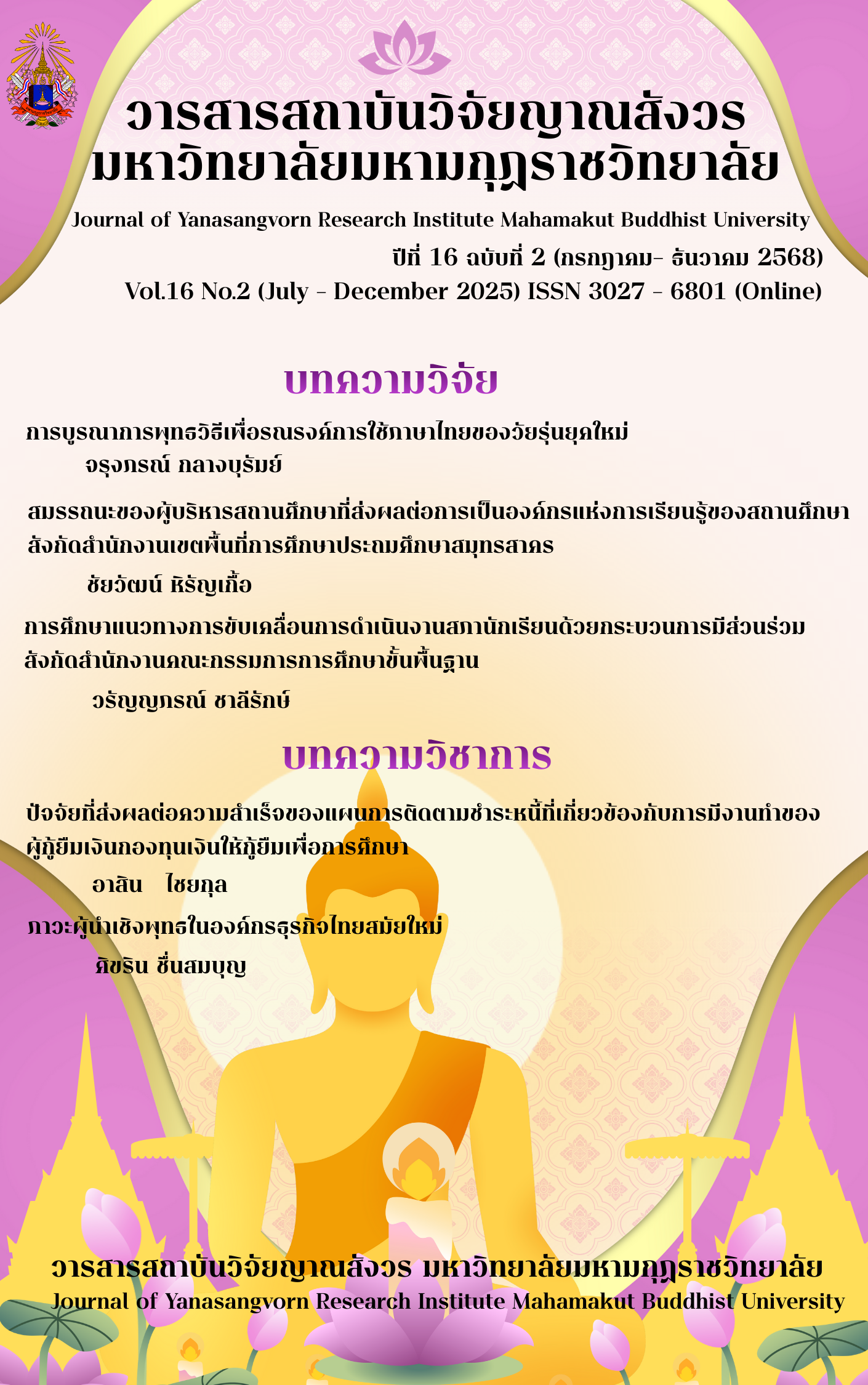
COMPETENCIES OF SCHOOL ADMINISTRATORS AFFECTING SCHOOLS’ DEVELOPMENT AS LEARNING ORGANIZATIONS UNDER THE SAMUTSAKHON PRIMARY EDUCATIONAL SERVICE AREA OFFICE
Article Sidebar
Main Article Content
Abstract
The objectives of this research were to: 1. study the competency level of school administrators under the Samutsakhon Primary Educational Service Area Office, 2. examine the level of schools as learning organizations under the Samutsakhon Primary Educational Service Area Office, 3. investigate the competencies of school administrators that influence the development of schools as learning organizations under the Samutsakhon Primary Educational Service Area Office. The sample consisted of 322 school administrators and teachers during the 2024 academic year, selected through stratified random sampling. The research instrument was a questionnaire. The statistics used for data analysis were frequency, percentage, mean, standard deviation, and stepwise multiple regression analysis.
The research findings revealed that 1. the overall competency level of school administrators under the Samutsakhon Primary Educational Service Area Office was at the highest level. Considering each aspect, the highest averages were in self-development and visionary leadership, followed by analytical and synthetic thinking and personnel potential development. The lowest average was in achievement orientation. 2. The overall level of schools as learning organizations was at a high level. By aspect, systematic thinking scored the highest average, followed by team learning, while mental models scored the lowest; and 3. The competencies of school administrators that significantly influenced the development of schools as learning organizations at the 0.01 level of statistical significance were, in order of influence: personnel development (X7), achievement orientation (X1), and teamwork (X4). Together, these factors could predict 50.80% of the variance in schools becoming learning organizations (R² = 0.50)
Article Details

This work is licensed under a Creative Commons Attribution-NonCommercial-NoDerivatives 4.0 International License.
References
ณิกัญญา สายธนู. (2562). ความสัมพันธ์ระหว่างสมรรถนะของผู้บริหารสถานศึกษากับองค์การแห่งการเรียนรู้ของสถานศึกษา สังกัดสำนักงานเขตพื้นที่การศึกษา
ประถมศึกษานครราชสีมา(วิทยานิพนธ์มหาบัณฑิตบัณฑิต). มหาวิทยาลัยราชภัฏนครราชสีมา, นครราชสีมา.
นิภา ใจทัน. (2555). สมรรถนะของผู้บริหารสถานศึกษาที่ส่งผลต่อการเป็นองค์กรแห่งการเรียนรู้ของ สถานศึกษาขั้นพื้นฐาน สังกัดสำนักงานเขตพื้นที่การศึกษา
ประถมศึกษานครปฐม เขต 2 (วิทยานิพนธ์มหาบัณฑิตบัณฑิต). มหาวิทยาลัยราชภัฏนครปฐม, นครปฐม.
ปวีณา รอดเจริญ. (2565). สมรรถนะของผู้บริหารสถานศึกษาที่ส่งผลต่อประสิทธิผลของสถานศึกษา สังกัดสำนักงานเขตพื้นที่การศึกษามัธยมศึกษา เขต 9
(วิทยานิพนธ์มหาบัณฑิต). มหาวิทยาลัยราชภัฏหมู่บ้านจอมบึง, ราชบุรี.
หนูกัณฑ์ ปาโส. (2562). สมรรถนะผู้บริหารสถานศึกษาที่ส่งผลต่อการเป็นองค์กรแห่งการเรียนรู้โรงเรียนเอกชนในจังหวัดร้อยเอ็ด (วิทยานิพนธ์มหาบัณฑิต
บัณฑิต). มหาวิทยาลัยราชภัฏร้อยเอ็ด, ร้อยเอ็ด.
ชัยสิทธิ เฉลิมมีประเสริฐ. (2545). เอกสารประกอบการสอนวิชาวิธีการทางสถิติสำหรับการวิจัย. วิทยาลัยการบริหารรัฐกิจ มหาวิทยาลัยบูรพา, ชลบุรี.
วีระเชษฐ์ ฮาดวิเศษ. (2551). สมรรถนะผู้บริหารสถานศึกษาสังกัดสำนักงานเขตพื้นที่การศึกษา หนองคาย เขต 3 (รายงานการศึกษาอิสระ). มหาวิทยาลัยขอนแก่น,
ขอนแก่น.
สำนักงานเขตพื้นที่การศึกษาประถมศึกษาสมุทรสาคร. (2567). รายงานผลการดำเนินงานตามแผนงานในปีงบประมาณ 2567. สมุทรสาคร : กลุ่มนโยบายและแผน.
สำนักงานเขตพื้นที่การศึกษาประถมศึกษาสมุทรสาคร.
Razik, T.A. & Swanson, A. D.,(2001). Fundamental concepts of educational leadership. (2nd ed.), New Jersey : Merrill Prentice-Hall.
