MODEL FOR CREATING A PEACEFUL SOCIETY THROUGH THE FIVE PRECEPTS VILLAGE PROJECT IN COMMUNITIES OF AMPHAWA DISTRICT, SAMUT SONGKHRAM PROVINCE
Keywords:
Peaceful Society, Drive Mechanism, Community Involvement, Five Precepts Village ProjectAbstract
Background and Objectives: The Five Precepts Village Project originated from an idea of the Sangha Supreme Council, which assigned the Buddhist Sangha to consider applying the principles of Buddhism as a tool for the development of the Thai community and society toward a peaceful society. In particular, it promotes the observance of the Five Precepts, which are the basic precepts in Buddhism that emphasize living together in a peaceful society, such as reducing conflicts, refraining from physical harm, and decreasing violence, as well as promoting volunteer-based accident prevention in the community. The Five Precepts function as a mechanism for mental and social development that integrates Buddhist teachings with structural development. This study aimed to examine the general conditions of peaceful society-building, patterns of community participation, and the driving mechanisms for creating a peaceful society according to the Five Precepts Village Project.
Methodology: This study employed a qualitative research design. The key informants consisted of Buddhist monks, community leaders, parent representatives, school administrators, and student representatives, totaling 25 participants. The informants were selected through purposive sampling. The research instrument was a structured interview guide. Data were collected through in-depth interviews and analyzed using descriptive analysis.
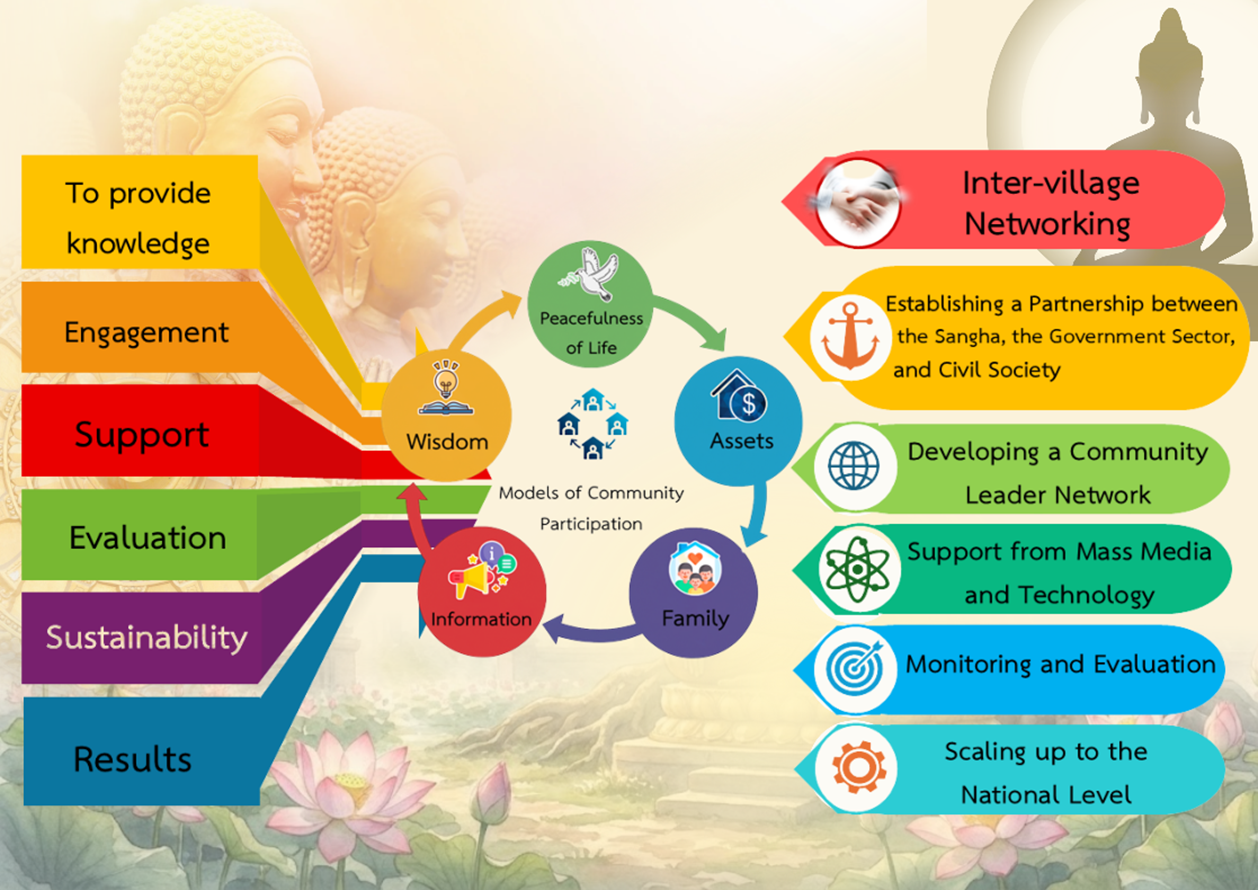
Main Results: It was found that the general conditions of a peaceful society were based on the Five Precepts, which serve as fundamental Dhamma principles that help regulate human behavior and promote responsibility toward oneself, others, and society. The emphasis is placed on refraining from harm to others, stealing, sexual misconduct, lying, and the consumption of alcohol and addictive substances, which form the foundation of peace and safety in the community. The results showed that: 1) The process of creating a peaceful society consisted of: 1.1) Educating and raising awareness; 1.2) Encouraging community participation; 1.3) Receiving support from monastic communities, the Sangha Order, and local organizations; 1.4) Evaluation and monitoring of progress; 1.5) Preserving sustainability; and 1.6) Assessing project outcomes;
2) The community participation model revealed that in aspects of peace in life, property, family, and information, villagers must think together, act together, and take care of one another, which will bring peace, safety, and warmth to families and the community. In terms of wisdom, villagers applied wisdom to solve problems; and 3) Regarding the driving mechanism, it was found that the creation of networks between villages resulted from the exchange of learning within local areas first, then expanded to other areas. Building alliances between the Sangha Order, the government, and other sectors integrated cooperation among the relevant government departments.
Involvement to Buddhadhamma: Building a peaceful society aligns with the fundamental principles of Buddhism, specifically the Five Precepts (Pañca Sīla), which consist of Pāṇātipātā, Adinnādānā, Kāmesu Micchācārā, Musāvādā, and Surāmerayamajja Pamādaṭṭhānā.
These principles focus on developing individuals' behavior and moral awareness so that they can live peacefully and sustainably with others in society. They also promote the development of self-discipline among community members, non-harm toward others, and coexistence based on respect for social rules and regulations, resulting in peace at the individual, family,
and community levels.
Conclusions: The model of creating a peaceful society according to the Five Precepts Village Project is important in fostering moral consciousness in daily life, leading to peaceful communities, morally and ethically grounded citizens, and a reduction in violence. It also contributes to strengthening families and communities. Participation from all sectors, including households, monasteries, schools, and both public and private sectors, jointly drives the development of strong communities and a peaceful society.
References
Department of Religious Affairs, Ministry of Education. (1997). Factors Contributing to the Abbot's Success in Developing the Temple into a Community Center. Bangkok, Thailand: The Religious Affairs Printing House.
Kosonniratwong, M. (1998). Buddhadhamma: Theory and technical to give consultation. Bangkok, Thailand: Suweeriyasan.
Mongkolkeha, S. (2018). Achievement of the Keeping Five-Precepts in Villages Project (the Project) applied in Amphur Mueng, Loei Province, Thailand. Pathumthani University Academic Journal, 10(1), 82-91.
Patton, M. Q. (2015). Qualitative Research Evaluation Methods. California, United States of America: Sage Publication.
Phra Thepwethi (Prayut Payutto). (1982). Buddhism and Thai Society 2nd ed. Bangkok, Thailand: Komol Keemthong Foundation.
Phrakhru Supphatthanakanchanakit (Supphin Supphattho/Kringkanchana). (2016). A Study on the Development of Working Model of Kanchanaburi Sangka on the Five Precepts Undertaking Village Project. [Doctoral dissertation, Mahachulalongkornrajavidyalaya University]. Thai Digital Collection. https://www.thailis.or.th/tdc/browse.php?option=show&browse_type=title&titleid=488591.
PhramahaNikorn Paladsung & Zumitzavan, V. (2017). The Investigation of Five Percepts and Peace-Making in The Society Sustainably: A Case Study of Khon Kaen, Thailand. Journal of Graduate Studies Review, 13(3), 43-56.
Seehampai, P. (1992). Foundations of Religious and Moral Education. Bangkok, Thailand: Chulalongkorn University Press.
Siriworasakun, W. & Intaprom, W. (2018). MODEL-DRIVEN FIVE PRECEPTS IN VILLAGES POLICY TO SUCCESSED. Journal of Humanities and Social Sciences Thonburi University, 12(29), 203-209.
Somdet Phra Buddhaghosacariya (P.A. Payutto). (2019). Buddhadhamma: The Expanded Edition 53nd ed. Bangkok, Thailand: Palidhamm Publications, Pet and Home Company Limited.
The Five Precepts Observance Project. (2025). Report of The Five Precepts Village Project Level Five of SamutSongkhram Province. Bangkok, Thailand: The Five Precepts Observance Project.
Uppakhun, A. (2021). Factors Affecting the Effectiveness of the Five Precepts Village Project in Mueang District, Sakon Nakhon Province.[Master's Thesis dissertation, Sakon Nakhon Rajabhat University]. SNRU e-Thesis Sakon Nakhon Rajabhat University. https://gsmis.snru.ac.th/e-thesis/thesis_detail?r=61426423105.
Downloads
Published
How to Cite
Issue
Section
License
Copyright (c) 2025 Journal of Buddhist Anthropology

This work is licensed under a Creative Commons Attribution-NonCommercial-NoDerivatives 4.0 International License.