
Energy Potential of Charcoal Briquette from Flamboyant and Black Rosewood Pods
Article Sidebar
Main Article Content
Abstract
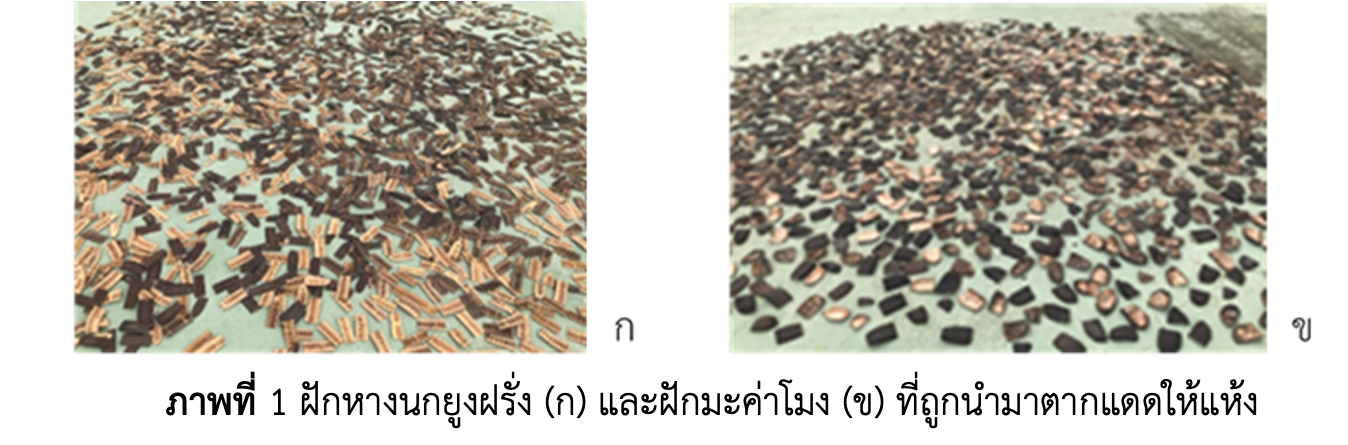
This research aimed to produce charcoal briquettes from Flamboyant (Delonix regia (Bojer ex Hook.) Raf.) and Black rosewood (Afzelia xylocarpa (Kurz) Craib) pods and evaluated the performance of them as an alternative fuel. Flamboyant and Black rosewood pods were burned to obtain charcoals and mashed into powders. The charcoal powders were mixed with the starch paste at the ratios of 1:1, 1.5:1, and 2:1 (kg : L) and then compressed into fuel briquettes. The fuel properties and heat utilization efficiency of charcoal briquettes were analyzed based on ASTM and Water Boiling Test (WBT), respectively. The results showed that the moisture and calorific values of all tested charcoal briquettes qualified the Community Products Standard of Charcoal Briquettes. The charcoal briquettes from Flamboyant and Black rosewood pods at the ratio of 2:1 showed the best fuel properties as evidenced by the lowest moisture values and volatile matters, but the highest fixed carbon and calorific. Charcoal briquettes at the ratio of 2:1 also showed the highest work values and heat utilization efficiency. During the combustion process, all tested charcoal briquettes were also highly flammable and produced low levels of crackling, drop shatter, and smoke emission. Due to the use of a small amount of starch paste and giving the largest number of charcoal briquettes, charcoal briquettes at the ratio of 2:1 were probably the most suitable to be selected to manufacture charcoal briquettes. In addition, the ratio of 2:1 also showed the best fuel properties and heat utilization efficiency. Overall, Flamboyant and Black rosewood pod wastes could be considered as a potential renewable raw material to produce charcoal briquette instead of wood charcoal for household cooking.
Article Details

This work is licensed under a Creative Commons Attribution-NonCommercial-NoDerivatives 4.0 International License.
The Journal of Science and Science Education (JSSE) retain the right of all articles published in JSSE. The coresponding author or the authorized person on behalf of the authors must send the complete Copyright Transfer Form to JSSE before any article get published in JSSE.
Copyright Transfer Form
The JSSE request the coresponding author or the authorized person on behalf of the authors upload the manuscript under the together with the Copyright Transfer Form under the supplementary data. The guidline for uploading both manuscript and Copyright Transfer Form is shown below:
1. Upload the manuscript in the sub-menu, Article Component > Article Text.
2. Upload the the Copyright Transfer Form in the sub-menu, Article Component > Other.
Download Copyright Transfer Form
References
American Society for Testing and Materials. (1996). Annual Book of American Standard Testing Method. Vol.05.06 MD: ASTM.
Anantanukulwong, R., Chemae, R. and Sareanu, N. (2019). Production of charcoal from agricultural residues (in Thai). YRU Journal of Science and Technology, 4(1), 47-53.
Boonchom, K. and Chaisompan, N. (2020). Study of charcoal briquette from longan wood (in Thai). Naresuan Phayao Journal, 13(2): 51-56.
Chaichana, T., Waewsak, J., Kaew-On, J. and Onthong, U. (2014). Fuel properties of mangosteen pericarp charcoal (in Thai). Thaksin University Journal, 17(3), 29-36.
Homhual, S. (2010). Makamong (in Thai). Retrieved 19 August 2021, from Herbal Database, Faculty of Pharmacy, Ubon Ratchathani University: http://www.phargarden.com/main.php?action=viewpage&p
id=260.
Janchaiyaphoom, H. (2018). Charcoal briquettes from tamarind shell (in Thai). In Proceedings of 3rd Minutes and National Research Presentations, Ratchathani Academic (pp. 288-296). Ubon Ratchathani: Ratchathani University.
Jutajan, W. (2019). A study of charcoal burning process and properties of briquetted charcoal from vetiver grass (in Thai). Journal of Industrial Technology Ubon Ratchathani Rajabhat University, 9(2), 135-146.
Ministry of Energy. (2020). Alternative Energy Development Plan 2018-2037 (in Thai). Retrieved 10 February 2022, from 20201021_TIEB_AEDP2018.pdf: https://www.dede.go.th/download/Plan_62/20201021 _TIEB_ AEDP2018.pdf.
Ngamlert, A., Saripan, K. and Pengngiw, P. (2019). The optimum binder for the production of charcoal briquettes from eucalyptus bark (in Thai). Thepsatre I-TECH Journal, 14(2), 86-97.
Phutteesakul, R. (2010). The production of charcoal briquette by coconut shell and cassava rhizome (in Thai). Master’s Thesis. Bangkok: Srinakharinwirot University.
PlantNet. (2022). Delonix regia (Bojer ex Hook.) Raf. Retrieved 10 April 2022, from Invasive plants: https://id entify.plantnet.org/invasion/species/Delonix%20regia%20(Bojer%20ex%20Hook.)%20Raf./data.
Provincial Energy Office of Nakhonpathom (2018). Manual of 200 liters charcoal kiln: Wood vinergar production (in Thai). Nakhonpathom: Provincial Energy Office of Nakhonpathom, Ministry of Energy.
Raikham, C., Khamwan, Y., Chanthawongrit, P. and Kaewmuang, S. (2017). Study the effect of molasses ratio to fuel properties made from mangosteen and rambutan shell (in Thai). Science and Technology Nakhon Sawan Rajabhat University Journal, 9(10), 79-90.
Sawekwiharee, S. (2012). Potential Energy of Fuel Briquettes from Mangosteen Shell (in Thai). Bangkok: Rajamangala University of Technology Phra Nakhon.
Tamilvanan, A. (2013). Preparation of biomass briquettes using various agro-residues and waste papers. Journal of Biofuel, 4(2), 47-55.
Thai Industrial Standards Institute. (2004). Community products standard of charcoal briquettes 238/2004 in Thai). Retrieved 15 December 2019, from Thai Community Products Standards: http://tcps.tisi.go.th
/public/StandardList.aspx.
Ussawarujikulchai, A., Semsayun, C., Prapakdee, N., Pieamsuwansiri, N. and Chuchat, N. (2011). Utilization of durian and mangosteen peels as briquette fuel. In Proceedings of 49th Kasetsart University Annual Conference (pp. 162-168). Bangkok: Kasetsart University.
Wirunphan, K., Saiplean, T. and Jaichompoo, P. (2017). Production of compressed charcoal fuel from the waste materials collected after processing Khao-Larm (in Thai). RMUTL Engineering Journal, 2(1), 1-15.
Wongkhamchan, B. and Rungratanaubon, T. (2018). Briquette fuel from waste wood pallet (in Thai). Thai Journal of Forestry, 37(1), 143-152.
