Development of engagement in learning that affects mathematics achievement on the graph of quadratic functions for Grade-9 students by using Think-Talk-Write technique with the GeoGebra program
Article Sidebar
Main Article Content
Abstract
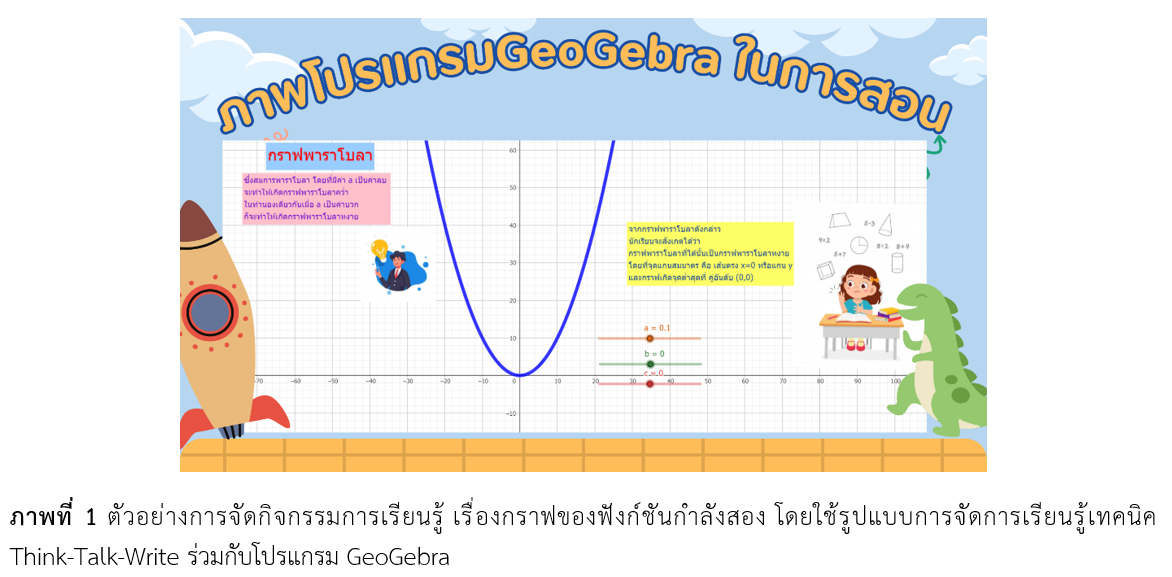
The purposes of this study were to 1) compare grade-9 students' engagement in learning mathematics graph of quadratic functions, and 2) compare their learning achievement in mathematics on the graph of quadratic functions before and after learning using the Think-Talk-Write technique with the GeoGebra program. The research sample group consisted of 43 grade-9 students from a school in Kalasin province during the first semester of the 2023 academic year, selected using simple random sampling. The research tools include learning management plans, achievement tests, and engagement in learning assessments. Statistical methods used in data analysis include mean, standard deviation, percentage, and the t-test for dependent samples. Using the Think-Talk-Write technique with the GeoGebra program, the study discovered 1) the results of grade-9 students' engagement in learning mathematics on the graph functions after learning were higher than before learning, with statistical significance at the level .05, and 2) grade-9 students' academic achievement in mathematics on the graph of quadratic functions after learning was higher than before learning with statistical significance at the level .05.
Article Details

This work is licensed under a Creative Commons Attribution-NonCommercial-NoDerivatives 4.0 International License.
The Journal of Science and Science Education (JSSE) retain the right of all articles published in JSSE. The coresponding author or the authorized person on behalf of the authors must send the complete Copyright Transfer Form to JSSE before any article get published in JSSE.
Copyright Transfer Form
The JSSE request the coresponding author or the authorized person on behalf of the authors upload the manuscript under the together with the Copyright Transfer Form under the supplementary data. The guidline for uploading both manuscript and Copyright Transfer Form is shown below:
1. Upload the manuscript in the sub-menu, Article Component > Article Text.
2. Upload the the Copyright Transfer Form in the sub-menu, Article Component > Other.
Download Copyright Transfer Form
References
Dila, D. O. (2012). Think-Talk-Write strategies. Retrieved 23 December 2023, from dila’ s story: http://syahputri90dila.blogspot.com/2012/01/metode-pembelajaran-bahasainggris_12.html
Fonglam. P. (2011). Problems in organizing the teaching and learning of general mathematics courses. (in Thai) Master's Thesis. Bangkok: Sripatum University.
Fredricks, J. A., Blumenfeld, P. C. and Paris, A. H. (2004). School engagement: Potential of the concept, state of the evidence. Review of educational research, 74 (1), 59-109.
Gafoor, K. A. and Kurukkan, A. (2015). Why High School Students Feel Mathematics Difficult? An Exploration of Affective Beliefs. Pedagogy of Teacher Education: Trends and Challenges, 23-27. 147887365.
Hurst, S. (2013). Seven ways to increase student engagement in the classroom. Retrieved 23 December 2023, Reading Horizons: https://readinghorizons.website/blog/seven-ways-to-increase-student-engagement-in-the-classroom/
Kruedsanoi. P. and Kaewpuang, P. (2023). Development of educational game activity packages for enhancing learning engagement and learning achievement in economics for seventh grade students (in Thai). Journal of MCU Social Science Review, 12(3), 150–165.
Ministry of Education. (2017). Learning standards and indicators. Mathematics learning group (revised edition 2017) according to the Basic Education Core Curriculum 2008 (in Thai). Bangkok: Agricultural Cooperative Assembly Printing Press Thailand Co., Ltd.
Pasong, A. (2016). Using the GeoGebra program to support 4MAT learning to develop academic achievement. study mathematics about basic calculus for grade 12 students (in Thai). Master's Thesis. Nakhon Ratchasima: Nakhon Ratchasima Rajabhat University.
Phattharakorn, S. (2009). The effect of organizing active learning on problem solving and mathematical communication abilities of Mathayomsuksa III students in probability (in Thai). Master's Thesis. Bangkok: Srinakharinwirot University.
Piper, L., Marchand-Martella, N. and Martella, R. (2010). Use of explicit instruction and double-dosing to teach ratios, proportions, and percentages to at-risk middle school students. The Journal of At-Risk Issues, 15(2), 9-17.
Suwannatthachot. P. (2018). Active Learning (in Thai). Bangkok: Chulalongkorn University Printing House.
The Institute for the Promotion of Teaching Science and Technology (IPST). (2017). Report on research results of the TIMSS 2015 project (in Thai). Retrieved 23 December 2023, from https ://timssthailand.ipst.ac.th/timss/reports/timss2015report
The Institute for the Promotion of Teaching Science and Technology (IPST). (2017). Mathematics learning group course manual. (Revised edition 2017) Lower secondary school level (in Thai). Retrieved 23 December 2023, from SciMath knowledge base: https://www.scimath.org/ebook-mathematics/item/8380-2560-2551-8380
Thipraksa. W. (2017). A study of understanding and learning retention on parabola for grade 9 students by using learning activities through GeoGebra (in Thai). Master's Thesis. Ubon Ratchathani: Ubon Ratchathani. University.
Thongnak. P. (2016). The effects of organizing learning activities through heuristics with Think-Talk-Write technique on mathematical problem solving and communication abilities of Mathayomsuksa four students (in Thai). Journal of Education, 29(1), 127-142.
Wang, M. T. and Holcombe, R. (2010). Adolescents’ perceptions of school environment, engagement, and academic achievement in middle school. American educational research journal, 47(3), 633-662.
Willms, J. D. (2003). Student engagement at school: A sense of belonging and participation: Results from PISA 2000. Retrieved 23 December 2023, from OECD iLibrary: https://www.oecd-ilibrary.org/education/student-engagement-at-school_9789264018938-en?fbclid=IwAR3B99LbTvXF04MVpj-_3ZqGdrE3ojnl5Qisy0eDqbTCTktouq324UJ7ZWw
Wuttisant. P. (2023). GeoGebra, another interesting option for mathematics teachers (in Thai). Retrieved 23 December 2023, from SciMath knowledge base system: https://www.scimath.org/article-mathematics/item/12824-geogebra
