A Comparative Study of Mathematical Problem-Solving Skills Using Cooperative Learning with the Think-Pair-Share Technique and Cooperative Learning with the Group Investigation (GI) Technique Among Mathayomsuksa 1 students
Article Sidebar
Main Article Content
Abstract
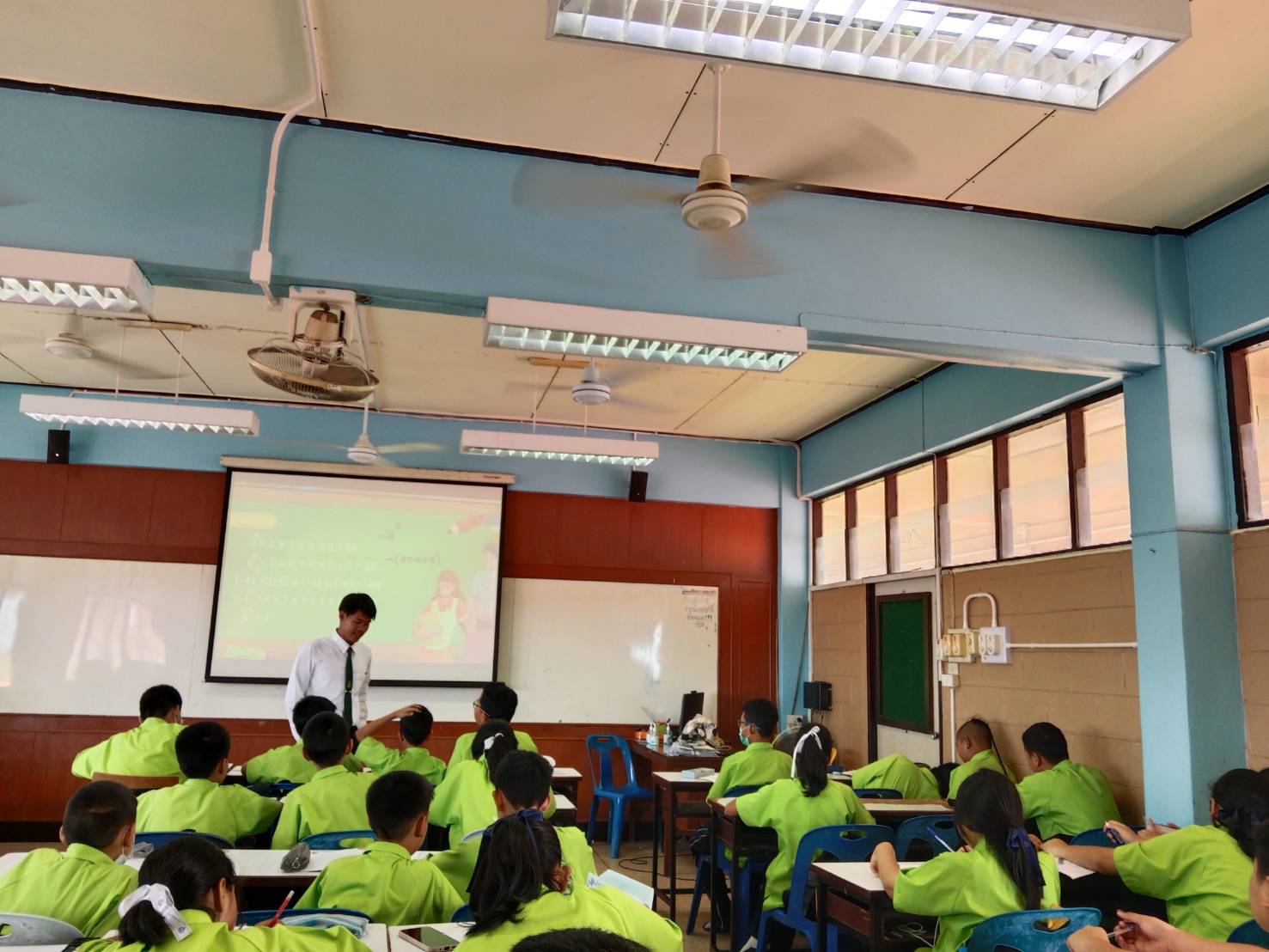
The objective of this study was to 1) compare the mathematics problem-solving skills of students following instruction using the Think-Pair-Share technique and the Group Investigation technique, 2) examine the changes in mathematics problem-solving skills of Mathayomsuksa 1 students before and after instruction using the Think-Pair-Share technique, 3) examine the changes in mathematics problem-solving skills of Mathayomsuksa 1 students before and after instruction using the Group Investigation technique. 4) assess students’ satisfaction with learning through the Think-Pair-Share technique, and 5) assess students’ satisfaction with learning through the Group Investigation technique. The sample consisted of 80 Mathayomsuksa 1 students from Phothawatthanasenee School, selected through the cluster random sampling method. The research instruments included 1) lesson plans designed for the Think-Pair-Share technique, 2) lesson plans designed for the Group Investigation technique, 3) a mathematics problem-solving skills assessment, and 4) a student satisfaction questionnaire. Data were analyzed using descriptive statistics, including the mean and the standard deviation, along with inferential statistics through the t-test. The research findings revealed that 1) there was no statistically significant difference in mathematics problem-solving skills between the two groups after instruction at the 0.05 significance level, 2) students who received instruction through the Think-Pair-Share technique demonstrated a statistically significant improvement in mathematics problem-solving skills after instruction compared to before instruction at the 0.05 significance level, 3) students who received instruction through the Group Investigation technique also exhibited a statistically significant improvement in mathematics problem-solving skills after instruction compared to before instruction at the 0.05 significance level, 4) students reported a high level of satisfaction with learning through the Think-Pair-Share technique, and 5) students reported a high level of satisfaction with learning through the Group Investigation technique.
Article Details

This work is licensed under a Creative Commons Attribution-NonCommercial-NoDerivatives 4.0 International License.
The Journal of Science and Science Education (JSSE) retain the right of all articles published in JSSE. The coresponding author or the authorized person on behalf of the authors must send the complete Copyright Transfer Form to JSSE before any article get published in JSSE.
Copyright Transfer Form
The JSSE request the coresponding author or the authorized person on behalf of the authors upload the manuscript under the together with the Copyright Transfer Form under the supplementary data. The guidline for uploading both manuscript and Copyright Transfer Form is shown below:
1. Upload the manuscript in the sub-menu, Article Component > Article Text.
2. Upload the the Copyright Transfer Form in the sub-menu, Article Component > Other.
Download Copyright Transfer Form
References
Atsena, O. and Sangsrikaew, P. (2024). Development of reasoning skills and academic achievement in mathematics by organizing learning activities using the peer-thinking technique on percentage and ratio of grade 6 students. (in Thai). Academic Journal of Graduate School, 2(1), 59-68.
Boonwas, K. (2003). Educational innovation (in Thai). Bangkok: Srinakharinwirot University.
Chitchanawanit, K. (2019). Learning Management (in Thai). Bangkok: Chulalongkorn University Press.
Compakea, J. (2020). Development of mathematical problem-solving skills on prisms and cylinders using peer-thinking techniques and math games for Mathayom 2 students (in Thai). Master's thesis. Nakhon Pathom: Silpakorn University.
Dachakupt, P. and Yindeesuk, P. (2018). 7C Skills of Teachers 4.0 (in Thai). Bangkok: Chulalongkorn University Press.
Khotcha, C., Sungdaung, T., Thongsomnuk, I. and Neammalai, P. (2023). The effect of cooperative learning management using buddy technique on learning achievement and reasoning skills on trigonometric ratios of Mathayomsuksa 3 students at Wachirathamsopit School (in Thai). The 14th Hatyai National and International Academic Conference (pp. 1563-1575). Hatyai: Hatyai University.
Koonkaew, A. (2019). Statistics for research (in Thai). Bangkok: Chulalongkorn University Press.
Ministry of Education. (2017). Learning standards and indicators for the Mathematics, Science and Geography subject groups in the Social Studies, Religion and Culture subject group (revised edition 2017) according to the Basic Education Core Curriculum B.E. 2008 (1st edition) (in Thai). Bangkok: Office of the Basic Education Commission, Ministry of Education.
Mingsiritham, M. (2011). Integrating cooperative learning and collaborative learning (in Thai). Veridian E-Journal SU, 4(1), 436-444.
Moonkham, S. and Moonkham, O. (2002). Methods for organizing learning to develop a thinking system (in Thai). Bangkok: Image Printing.
Muhammad, M. (2018). The Effect of Group Investigation (GI) Cooperative Learning Type on Mathematical Problem and Self-Confidence of the Students in SMP Negeri 2 Rembang. Proceedings of the 5th Asia Pasific Education Conference (AECON 2018) (pp. 91-94). Purwokerto, Indonesia: Atlantis Press.
Nanang. and Rahmawati, A. T. (2022). Improving Mathematical Problem Solving Ability Through Think Pair Share for Junior High School Students. Thinking Skills and Creativity Journal, 5(2), 43-51.
Ningsih, Y., Andika, R., Sari I. K., Ahmad, S. and Kenedi, A. K. (2019). The application think pair share in learning mathematic. Journal of Physics: Conference Series, 1321, 022092.
Nisa, T. F. and Cuevas, J. V. (2022). Group Investigation (GI) to increase student mathematics learning outcomes. Transpublika International Research in Exact Sciences, 1(1), 37-45.
Ritjaroon, P. (2009). Principles of Measurement and Evaluation in Education (in Thai). Bangkok: House of Kermyst co.,ltd.
Rodseesen, T., Chanakul, B. and Bangtho, K. (2019). The development of student achievement for solving the single linear equations by teaching through the STAD approach among grade 7 students (in Thai). Journal of Graduate School Sakon Nakhon Rajabhat University, 16(72), 119-128.
Sripradit, N. (1996). Academic achievement and problem-solving ability between teaching investigative methods using group process and teaching according to the teacher's manual of Mathayom 3 students (in Thai). Master's thesis. Bangkok: Srinakharinwirot University.
Tantiphongsanurak, C. (2000). Cooperative Learning (in Thai). Academic journal, 3(12), 36-55.
Thanyacharoen, A., Chanphen, S., Ngenniam, S., Hengtaweesapsiri, N. and Nantratkul, P. (2023). A study on learning achievement in mathematics on polynomial of mattayomsuksa 2 students by cooperative learning using Think-Pair-Share techniques and normal teaching (in Thai). Proceedings of the 11th National Academic Conference of Muban Chombueng Rajabhat University (pp. 110-119). Ratchaburi: Muban Chombueng Rajabhat University.
Tubtawee, C. (2011). The effect of collaborative learning with peer thinking technique on the ability to think logically about trigonometric ratios of Mathayom 3 students (in Thai). Master's Thesis. Bangkok: Srinakharinwirot University.
Unton, A. R., Rizal R., Susanto, A. and Dinda, W. (2023). Meningkatkan Kemampuan Berpikir Kritis Matematika Siswa Melalui Model Pembelajaran Group Investigation (GI). Innovative: Journal Of Social Science Research, 3(4), 2932-2941.
