
Implementing Mathematical Argumentation-Based Learning Activities to Promote Mathematical Thinking Ability on the Topic of Polygons for Grade 6 Students
Article Sidebar
Main Article Content
Abstract
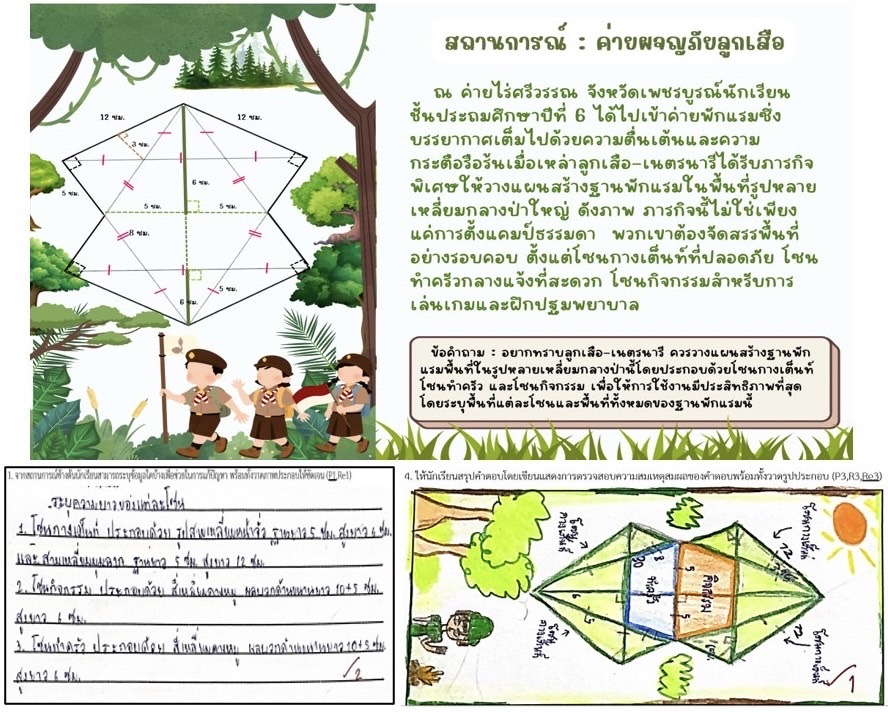
Mathematical thinking is an essential skill that enables learners to deeply understand mathematical concepts and solve problems with logical reasoning. However, research and classroom observations indicate that student is still unable to systematically analyze and solve geometry problems. This research aimed to study the effects of implementing mathematical argumentation in mathematics learning activities on mathematical thinking in the topic of polygons for Grade 6 students during the second semester of the 2024 academic year. The participants were 8 students from a small school in Phetchabun Province. The study employed classroom action research methodology consisting of 3 cycles for a total of 11 hours. The research instruments included 3 lesson plans (an appropriateness average value of 4.88), activity worksheets, and a mathematical thinking ability test (an IOC value of 1 for all items). Data was analyzed according to the components of mathematical thinking. The results from the activity worksheets showed good development; initially, a similar number of students were at levels 1 and 2. Across all three cycles, students exhibited advanced mathematical thinking in specific domains Level 2 the highest level in the following order from highest to lowest: problem-solving, representation, and reasoning. These findings were consistent with the results from a mathematical thinking ability test. After participating in the learning activities, students were able to correctly summarize problem solutions and better explain the reasoning behind applying mathematical knowledge to understand problems.
Article Details

This work is licensed under a Creative Commons Attribution-NonCommercial-NoDerivatives 4.0 International License.
The Journal of Science and Science Education (JSSE) retain the right of all articles published in JSSE. The coresponding author or the authorized person on behalf of the authors must send the complete Copyright Transfer Form to JSSE before any article get published in JSSE.
Copyright Transfer Form
The JSSE request the coresponding author or the authorized person on behalf of the authors upload the manuscript under the together with the Copyright Transfer Form under the supplementary data. The guidline for uploading both manuscript and Copyright Transfer Form is shown below:
1. Upload the manuscript in the sub-menu, Article Component > Article Text.
2. Upload the the Copyright Transfer Form in the sub-menu, Article Component > Other.
Download Copyright Transfer Form
References
Ayalon, M., Wilkie, K. J. and Swaid, R. (2024). Investigating students’ arguments with real-life functional situations throughout a sequence of collaborative activities. Eurasia Journal of Mathematics, Science and Technology Education, 20(11), em2526.
Aziza, M. (2017). The use of open-ended question pictures in the mathematics classroom. New Trends and Issues Proceedings on Humanities and Social Sciences, 4(9), 1–9.
Calgary Board of Education. (2024). Kindergarten to grade 12 mathematics framework. Retrieved 4 Mar 2025 from GoToKnow: https://www.cbe.ab.ca/FormsManuals/Education-Plan.pdf
Cervantes-Barraza, J., Cabañas-Sánchez, G. and Reid, D. (2019). Complex argumentation in elementary school. PNA: Revista de Investigación en Didáctica de la Matemática, 13(4), 221–246.
Doğan, A. and Sır, H. K. Y. (2022). Development of primary school fourth-grade students’ fraction calculation strategies through the argumentation method. Journal of Education and Learning, 16(2), 262–272.
Doğan, Z. and Sönmez, D. (2019). The effect of using mathematical games on primary school 4th grade students’ attitudes towards mathematics course and their visual metaphorical perceptions. Journal of Education and E-Learning Research, 6(2).
Jaroenphon, K. and Kitkuakul, S. (2023). Enhancing reasoning and mathematical communication skills of Grade 6 students on triangles through mathematics argumentation-based learning (in Thai). Roykaensan Journal of Education, 8(8), 187–202.
Juniati, D. and Khabibah, S. (2024). Collective argumentation and participation in solving geometry problems in the mathematics classroom. Journal of Mathematics Education, 9(2), 259–272.
Khawthong, P. and Bongkotphet, T. (2021). Problem-based learning management based on the STEM education approach to promote creative problem-solving ability on polygons of Grade 6 students (in Thai). Journal of MCU Peace Studies, 10(7), 2866–2879.
Knudsen, J., Stevens, H. S., Lara-Meloy, T., Kim, H. J. and Shechtman, N. (2018). Image mathematical argumentation: Why and what. In Mathematical Argumentation in Middle School–The What, Why, and How: A Step-by-Step Guide with Activities, Games, and Lesson Planning Tools. SAGE Publications, Inc.
Kriegler, S. (2004). Justifying the case for problem solving in mathematics education. University of California, Los Angeles.
National Council of Teachers of Mathematics. (2000). Principles and standards for school mathematics. Reston, VA: National Council of Teachers of Mathematics.
Office of the Basic Education Commission. (2017). Indicators and core mathematics content (Revised Edition 2017) according to the Basic Education Core Curriculum B.E. 2551 (A.D. 2008) (in Thai). Office of the Basic Education Commission.
Phuangsuea, K. and Poonpaiboonpipat, W. (2022). The effects of mathematics learning activities using a mathematical argumentation approach on Grade 5 students’ mathematical reasoning ability (in Thai). Naresuan University Journal of Education, 24(1), 65–75.
Rocha, H., Viseu, F. and Matos, S. (2024). Problem-solving in a real-life context: An approach during the learning of inequalities. European Journal of Science and Mathematics Education, 12(1), 21–37.
Kitkuekul, S. (2014). Organizing science learning activities: Directions for 21st century teachers (in Thai). Bangkok: Juladis.
Tarigan, M. S., Azis, Z. and Nasution, M. D. (2022). Improved Mathematical Representation of Students with The Open-Ended Approach. JMEA: Journal of Mathematics Education and Application, 1(3), 130-134.
Thanawiboonkiat, L., Aksornkit, S. and Lertamornphong, C. (2023). A study of critical thinking ability on polygons of Grade 6 students through thinking-based learning (in Thai). Kasetsart Journal of Education, 41(2), 123–140.
Tsamir, P., Tirosh, D., Tabach, M. and Levenson, E. (2010). Multiple solution methods and multiple outcomes - Is it a task for kindergarten children?. Educational Studies in Mathematics, 73, 217–231.
