The Effects of Learning Activities Based on the GPAS 5 Steps Approach on Mathematical Concepts of Division Among Grade-2 Students
Article Sidebar
Main Article Content
Abstract
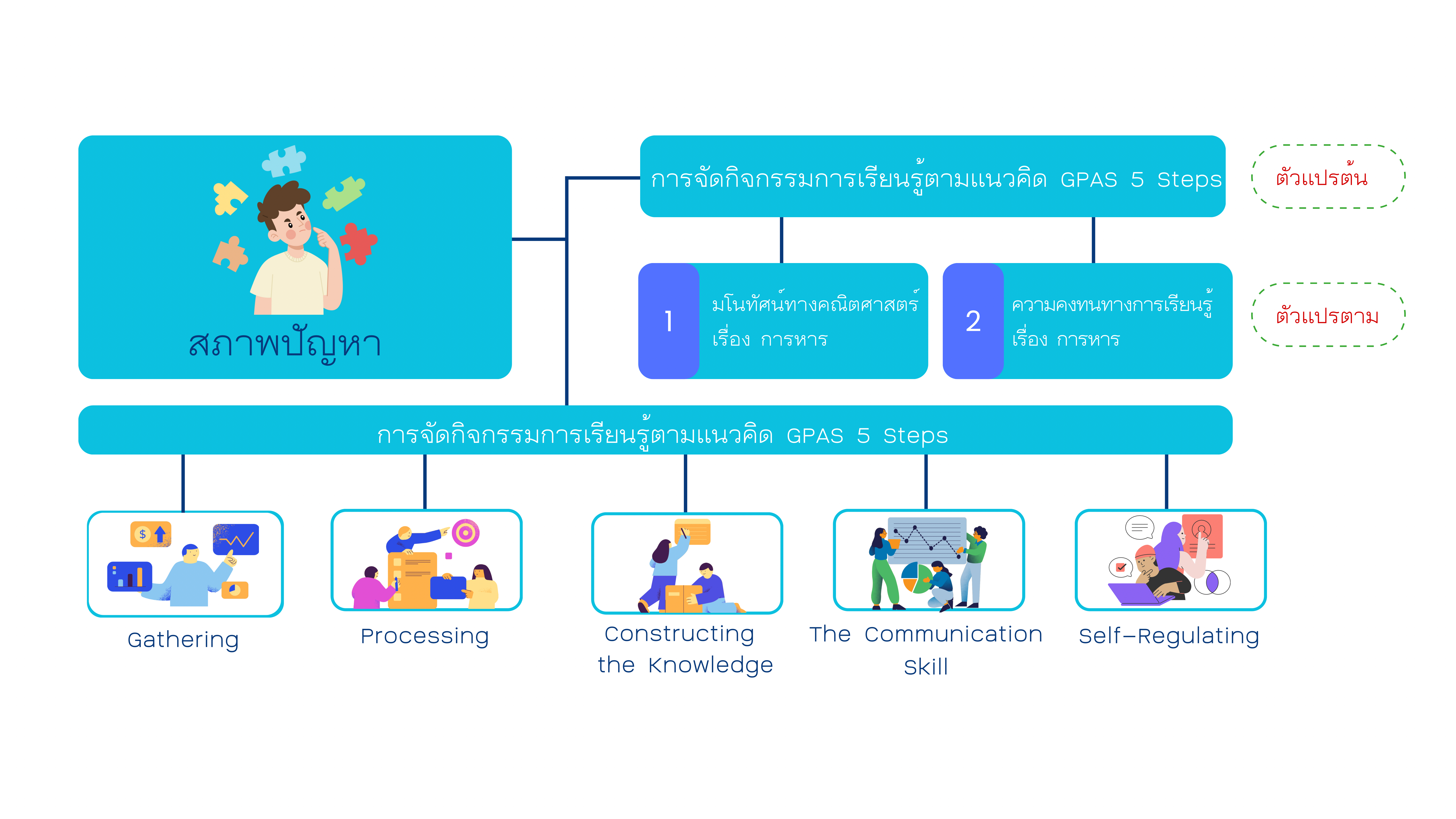
The objectives of this study were: (1) to compare the level of mathematical conceptual understanding of division among Grade-2 students before and after participating in learning activities based on the GPAS 5 Steps approach, (2) to compare the mathematical conceptual understanding of division among Grade-2 students after participating in the learning activities based on the GPAS 5 Steps approach with the criterion of 70%, and (3) to examine the retention of learning in division among Grade-2 students after participating in the learning activities based on the GPAS 5 Steps approach. The sample group consisted of one Grade-2 classroom, comprising eight students, at Chum chon Song Dao School, under the Sakon Nakhon Primary Educational Service Area Office 2, during the second semester of the 2024 academic year. The sample was selected using cluster sampling, with the school as the sampling unit. The research instruments included a lesson plan, which was rated at 4.76, indicating the highest level of appropriateness, and a mathematical conceptual understanding test with a reliability coefficient of 0.90. Data were analyzed using basic statistical methods and t-tests. The research findings revealed that: (1) the mathematical conceptual understanding of division among Grade-2 students after participating in the learning activities based on the GPAS 5 Steps approach was significantly higher than before at the .01 level, (2) the students' mathematical conceptual understanding of division after participating in the learning activities based on the GPAS 5 Steps approach exceeded the 70% criterion at a statistically significant level of .01, and (3) Grade-2 students who participated in learning activities based on the GPAS 5 Steps approach demonstrated retention of mathematical learning on the topic of division after a two-week interval.
Article Details

This work is licensed under a Creative Commons Attribution-NonCommercial-NoDerivatives 4.0 International License.
The Journal of Science and Science Education (JSSE) retain the right of all articles published in JSSE. The coresponding author or the authorized person on behalf of the authors must send the complete Copyright Transfer Form to JSSE before any article get published in JSSE.
Copyright Transfer Form
The JSSE request the coresponding author or the authorized person on behalf of the authors upload the manuscript under the together with the Copyright Transfer Form under the supplementary data. The guidline for uploading both manuscript and Copyright Transfer Form is shown below:
1. Upload the manuscript in the sub-menu, Article Component > Article Text.
2. Upload the the Copyright Transfer Form in the sub-menu, Article Component > Other.
Download Copyright Transfer Form
References
Chanmala, K, and Bhiasiri, S. (2025). The Development of Listening and Speaking English Ability for Communication Using Active Learning Based on GPAS 5 Steps Model with Augmented Reality of Grade 6 Students. (in Thai). Journal of Intellect Education, 4(1), 12-26.
Chuenmala, K., Chuntra, C. and Ugsonkid, S. (2023). The Study of Mathematics Learning Achievement and Ability in Solving Problems of Mathayomsuksa Five Students on Sequences and Series by Using Active Learning GPAS 5 STEPSs. (in Thai). Journal of Legal Entity Management and Local Innovation, 9(7), 531-543
Jaihow, N. and Chumsukon, M. (2024). The Development Of Critical Thinking Skills and Learning Achievement Using the GPAS 5 Steps with Strategy Card Game in Social Studies Course of Grade 12 Students at Sisaketwitthayalai 2 Huaykla (Promdirek -Anusorn) School (in Thai). Journal of Association of Professional Development of Educational Administration of Thailand, 6(1), 276-291.
Kaewsuk, C. (2007). The Effects of Biology Teaching Using the Experiential-Dynamic-Diverse Model with Computer-Based Simulation on Science Process Skills and Learning Persistence of High School Students. (in Thai). Master’s Thesis. Bangkok: Chulalongkorn University.
Ministry of Education. (2017). Indicators and Core Content Mathematics Department (Revised Version B.E. 2560, A.D.2017) The Basic Education Care Curriculum B.E. 2551 (A.D. 2008). (in Thai). The Agricultural Cooperative Federation of Thailand Limited
Naktamna, Y., Kuharueangrong, N. and Othakanon, L. (2020). Creative music club activity on the concept of gpas 5 steps to develop creative thinking skills for students in secondary school. (in Thai). Valaya Alongkorn Review Journal, 10(3), 14-18.
Kowtrakul, S. (2010). Educational Psychology. 9th printing. Bangkok: Chulalongkorn University.
Papun, L. and Kongnavang, S. (2022). The development of Practical Skills and Academic Achievement on Editing Graphics Using the 5-Steps GPAS Process with Multimedia of the Second year Vocational Certificate Students. (in Thai). Northeastern University Academic and Research Journal, 12(3) 89-101.
Po Ngern, W., Sithsungnoen, C., Nilapun, M. and Poomraruen, A. (2021). The effect of using the model to enhance the quality of teaching Based on learning according to GPAS 5 Steps to enhance students’ learning skills in Thailand 4.0 of the elementary education. (in Thai). Journal of Research and Curriculum Development, 11(1) 22-35.
The Institute for the Promotion of Teaching Science and Technology. (2012). Professional Math Teachers: Path to Success. Bangkok: 3-Q Media.
Wingworn, O., Sucher, S. and Jaradrawiwat, S. (2022). Effects of CIRC Model to Develop Reading Comprehension Ability, Summary Writing and Learning Retention of Prathomsuksa 3 Students. (in Thai) . Association of Private Higher Education Institutions of Thailand Humanities and Social Sciences Journal, 28(2), 1-13.
Wadeesirisak, P. and Makanong, A., (2024). Effects of Organizing Learning Activities Using Case-based Learning and Higher OrderQuestions on Media and Information Literacy of High School Students. (in Thai). An Online Journal of Education, 19(1), 1-12.
