
Promoting Electricity Usage Behaviors among Secondary School Dormitory Students to Reduce the School’s Carbon Footprint
Article Sidebar
Main Article Content
Abstract
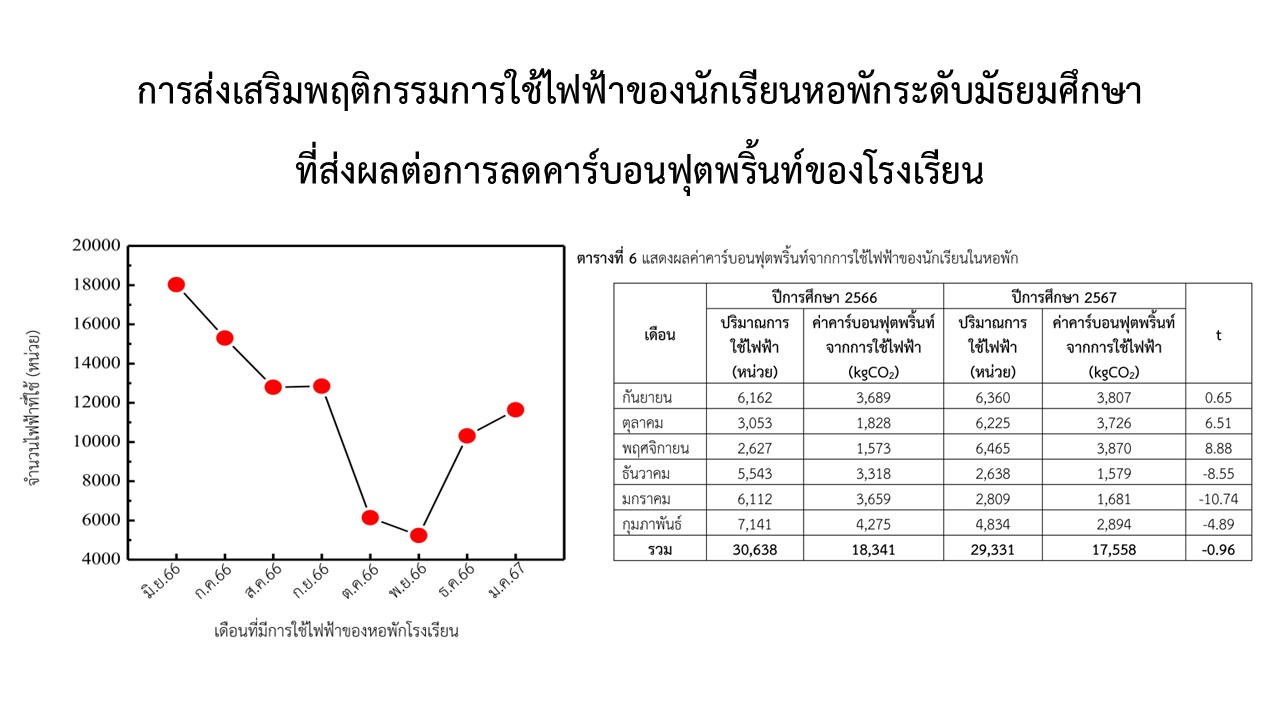
This research implemented a learning activity aimed at promoting efficient electricity usage behavior among secondary school dormitory students (Grades 7–12), with the goal of reducing electricity consumption that indirectly contributes to the school’s carbon footprint. The findings revealed that students demonstrated significant improvements in both understanding and attitudes toward electricity use and its impact on global warming and greenhouse gas emissions. The average understanding score increased from 11.86 to 23.82 (t = 39.89, p = .000). Students' attitudes after participating in the learning activity also improved, rising from an average score of 4.29 to 4.46. In particular, students expressed stronger agreement with the idea that addressing global warming should begin with individual actions, with the average score increasing from 3.98 to 4.60. Students also changed their electricity usage behaviors, reducing the average daily usage of electrical appliances from 4.18 to 3.87 hours per day (t = -4.82, p = .000). Key behavior changes included reducing phone charging and computer usage time, unplugging devices, and turning off lights during the day. Electricity usage data collected from the dormitory students showed a reduction of 1,307 units compared to the previous year, which translates to a decrease in carbon footprint by 783 kgCO2. After the learning activity, it was found that students' electricity usage behaviors were influenced by multiple factors, including personal habits, the environment, and social motivation. Therefore, promoting energy-saving behaviors should be approached holistically, focusing on three key aspects: providing knowledge, fostering motivation, and improving the residential environment. These strategies aim to instill long-term sustainable electricity usage behaviors in students.
Article Details

This work is licensed under a Creative Commons Attribution-NonCommercial-NoDerivatives 4.0 International License.
The Journal of Science and Science Education (JSSE) retain the right of all articles published in JSSE. The coresponding author or the authorized person on behalf of the authors must send the complete Copyright Transfer Form to JSSE before any article get published in JSSE.
Copyright Transfer Form
The JSSE request the coresponding author or the authorized person on behalf of the authors upload the manuscript under the together with the Copyright Transfer Form under the supplementary data. The guidline for uploading both manuscript and Copyright Transfer Form is shown below:
1. Upload the manuscript in the sub-menu, Article Component > Article Text.
2. Upload the the Copyright Transfer Form in the sub-menu, Article Component > Other.
Download Copyright Transfer Form
References
Ajzen, I. (2020). The theory of planned behavior: Frequently asked questions. Human Behavior and Emerging Technologies, 2(4), 314-324.
Bianchi, G., Pisiotis, U. and Cabrera, M. (2022). GreenComp – The European sustainability competence framework. Luxembourg: Publications Office of the European Union.
Frederiks, E. R., Stenner, K. and Hobman, E. V. (2015). Household energy use: Applying behavioural economics to understand consumer decision-making and behaviour. Renewable and Sustainable Energy Reviews, 41(1), 1385-1394.
Hayiwangoh, N. (2023). Carbon footprint assessment and greenhouse gas emission reduction guideline to promote green universities of Rajabhat University southern area group in Thailand (in Thai). Doctoral Dissertation. Yala: Yala Rajabhat University.
Intergovernmental Panel on Climate Change : IPCC. (1995). Climate change. Geneva: World Meterological Organization and United Nations Environment Programme.
Matrasongkram, N. and Khunthong, S. (2020). Assessment of carbon footprint and water footprint from electricity consumption of activities in educational buildings (in Thai). Proceedings of the 4th Academic Conference, Kasetsart University Sriracha Campus (pp. 52-60). Chonburi: Kasetsart University Sriracha Campus.
Sanguanrat, S. (2020). Factors affecting the participation behavior in energy conservation of students at Rattanakosin Sompoch Bangkhen School (in Thai). Master’s Thesis. Phayao: University of Phayao.
Sawangarom, L., Boonprom, P., Suttimas, S. and Phetphan, P. (2023). Carbon footprint assessment from waste disposal in Saladan Sub-district Municipality, Krabi Province (in Thai). Journal of Energy and Environmental Technology, 10(1), 57-65.
Suebsurmran, D. and Saowiang, T. (2019). The development for instructional learning packages on home electrical appliances for Mathayomsuksa 3 students, Banlinphapittayakom School, Sisaket Province (in Thai). Journal of Academic and Research, Northeastern University, 9(2), 1-10.
Thailand Greenhouse Gas Management Organization. (2021). Calculation of greenhouse gas emissions from electricity production and consumption (in Thai). Bangkok: Thailand Greenhouse Gas Management Organization (Public Organization).
Udompornphibul, C. and Thonghopit, S. (2015). A comparative study of energy literacy among secondary school students: A case study of 3 districts in Lopburi Province (in Thai). Journal of Energy Research, 12(2), 20-34.
World Resources Institute and WBCSD. (2013). Technical guidance for calculating Scope 3 emissions (version 1.0). Retrieved 20 June 2024, from Greenhouse Gas Protocol: https://ghgprotocol.orgsites/default/files/standards/Scope3_Calculation_Guidance_0.pdf
