Constructed a Low-Vacuum chamber with a food container: A wireless sensor Gas Law Experiment
Article Sidebar
Main Article Content
Abstract
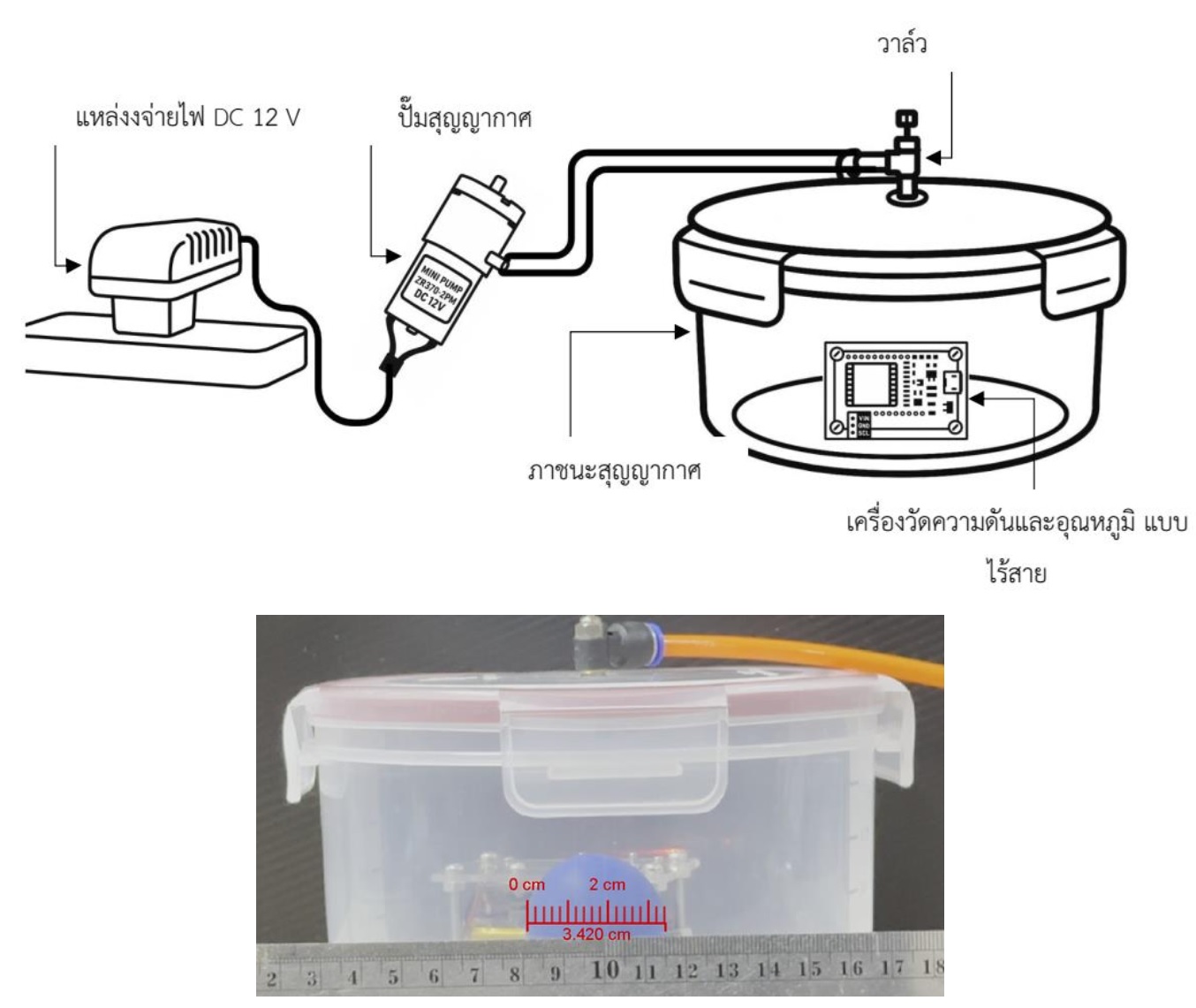
This research aimed to develop a user-friendly experimental set for studying gas laws and to investigate the relationship between volume and pressure inside a vacuum food container. The prototype consisted of a 1-litre polypropylene food vacuum container with a four-sided locking lid, modified to connect to a small air pump as vacuum pump. A wireless pressure sensor was integrated, capable of measuring pressures in the range of 300–1100 hPa. The developed apparatus demonstrated that the selected vacuum container maintained its shape without deformation under low-pressure conditions and was able to sustain reduced pressure throughout the experiments. Within a 30-second period, the small air pump successfully achieved a minimum pressure of approximately 474 hPa, which does not deform the shape of the food container. In the experiment, a balloon was placed inside the food container, and then the volume changes of the balloon were investigated. When the pressure decreased, the balloon expanded. The Tracker program was used to measure changes in the balloon’s diameter, from which its volume was calculated. The measured pressures from the wireless sensor showed an error margin of 6.06% compared to the calculated. The results indicated that the relationship between the balloon’s volume and the reciprocal of pressure (1/P) exhibited a linear trend with range 1003.15 – 474.90 hPa pressure, confirming an inverse relationship between volume and pressure, consistent with Boyle’s Law. This study demonstrates that an easy-to-construct experimental set can effectively study the gas laws, especially in contexts where access to specialized laboratory equipment is limited.
Article Details

This work is licensed under a Creative Commons Attribution-NonCommercial-NoDerivatives 4.0 International License.
The Journal of Science and Science Education (JSSE) retain the right of all articles published in JSSE. The coresponding author or the authorized person on behalf of the authors must send the complete Copyright Transfer Form to JSSE before any article get published in JSSE.
Copyright Transfer Form
The JSSE request the coresponding author or the authorized person on behalf of the authors upload the manuscript under the together with the Copyright Transfer Form under the supplementary data. The guidline for uploading both manuscript and Copyright Transfer Form is shown below:
1. Upload the manuscript in the sub-menu, Article Component > Article Text.
2. Upload the the Copyright Transfer Form in the sub-menu, Article Component > Other.
Download Copyright Transfer Form
References
Bartholomew, A. and Zürcher, U. (2023). Measuring the pressure inside a party balloon with a ruler. Physics Education, 58(3), 035006.
Boonrangsri, K. (2025). Development of learning achievement, learning progress, and advanced science process skills of grade 9 students through inquiry-based learning with virtual experimental media on the topic of waves and light (in Thai). Journal of Science and Science Education, 8(1), 123–139.
Erol, M. and Oğur, M. (2023). Teaching a large-angle pendulum via Arduino-based STEM education material. Physics Education, 58(4), 045001.
Holovko, M., Kryzhanovskyi, S. and Matsyuk, V. (2025). Studying the pressure in a rubber balloon in a vacuum bell jar using digital technologies. Physics Education, 60(3), 035008.
Jaewijarn, C. (2020). Adapting Arduino for low-cost laboratory for developing students’ conception on pressure and buoyant force (in Thai). Doctoral Dissertation. Ubon Ratchathani: Ubon Ratchathani University.
Kaewsri, T., Kaewurai, R. and Meesuwan, W. (2023). Using digital technology in scientific practices of student (in Thai). Research and Development Journal Suan Sunandha Rajabhat University, 15(2), 27-36.
Khamprawat, B., Thippharat, U., Phiromchitphong, T., Wuttisela, K. and Wutthiprom, S. (2025). Student-constructed low-cost experimental kit for enhancing inquiry-based learning in high school fluid dynamics (in Thai). Journal of Science and Science Education, 8(1), 24 – 31.
Kongthong, S., (2024). Design and construction of low-pressure chamber for gas laws experimental set (in Thai). Master’s Thesis. Bangkok: King Mongkut’s University of Technology Thonburi.
McClymer, J. (2010). Using vacuum food sealers as a low-cost vacuum pump. The Physics Teacher, 48(3), 202-203.
Murray, J. K. (2022). Exploring to explain the marshmallow phenomenon. The Physics Teacher, 60(6), 449–452.
Ogawara, Y. (2020). Teaching thermodynamics using a vacuum container for food. The Physics Teacher, 58(3), 186 – 190.
Ramos, L. M., Rodrigues, F. B., Reis, C. R. N., Bozano, D. F., Reis, D. D. and Goncalves, A. M. B. (2020). An experiment to observe Stevin’s law with an Arduino. Physics Education, 55(3), 033004.
Schnider, D. and Hömöstrei, M. (2024). Classroom experimentation: Arduino projects to teach electromagnetism. Journal of Physics: Conference Series, 2693, 012015.
