Effects of a STEAM-Integrated Paper Circuit Card Activity on Elementary Students’ Conceptual Understanding, Creativity, and Scientific Attitudes
Article Sidebar
Main Article Content
Abstract
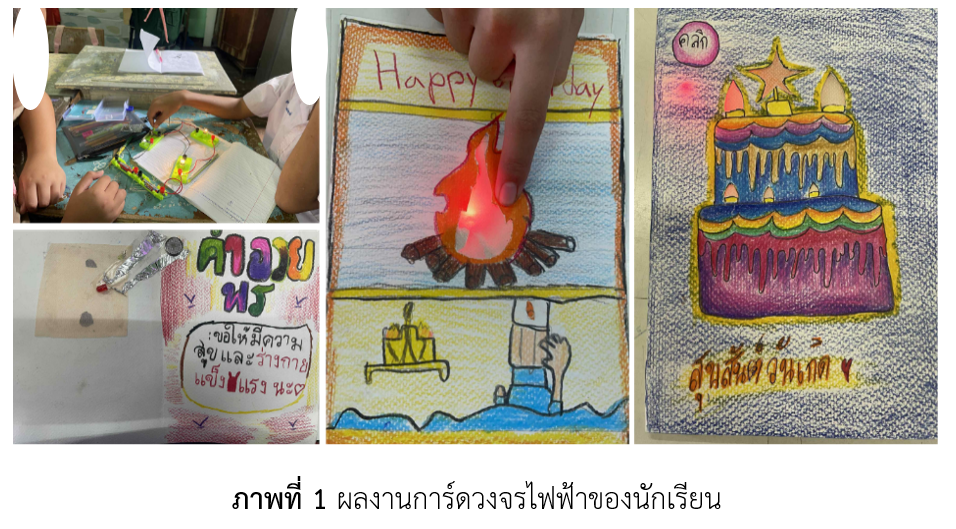
This study investigated the effects of a STEAM-integrated paper circuit card activity on elementary students’ conceptual understanding of electric circuits, creativity and scientific attitudes. Sixteen Grade 6 students from Ban Kaeng Yang School, Thailand, participated in a quasi-experimental one-group pretest–posttest design. Research instruments included the DIRECT 1.0 test, a modified Test of Science-Related Attitudes (TOSRA), and a creativity rubric. Results revealed significant improvement in students’ conceptual understanding (t(15) = 10.77, p < .001), with a normalized gain of 0.56, indicating a medium level of improvement. Their creative performance was at a high level (M = 4.52, SD = 0.39), especially in design aesthetics and functional accuracy. Scientific attitudes were also rated highly (M = 4.39, SD = 0.82), particularly in scientific curiosity and participation. These findings demonstrate that STEAM-based maker activities effectively enhance students’ understanding, motivation, and creativity by linking artistic design with scientific inquiry. The study highlights the value of integrating Maker-based Learning within STEAM contexts to promote holistic development in science education.
Article Details

This work is licensed under a Creative Commons Attribution-NonCommercial-NoDerivatives 4.0 International License.
The Journal of Science and Science Education (JSSE) retain the right of all articles published in JSSE. The coresponding author or the authorized person on behalf of the authors must send the complete Copyright Transfer Form to JSSE before any article get published in JSSE.
Copyright Transfer Form
The JSSE request the coresponding author or the authorized person on behalf of the authors upload the manuscript under the together with the Copyright Transfer Form under the supplementary data. The guidline for uploading both manuscript and Copyright Transfer Form is shown below:
1. Upload the manuscript in the sub-menu, Article Component > Article Text.
2. Upload the the Copyright Transfer Form in the sub-menu, Article Component > Other.
Download Copyright Transfer Form
References
Amabile, T. (2012). Componential theory of creativity. Boston, MA: Harvard Business School.
Chen, K.-C., Chu, S. L., Quek, F. and Schlegel, R. J. (2024). Integrating making with authentic science classes: An approach and evidence. Journal of Science Education and Technology, 33(4), 479-492.
Dinç, B. G., Özkan, B. and Alaca, I. V. (2021). Interactive storytelling through LEDs and paper circuits: Tapping into materials and technology in children’s literature education. Journal of Literary Education, (4), 266-288.
Engelhardt, P. V. and Beichner, R. J. (2004). Students’ understanding of direct current resistive electrical circuits. American Journal of Physics, 72(1), 98-115.
Fraser, B. J. (1981). TOSRA: test of science-related attitudes. Sydney: Australian Council for Educational Research.
Hake, R. R. (1998). Interactive-engagement versus traditional methods: A six-thousand-student survey of mechanics test data for introductory physics courses. American Journal of Physics, 66(1), 64-74.
Juntana, P. and Wuttiprom, S. (2015). Using a predict–observe–explain teaching method to enhance scientific concept about simple direct current circuits of grade 11 student (in Thai). Journal of Research Unit on Science, Technology and Environment for Learning, 6(1), 1-13.
Kamcharean, C. (2022). Analyzing high school students’ understandings of direct current circuits by using multiple choice questions (in Thai). Journal of Research Unit on Science, Technology and Environment for Learning, 13(1), 71–81.
Landis, J. R. and Koch, G. G. (1977). The measurement of observer agreement for categorical data. Biometrics, 33(1), 159-174.
Lu, C., Xu, S. and Liu, Q. (2021). Creative learning through maker education: A constructivist approach. International Journal of STEM Education, 8(1), 45-58.
Narjaikaew, P. and Jeeravipoonvarn, W. (2014). Using inquiry-based learning supplemented with predict-observe-explain and analogy teaching strategies enhancing electric DC circuit conceptions of elementary school teachers (in Thai). Journal of Research Unit on Science, Technology and Environment for Learning, 5(1), 1–10.
Ogunleye, A. O. (2018). Students’ attitudes towards science: A review of the literature and its implications. Eurasia Journal of Mathematics Science and Technology Education, 14(1), 1–15.
Papert, S. (1980). Mindstorms: Children, computers, and powerful ideas. New York, NY: Basic Books.
Peppler, K., Sedas, R. M. and Thompson, N. (2023). Paper circuits vs. breadboards: Materializing learners’ powerful ideas around circuitry and layout design. Journal of Science Education and Technology, 32(4), 469-492.
Piaget, J. (1977). The development of thought: Equilibration of cognitive structures. New York, NY: Viking Press.
Qi, J. and Buechley, L. (2014). Sketching in circuits: Designing and building electronics on paper. Proceedings of the SIGCHI Conference on Human Factors in Computing Systems (pp. 1713–1722). New York: Association for Computing Machinery.
Shepherd, C. E., Smith, S. M., Kvenild, C., Buss, A. and Ratcliffe, C. (2021). Adding reach and ownership with paper airplane circuits. International Journal of Designs for Learning, 12(2), 127-136.
Vygotsky, L. S. (1978). Mind in society: The development of higher psychological processes. Cambridge, MA: Harvard University Press.
Zulkarnain, A. N., Prima, E. C., Winarno, N. and Wahono, B. (2024). Paper circuit project-based STEAM learning to enhance student understanding and creativity. Journal of Science Learning, 7(1), 1-16.
