ผลของกิจกรรมการ์ดวงจรไฟฟ้าตามแนวคิดสะตีมศึกษาที่มีต่อความเข้าใจมโนมติทางวิทยาศาสตร์ ความคิดสร้างสรรค์ และเจตคติทางวิทยาศาสตร์ของนักเรียนประถมศึกษา
Article Sidebar
Main Article Content
บทคัดย่อ
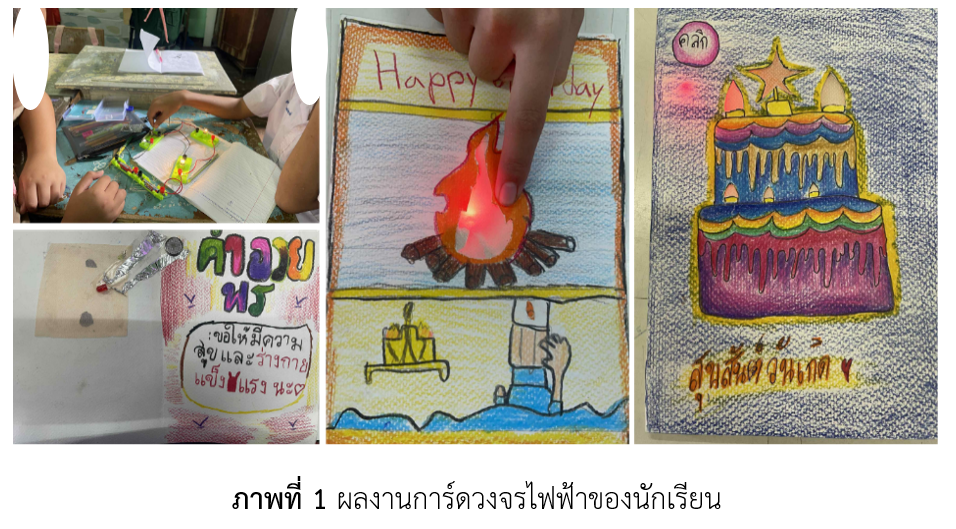
การวิจัยนี้มีวัตถุประสงค์เพื่อศึกษาผลของกิจกรรมการ์ดวงจรไฟฟ้าแบบบูรณาการ STEAM ที่มีต่อความเข้าใจมโนมติทางวิทยาศาสตร์เรื่องวงจรไฟฟ้า ความคิดสร้างสรรค์ และเจตคติทางวิทยาศาสตร์ของนักเรียนประถมศึกษา กลุ่มตัวอย่างคือ นักเรียนชั้นประถมศึกษาปีที่ 6 โรงเรียนบ้านแก่งยาง จังหวัดอุบลราชธานี จำนวน 16 คน ใช้รูปแบบการวิจัยกึ่งทดลองแบบกลุ่มเดียววัดผลก่อนและหลัง เครื่องมือวิจัยประกอบด้วยแบบทดสอบ DIRECT 1.0 แบบวัดเจตคติทางวิทยาศาสตร์ที่ดัดแปลงจาก TOSRA และรูบริกประเมินความคิดสร้างสรรค์ ผลการวิจัยพบว่า ความเข้าใจมโนมติทางวิทยาศาสตร์เพิ่มขึ้นอย่างมีนัยสำคัญทางสถิติ (t(15) = 10.77, p<.001) โดยมีค่าความก้าวหน้า (normalized gain) เท่ากับ 0.32 ซึ่งอยู่ในระดับปานกลาง ความคิดสร้างสรรค์ของนักเรียนอยู่ในระดับสูง (M = 4.52, SD = 0.39) โดยเฉพาะด้านความสวยงามของการออกแบบและความถูกต้องของวงจรไฟฟ้า ขณะที่เจตคติทางวิทยาศาสตร์อยู่ในระดับมาก (M = 4.39, SD = 0.82) โดยมีความโดดเด่นด้านความอยากรู้อยากเห็นและการมีส่วนร่วม ผลลัพธ์ชี้ให้เห็นว่ากิจกรรมการ์ดวงจรไฟฟ้าแบบบูรณาการ STEAM สามารถเสริมสร้างความเข้าใจ ความสนใจ และความคิดสร้างสรรค์ของนักเรียนได้อย่างมีประสิทธิภาพบนพื้นฐานแนวคิด Maker-based Learning และการเรียนรู้เชิงสร้างสรรค์
Article Details

อนุญาตภายใต้เงื่อนไข Creative Commons Attribution-NonCommercial-NoDerivatives 4.0 International License.
วารสารวิทยาศาสตร์และวิทยาศาสตร์ศึกษา (JSSE) เป็นผู้ถือลิสิทธิ์บทความทุกบทความที่เผยแพร่ใน JSSE นี้ ทั้งนี้ ผู้เขียนจะต้องส่งแบบโอนลิขสิทธิ์บทความฉบับที่มีรายมือชื่อของผู้เขียนหลักหรือผู้ที่ได้รับมอบอำนาจแทนผู้เขียนทุกนให้กับ JSSE ก่อนที่บทความจะมีการเผยแพร่ผ่านเว็บไซต์ของวารสาร
แบบโอนลิขสิทธิ์บทความ (Copyright Transfer Form)
ทางวารสาร JSSE ได้กำหนดให้มีการกรอกแบบโอนลิขสิทธิ์บทความให้ครบถ้วนและส่งมายังกองบรรณาธิการในข้อมูลเสริม (supplementary data) พร้อมกับนิพนธ์ต้นฉบับ (manuscript) ที่ส่งมาขอรับการตีพิมพ์ ทั้งนี้ ผู้เขียนหลัก (corresponding authors) หรือผู้รับมอบอำนาจ (ในฐานะตัวแทนของผู้เขียนทุกคน) สามารถดำเนินการโอนลิขสิทธิ์บทความแทนผู้เขียนทั้งหมดได้ ซึ่งสามารถอัพโหลดไฟล์บทความต้นฉบับ (Manuscript) และไฟล์แบบโอนลิขสิทธิ์บทความ (Copyright Transfer Form) ในเมนู “Upload Submission” ดังนี้
1. อัพโหลดไฟล์บทความต้นฉบับ (Manuscript) ในเมนูย่อย Article Component > Article Text
2. อัพโหลดไฟล์แบบโอนลิขสิทธิ์บทความ (Copyright Transfer Form) ในเมนูย่อย Article Component > Other
ดาวน์โหลด ไฟล์แบบโอนลิขสิทธิ์บทความ (Copyright Transfer Form)
เอกสารอ้างอิง
Amabile, T. (2012). Componential theory of creativity. Boston, MA: Harvard Business School.
Chen, K.-C., Chu, S. L., Quek, F. and Schlegel, R. J. (2024). Integrating making with authentic science classes: An approach and evidence. Journal of Science Education and Technology, 33(4), 479-492.
Dinç, B. G., Özkan, B. and Alaca, I. V. (2021). Interactive storytelling through LEDs and paper circuits: Tapping into materials and technology in children’s literature education. Journal of Literary Education, (4), 266-288.
Engelhardt, P. V. and Beichner, R. J. (2004). Students’ understanding of direct current resistive electrical circuits. American Journal of Physics, 72(1), 98-115.
Fraser, B. J. (1981). TOSRA: test of science-related attitudes. Sydney: Australian Council for Educational Research.
Hake, R. R. (1998). Interactive-engagement versus traditional methods: A six-thousand-student survey of mechanics test data for introductory physics courses. American Journal of Physics, 66(1), 64-74.
Juntana, P. and Wuttiprom, S. (2015). Using a predict–observe–explain teaching method to enhance scientific concept about simple direct current circuits of grade 11 student (in Thai). Journal of Research Unit on Science, Technology and Environment for Learning, 6(1), 1-13.
Kamcharean, C. (2022). Analyzing high school students’ understandings of direct current circuits by using multiple choice questions (in Thai). Journal of Research Unit on Science, Technology and Environment for Learning, 13(1), 71–81.
Landis, J. R. and Koch, G. G. (1977). The measurement of observer agreement for categorical data. Biometrics, 33(1), 159-174.
Lu, C., Xu, S. and Liu, Q. (2021). Creative learning through maker education: A constructivist approach. International Journal of STEM Education, 8(1), 45-58.
Narjaikaew, P. and Jeeravipoonvarn, W. (2014). Using inquiry-based learning supplemented with predict-observe-explain and analogy teaching strategies enhancing electric DC circuit conceptions of elementary school teachers (in Thai). Journal of Research Unit on Science, Technology and Environment for Learning, 5(1), 1–10.
Ogunleye, A. O. (2018). Students’ attitudes towards science: A review of the literature and its implications. Eurasia Journal of Mathematics Science and Technology Education, 14(1), 1–15.
Papert, S. (1980). Mindstorms: Children, computers, and powerful ideas. New York, NY: Basic Books.
Peppler, K., Sedas, R. M. and Thompson, N. (2023). Paper circuits vs. breadboards: Materializing learners’ powerful ideas around circuitry and layout design. Journal of Science Education and Technology, 32(4), 469-492.
Piaget, J. (1977). The development of thought: Equilibration of cognitive structures. New York, NY: Viking Press.
Qi, J. and Buechley, L. (2014). Sketching in circuits: Designing and building electronics on paper. Proceedings of the SIGCHI Conference on Human Factors in Computing Systems (pp. 1713–1722). New York: Association for Computing Machinery.
Shepherd, C. E., Smith, S. M., Kvenild, C., Buss, A. and Ratcliffe, C. (2021). Adding reach and ownership with paper airplane circuits. International Journal of Designs for Learning, 12(2), 127-136.
Vygotsky, L. S. (1978). Mind in society: The development of higher psychological processes. Cambridge, MA: Harvard University Press.
Zulkarnain, A. N., Prima, E. C., Winarno, N. and Wahono, B. (2024). Paper circuit project-based STEAM learning to enhance student understanding and creativity. Journal of Science Learning, 7(1), 1-16.
