
Constructive crimes arising out of the protection of creative works (copyright)
Article Sidebar
Main Article Content
Abstract
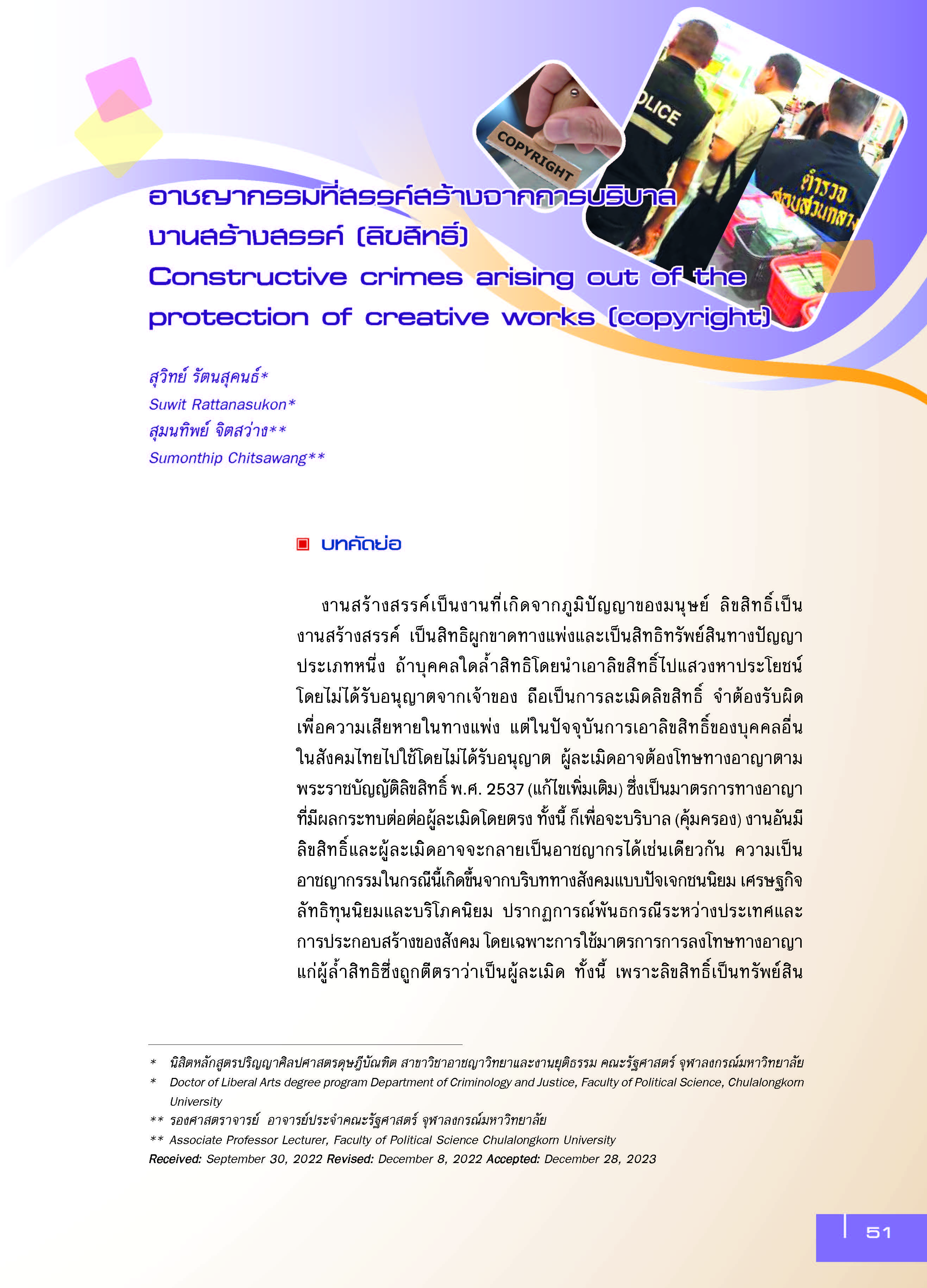
Creative works are generated from the intellectuality of human beings. Apart from its status of a civil right with an exclusive right, copyright has also been a category of Intellectual Property Rights. A trespasser, with an unpermitted copyright utilisationfrom the copyright owner, shall be labelled as a copyright infringer and must be liable for any civil damages sustained. Meanwhile,in the Thai Society, the unpermitted usage of copyright may also give rise to being criminally offended according to Copyright Act B.E. 2537, which has been enacted to protect copyrighted works, and can become a criminal simultaneously. In such a case, criminality would arise pertaining to social value of Individualism, economic theory of capitalism and consumerism,international obligation phenomena, along with a social construction through the criminal penalties enforced to the labelled trespasser-the infringer since copyrightis made existing from the intellectuality of human creatures. For this reason,copyright is of a unique identity and some special characteristics possessions unlike those of naturally created or naturally derived resources. With its invaluableness, cherishing and shareability-free, a direct copyright infringement also means an infringement directly detrimental to the private right of the copyright owner, The infringer is, therefore, exposed to a severe and practically enforceable punishment.In such a case, according to the Thai Society, criminal penalties rank the most effective methods for problem solutions. To achieve a better understanding of phenomena contexts and the how-to of criminality construction, the methodology of discourse studies and discourse analysis would be suitably administered. Besides, human’s direct construction, copyrightholds an especially unique identity differentfrom other naturally created or naturally derived resources as the result of the world society’s contexts as well as the value of consumption of sign. Parallelly, apart from the aforesaid elements, the advancement of the printing technology in Thailand plays a major role therein. This makes it available to make unlimited copies of the literary works and helps support the copyright identity. However, in terms of the strengthening copyright identity made by human beings, the legal severity arising from intense criminal penalties enforcements, labelling resuming, state officials and private sector officers’ operations, seizures, forfeitures and destructions of the infringed products, along with excuses of creativity encouragements as well as the economic growth are herewith justified. As the results of social phenomenaand social contexts together with human’s construction in the Thai Society, copyright, with its fully nourished status, gracious existence, and specialised identity, awaits respectful paying from all those in the Thai Communities. Any deeds in forms of controversy or infringement shall be certainly refrained, otherwise deadly punishmentswould be strictly applied. In other words, criminal measures would be enforced with infringements, regardless of malicious act or mens rea, criminal measures would be certainly carried out to the cases in forms of collectiveness and non-differentiationon nature, severities of acts and extents of losses, infringements with different severities and extent of losses may be on the same ranges of penalties, infringers are exposed to more critical penalties,regardless of factual factors of acts, or even criminal measure applications are not in line with the international standards, as well as the crime prevention models are more concentrated in actions than due processesmodels. These sophisticated practices can totally give rise to overwhelming creations of criminalities into the Thai Society at the end. To mitigate such criminalities, varieties of practical measures such as enhancement of creative economy, copyright accessibility of marginalised groups, reduction of ordinary persons’ income tax and grants of soft loan provided to the creators, exporting of creative cultures, along with the buildings of appropriate understanding on righteous and fair uses of copyright should be employed.
Article Details

This work is licensed under a Creative Commons Attribution-NonCommercial-NoDerivatives 4.0 International License.
Published Manuscripts are the copyright of the Journal of the Justice System. However; the opinions that appeared in the content are the sole responsibility of the author.
References
กรมทรัพย์สินทางปัญญา. (2562). คู่มือการปฏิบัติงานป้องปรามการละเมิดทรัพย์สินทางปัญญาด้านลิขสิทธิ์ และเครื่องหมายการค้า บทที่ 4 แนวทางการปฏิบัติงานป้องกันและปราบปรามการละเมิดทรัพย์สินทางปัญญา. ค้นเมื่อ 16 สิงหาคม 2565, จาก http://www.ipthailand.go.th/images/2562/Suppress/lesson4.pdf
จารุณี ศิริพันธุ์. (2558). วาทกรรมเกี่ยวกับสารเสพติด : ปฏิบัติการทางสังคมวัฒนธรรม. วิทยานิพนธ์ปริญญามหาบัณฑิต. มหาวิทยาลัยศิลปากร.
จุมพล ภิญโญสินวัฒน์ และภูมินทร์ บุตรอินทร์. (2561). ประวัติศาสตร์และแนวคิดเกี่ยวกับทรัพย์สินทางปัญญา (พิมพ์ครั้งที่ 2). กรุงเทพฯ: โรงพิมพ์เดือนตุลาคม.
ไชยยศ เหมะรัชตะ. (2545). คำอธิบายกฎหมายลิขสิทธิ์ (พิมพ์ครั้งที่ 3). กรุงเทพฯ: BJ เพลท โปรเซสเซอร์.
ไชยรัตน์ เจริญสินโอฬาร. (2557). รัฐศาสตร์แนววิพากษ์ (พิมพ์ครั้งที่ 4). กรุงเทพฯ: สามลดา.
ผู้จัดการออนไลน์. (2563). คดีละเมิดลิขสิทธิ์ซอฟต์แวร์ไทยปี 62 เพิ่มจำนวนแต่มูลค่าลดฮวบ BSA เริ่มศึกษา“ของเถื่อนบนคลาวด์”. ค้นเมื่อ 18 สิงหาคม 2565, จาก https://mgronline.com/cyberbiz/detail/9630000011789
ไพเราะ เบญจกุล. (2552). หยุด ! การขโมยคัดลอกผลงานผู้อื่น. วารสารวิทยาลัยพยาบาลบรมราชชนนีสรรพสิทธิประสงค์, 7(2), 1-8.
ภูมินทร์ บุตรอินทร์. (2563). เอกสารคำสอนวิชาทรัพย์สินทางปัญญา. กรุงเทพฯ: มหาวิทยาลัยธรรมศาสตร์.
ภูมินทร์ บุตรอินทร์. (ม.ป.ป.). โทษทางอาญากับการล่วงสิทธิในกฎหมายทรัพย์สินทางปัญญา. วารสารนิติศาสตร์, 37(4), 735-765.
สามชาย ศรีสันต์. (2561). On Critical Discourse Analysis – ว่าด้วยการวิเคราะห์วาทกรรมแนววิพากษ์. กรุงเทพฯ: โรงพิมพ์ภาพพิมพ์.
อดิเทพ พันธ์ทอง. (2565). ความเป็นมาของกฎหมาย “ลิขสิทธิ์” และ “หลักสากล” ในกฎหมายลิขสิทธิ์ไทย. ค้นเมื่อ 18 สิงหาคม 2565, จาก https://www.silpa-mag.com/history/article_786
อัครพนธ์ เอี้ยวรัตนวดี. (2562). วาทกรรม “กัญชา” ในสังคมไทย : กัญชายาเสพติด กัญชาการแพทย์. วิทยานิพนธ์ปริญญาดุษฎีบัณฑิต. จุฬาลงกรณ์มหาวิทยาลัย.
Akurugoda, C., L. (2013). Biopiracy and its impact on biodiversity: A critical analysis with special reference to Sri Lanka. International Journal of Business, Economics and Law, 2(3), 48-52. Retrieved Aprill 21, 2022 from https://www.semanticscholar.org/paper/BIO-PIRACY-AND-ITS-IMPACT-ON-BIO-DIVERSITY%3A-A-WITH- Akurugoda/cba27a3e53dc64dbfa7674ec189516f017715608
Introsociobuu. (2558). Introduction to Sociology แนวคิดสังคมวิทยาและมานุษยวิทยา. ค้นเมื่อ 15 สิงหาคม 2565, จาก https://issuu.com/introsociobuu/docs/intro_sociology_week6_--_14.9.58
Manta, I. D. (2019). Explaining criminal sanctions in intellectual property law. Retrieved August 14, 2022, from https://www.law.nyu.edu/sites/default/files/upload_documents/Irina%20Manta.pdf
May, C., & Sell, S. K. (2006). Intellectual property rights a critical history the first edition. The United States of America: Lynne Rienner Publishers.
Roy, K. (2017). Competition Law & Intellectual Property Rights : A Dialogue of Convergence. Retrieved Aprill 21, 2022, from http://www.mucweburdwan.org
