
Guidelines for Participants in the Employment Generation and Occupational Training Program in the Industrial Sector (Special Parole Program): A Case Study of Samut Prakan Central Prison
Article Sidebar
Main Article Content
Abstract
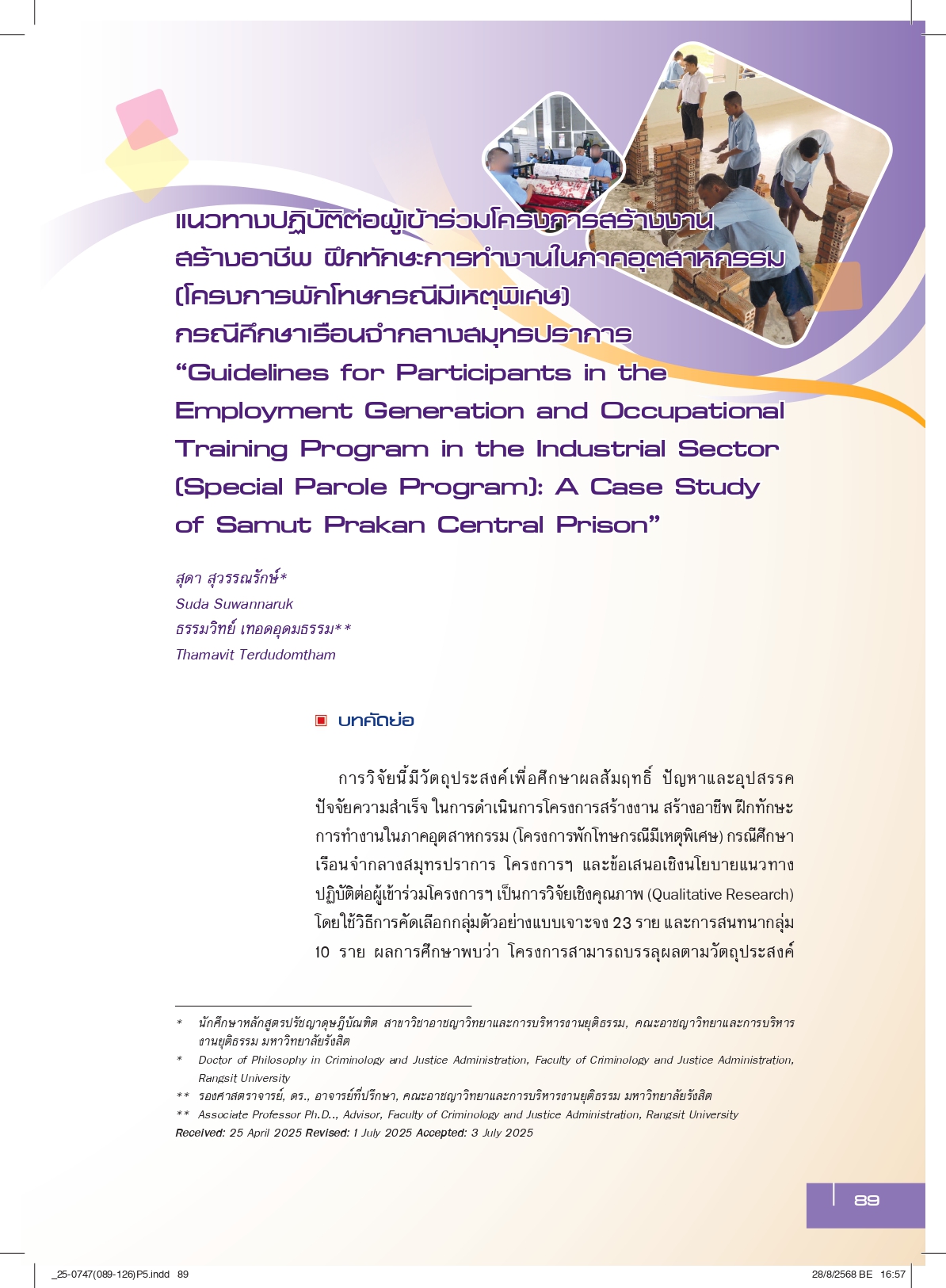
This research aims to study the effectiveness, challenges, obstacles, and success factors in the implementation of the Employment Generation and Occupational Training Program in the industrial sector (Special Parole Program), using Samut Prakan Central Prison as a case study, and to propose policy recommendations and practical guidelines for program participants. This qualitative study employed purposive sampling of 23 participants and focus group discussions involving 10 participants. The findings reveal that the program successfully achieved its objectives in terms of outputs, outcomes, and cost-effectiveness. The “Samut Prakan Model” integrates parole policies with vocational training in real workplaces, using electronic monitoring (EM) bracelets to supervise participants. The program reduces the burden on prisons, enhances vocational skills, and prepares inmates for reintegration into society. The government benefits from reduced incarceration costs and improved organizational image to public, while the private sector gains access to skilled labor and lower training costs. Inmates are able to earn income, provide financial support to their families, and gain greater social acceptance. This program serves as a successful prototype for creating sustainable reform in the Thai correctional system.
Article Details

This work is licensed under a Creative Commons Attribution-NonCommercial-NoDerivatives 4.0 International License.
Published Manuscripts are the copyright of the Journal of the Justice System. However; the opinions that appeared in the content are the sole responsibility of the author.
References
Beccaria, C. (1963). On crimes and punishments (Introduction by H. Paolucci, Trans.). Macmillan.
Becker, H. S. (1963). Outsiders: Studies in the sociology of deviance. Free Press.
Bentham, J. (1948). An introduction to the principles of morals and legislation. Hafner Publishing Company.
Budget Bureau. (2021). Budget expenditure analysis report for fiscal year 2021. Bangkok: Office of the Prime Minister.
Bertalanffy, L. von. (1968). General system theory: Foundations, development, applications. George Braziller.
Department of Corrections, Bureau of Behavioral Development. (2022). Annual report 2022. Author.
Department of Corrections. (2023). Five-year operational plan (2023–2027). Author.
Department of Corrections. (2025, April 22 ). Recidivism statistics of inmates. http://www.correct.go.th/recstats/index.php#
Kitcharoen, W. (2015). Parole condition with electronic monitoring [Unpublished Master’s Thesis]. Dhurakij Pundit University.
Martinson, R. (1974). What works? Questions and answers about prison reform. The Public Interest, 35(1), 22-54.
Meepien, P., & Bubphamala, B. (2022). Factors causing recidivism in Narcotics cases of the Inmates Udon Thani Central Prison.
Journal of Roi Kaensarn Academi, 7(3), 17-32.
Prachachat Turakij Online. (2021, July). Thai chamber of commerce reveals labor shortage of 500,000
due to migrant workers returning home during COVID-19. https://www.prachachat.net/economy /news-708917
Silarat, N., & Boonsathorn, W. (2019). Factors and benefit for organizations in hiring former convicts to work in organizations.
Human Resource and Organization Development Journal,11(2), 90-115.
Srinakharinwirot University, Behavioral Science Research Institute. (2008). Result-Based Management – RBM.
http://bsris.swu.ac.th/health/doc/knowledge/result_based_management.pdf
Tannenbaum, F. (1938). Crime and the community. Ginn.
Valentine, E. J., & Redcross, C. (2015). Transitional jobs after release from prison: Effects on employment and recidivism.
