
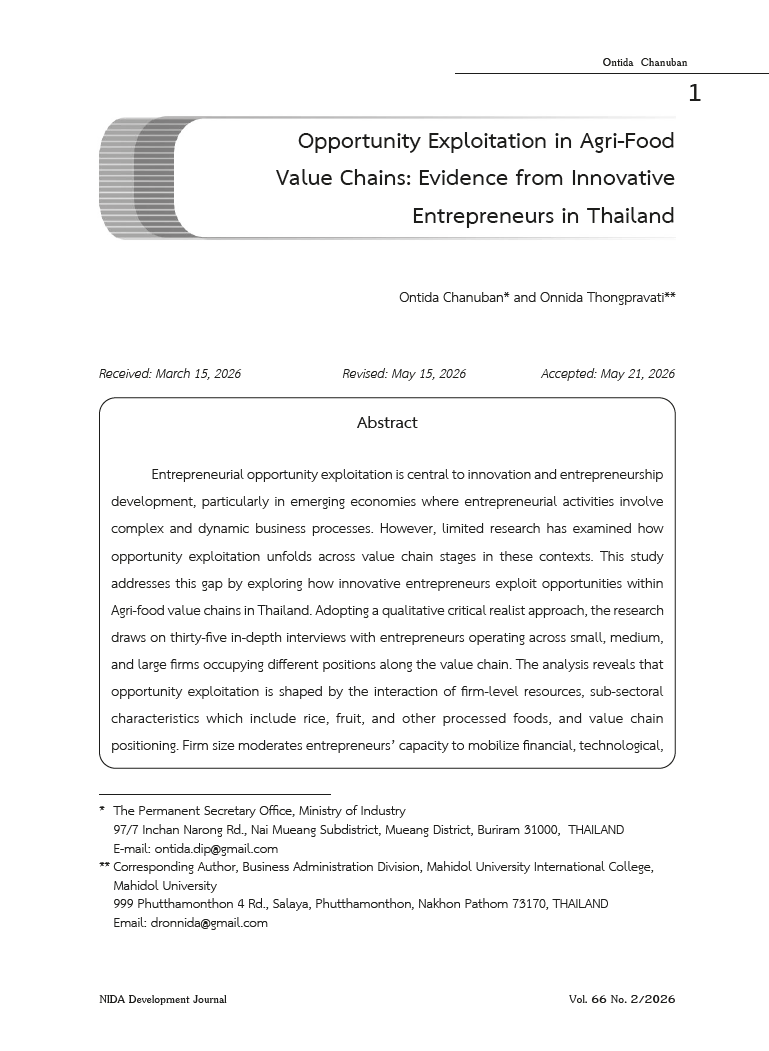
Opportunity Exploitation in Agri-Food Value Chains: Evidence from Innovative Entrepreneurs in Thailand
DOI:
https://doi.org/10.14456/ndj.2026.7Keywords:
Opportunity Exploitation, Value Chain, Innovation, Agri-Food Sector, ThailandAbstract
Entrepreneurial opportunity exploitation is central to innovation and entrepreneurship development, particularly in emerging economies where entrepreneurial activities involve complex and dynamic business processes. However, limited research has examined how opportunity exploitation unfolds across value chain stages in these contexts. This study
addresses this gap by exploring how innovative entrepreneurs exploit opportunities within Agri-food value chains in Thailand. Adopting a qualitative critical realist approach, the research draws on thirty-five in-depth interviews with entrepreneurs operating across small, medium, and large firms occupying different positions along the value chain. The analysis reveals that opportunity exploitation is shaped by the interaction of firm-level resources, sub-sectoral characteristics which include rice, fruit, and other processed foods, and value chain positioning. Firm size moderates entrepreneurs’ capacity to mobilize financial, technological, and relational resources, while sub-sector contexts influence the nature and timing of opportunity exploitation. Across the value chain, upstream actors primarily emphasize efficiency improvements and innovations developed to reduce production costs and improve research utilization; midstream entrepreneurs focus on processing capabilities and value-adding activities; and downstream firms leverage branding, market access, and export-oriented strategies. In addition, small firms tend to rely on informal networks and localized knowledge, whereas larger firms are more able to draw on formal partnerships and advanced technologies. Derived from key findings, the study proposes a conceptual framework presenting how entrepreneurs process opportunity exploitation through contextual moderators such as firm size, value chain context, and actor role, leading to different exploitation modes. The paper contributes to entrepreneurship and value chain literature by advancing opportunity-based entrepreneurship theory and linking opportunity exploitation to stage-specific entrepreneurial roles across value chain positions. Policy and practical implications further highlight the importance of differentiated support mechanisms and strong linkages among policymakers, support organizations, and entrepreneurs in strengthening Thailand’s agri-food ecosystem.
References
Aldrich, H. E., & Auster, E. R. (1986). Even dwarfs started small: Liabilities of age and size and their strategic implications. Research in Organizational Behavior, 8, 165-198.
Alvarez, S. A., & Barney, J. B. (2007). Discovery and creation: Alternative theories of entrepreneurial action. Strategic Entrepreneurship Journal, 1(1-2), 11-26. https://doi.org/10.1002/sej.4
Alvarez, S. A., Barney, J. B., & Anderson, P. (2013). Forming and exploiting opportunities: The implications of discovery and creation processes for entrepreneurial and organizational research. Organization Science, 24(1), 301-317. https://doi.org/10.1287/orsc.1110.0727
Asad, M., Shabbir, M. S., Salman, R., Hussain Haider, S., & Ahmad, I. (2018). Do entrepreneurial orientation and size of enterprise influence the performance of micro and small enterprises? A study on mediating role of innovation. Management Science Letters, 8(10), 1015-1026.
Baron, R. A. (2006). Opportunity recognition as pattern recognition: How entrepreneurs “connect the dots” to identify new business opportunities. Academy of Management Perspectives, 20(1), 104-119. https://doi.org/10.5465/amp.2006.19873412
Barrett, C. B., Reardon, T., Swinnen, J., & Zilberman, D. (2022). Agri-food value chain revolutions in low- and middle-income countries. Journal of Economic Literature, 60(4), 1316-1377. https://doi.org/10.1257/jel.20201539
Bhaskar, R. (2008). A Realist Theory of Science (1st ed.). Routledge. https://doi.org/10.4324/9780203090732
Bruton, G. D., Ahlstrom, D., & Obloj, K. (2008). Entrepreneurship in emerging economies: Where are we today and where should the research go in the future? Entrepreneurship Theory and Practice, 32(1), 1-14. https://doi.org/10.1111/j.1540-6520.2007.00213.x
Casson, M., & Giusta, M. D. (2007). Entrepreneurship and social capital: Analysing the impact of social networks on entrepreneurial activity from a rational action perspective. International Small Business Journal, 25(3), 220-244. https://doi.org/10.1177/026624260707652
Cenamor, J., Parida, V., & Wincent, J. (2019). How entrepreneurial SMEs compete through digital platforms: The roles of digital platform capability, network capability and ambidexterity. Journal of Business Research, 100, 196-206. https://doi.org/10.1016/j.jbusres.2019.03.035
Chen, Y. (2025). Examining the dynamics of entrepreneurial knowledge and firm performance: A longitudinal study of start-ups in emerging markets. Journal of the Knowledge Economy, 16(1), 2549-2581. https://doi.org/10.1007/s13132-024-02112-7
Choi, Y. R., & Shepherd, D. A. (2004). Entrepreneurs’ decisions to exploit opportunities. Journal of Management, 30(3), 377-395. https://doi.org/10.1016/j.jm.2003.04.002
Cliff, J. E., Jennings, P. D., & Greenwood, R. (2006). New to the game and questioning the rules: The experiences and beliefs of founders who start imitative versus innovative firms. Journal of Business Venturing, 21(5), 633-663. https://doi.org/10.1016/j.jbusvent.2005.02.010
Dallas, M. P., Ponte, S., & Sturgeon, T. J. (2019). Power in global value chains. Review of International Political Economy, 26(4), 666-694. https://doi.org/10.1080/09692290.2019.1608284
Davidsson, P. (2015). Entrepreneurial opportunities and the entrepreneurship nexus: A reconceptualization. Journal of Business Venturing, 30(5), 674-695. https://doi.org/10.1016/j.jbusvent.2015.01.002
Davidsson, P., Recker, J., & Von Briel, F. (2020). External enablement of new venture creation: A framework. Academy of Management Perspectives, 34(3), 311-332. https://doi.org/10.5465/amp.2017.0163
de Jong, J. P. (2013). The decision to exploit opportunities for innovation: A study of high-tech small-business owners. Entrepreneurship Theory and Practice, 37(2), 281-301. https://doi.org/10.1111/j.1540-6520.2011.00459.x
De Massis, A., Eddleston, K. A., & Rovelli, P. (2021). Entrepreneurial by design: How organizational design affects family and non-family firms’ opportunity exploitation. Journal of Management Studies, 58(1), 27-62. https://doi.org/10.1111/joms.12568
Dentoni, D., Cucchi, C., Roglic, M., Lubberink, R., Bender-Salazar, R., & Manyise, T. (2023). Systems thinking, mapping and change in food and agriculture. Bio-Based and Applied Economics, 11(4), 277. https://doi.org/10.36253/bae-13930
Dimov, D. (2010). Nascent entrepreneurs and venture emergence: Opportunity confidence, human capital, and early planning. Journal of Management Studies, 47(6), 1123-1153. https://doi.org/10.1111/j.1467-6486.2009.00874.x
Dimov, D. (2011). Grappling with the unbearable elusiveness of entrepreneurial opportunities. Entrepreneurship Theory and Practice, 35(1), 57-81. https://doi.org/10.1111/j.1540-6520.2010.00423.x
Donbesuur, F., Hultman, M., Oghazi, P., & Boso, N. (2022). External knowledge resources and new venture success in developing economies: Leveraging innovative opportunities and legitimacy strategies. Technological Forecasting and Social Change, 185, 122034. https://doi.org/10.1016/j.techfore.2022.122034
Eisenhardt, K. M. (1989). Building theories from case study research. Academy of Management Review, 14(4), 532-550. https://doi.org/10.2307/258557
Federation of Thai Industries. (2018). OEM manufacturer expo.
Fischer, E., & Reuber, A. R. (2003). Support for rapid-growth firms: A comparison of the views of founders, government policymakers, and private sector resource providers. Journal of Small Business Management, 41(4), 346-365. https://doi.org/10.1111/1540-627X.00087
Foss, N. J., Lyngsie, J., & Zahra, S. A. (2013). The role of external knowledge sources and organizational design in the process of opportunity exploitation. Strategic Management Journal, 34(12), 1453-1471. https://doi.org/10.1002/smj.2135
Gereffi, G., Humphrey, J., & Sturgeon, T. J. (2005). The governance of global value chains. Review of International Political Economy, 12(1), 78-104. https://doi.org/10.1080/09692290500049805
Gerke, A., Benson-Rea, M., & Odlin, D. (2023). SME upgrading in emerging market clusters: The case of Taiwan’s bicycle industry. Journal of Business Research, 164, 113967. https://doi.org/10.1016/j.jbusres.2023.113967
Helfat, C. E., & Peteraf, M. A. (2015). Managerial cognitive capabilities and the microfoundations of dynamic capabilities. Strategic Management Journal, 36(6), 831-850. https://doi.org/10.1002/smj.2247
Helfat, C. E., & Raubitschek, R. S. (2018). Dynamic and integrative capabilities for profiting from innovation in digital platform-based ecosystems. Research Policy, 47(8), 1391-1399. https://doi.org/10.1016/j.respol.2018.01.019
Hulbert, B., Gilmore, A., & Carson, D. (2013). Sources of opportunities used by growth minded owner managers of small and medium sized enterprises. International Business Review, 22(1), 293-303. https://doi.org/10.1016/j.ibusrev.2012.04.004
Humphrey, J., & Schmitz, H. (2002). How does insertion in global value chains affect upgrading in industrial clusters? Regional Studies, 36(9), 1017-1027. https://doi.org/10.1080/0034340022000022198
Jack, S. L., & Anderson, A. R. (2002). The effects of embeddedness on the entrepreneurial process. Journal of Business Venturing, 17(5), 467-487. https://doi.org/10.1016/S0883-9026(01)0076-3
Kaplinsky, R., & Morris, M. (2000). A handbook for value chain research. Institute of Development Studies, University of Sussex.
Kuckertz, A., Kollmann, T., Krell, P., & Stöckmann, C. (2017). Understanding, differentiating, and measuring opportunity recognition and opportunity exploitation. International Journal of Entrepreneurial Behavior & Research, 23(1), 78-97. https://doi.org/10.1108/IJEBR-12-2015-0290
Kano, L., Tsang, E. W. K., & Yeung, H. W.-c. (2020). Global value chains: A review of the multi-disciplinary literature. Journal of International Business Studies, 51(4), 577-622. https://doi.org/10.1057/s41267-020-00304-2
Lincoln, Y. S., & Guba, E. G. (1985). Naturalistic inquiry. Sage.
Malfense Fierro, A. C., Noble, D., Hatem, O., & Balunywa, W. (2018). African portfolio entrepreneurship and the creation of jobs. Journal of Small Business and Enterprise Development, 25(5), 730-751. https://doi.org/10.1108/JSBED-02-2017-0074
Mathafena, R.B., Msimango-Galawe, J. (2023), Entrepreneurial orientation, market orientation and opportunity exploitation in driving business performance: moderating effect of interfunctional coordination. Journal of Entrepreneurship in Emerging Economies, 15(3), 538–565. https://doi-org/10.1108/JEEE-03-2021-0114
McMullen, J. S., & Shepherd, D. A. (2006). Entrepreneurial action and the role of uncertainty in the theory of the entrepreneur. Academy of Management Review, 31(1), 132-152.
Mello, L. P. D., Moraes, G. H. S. M. D., & Fischer, B. B. (2022). The impact of the institutional environment on entrepreneurial activity: An analysis of developing and developed countries. Journal of Entrepreneurship and Public Policy, 11(1), 1-22. https://doi.org/10.1108/JEPP-09-2021-0113
Miles, M. B., & Huberman, A. M. (1994). Qualitative data analysis: An expanded sourcebook (2nd ed.). Sage Publications.
Miles, M. B., Huberman, A. M., & Saldaña, J. (2014). Qualitative data analysis: A methods sourcebook (3rd ed.). Sage Publications.
Morrison, A., Pietrobelli, C., & Rabellotti, R. (2008). Global value chains and technological capabilities: A framework to study learning and innovation in developing countries. Oxford Development Studies, 36(1), 39-58. https://doi.org/10.1080/13600810701848144
National Economic and Social Development Council. (2022). Thailand’s Bio-Circular-Green (BCG) economy model.
Nieto, M., & González-Álvarez, N. (2016). Social capital effects on the discovery and exploitation of entrepreneurial opportunities. International Entrepreneurship and Management Journal, 12(2), 507-530. https://doi.org/10.1007/s11365-014-0353-0
Osei, C. D., Zhuang, J., & Adu, D. (2024). Impact of regulatory, normative and cognitive institutional pressures on rural agribusiness entrepreneurial opportunities and performance: Empirical evidence from Ghana. International Food and Agribusiness Management Review, 27(4), 651-670. https://doi.org/10.22434/ifamr1008
Pietrobelli, C., & Rabellotti, R. (2011). Global value chains meet innovation systems: Are there learning opportunities for developing countries? World Development, 39(11), 1887-1897.
Pitelis, C. N., & Teece, D. J. (2009). The (new) nature and essence of the firm. European Management Review, 6(1), 5-15. https://doi.org/10.1057/emr.2009.1
Ponte, S., Gereffi, G., & Raj-Reichert, G. (Eds.). (2019). Handbook on global value chains. Edward Elgar Publishing. http://doi.org/10.4337/9781788113779
Ponte, S., & Sturgeon, T. J. (2014). Explaining governance in global value chains: A modular theory-building effort. Review of International Political Economy, 21(1), 195-223. https://doi.org/10.1080/09692290.2013.809596
Ponte, S., Gereffi, G., & Raj-Reichert, G. (2019). Handbook on global value chains. Edward Elgar Publishing.
Porter, M. E. (1985). Competitive advantage: Creating and sustaining superior performance. Free Press.
Reardon, T., Liverpool-Tasie, L. S. O., & Minten, B. (2021). Quiet revolution by SMEs in the midstream of value chains in developing regions: Wholesale markets, wholesalers, logistics, and processing. Food Security, 13, 1577-1594. https://doi.org/10.1007/s12571-021-01224-1
Rosa, P. (1998). Entrepreneurial processes of business cluster formation and growth by habitual entrepreneurs. Entrepreneurship Theory and Practice, 22(4), 43-61. https://doi.org/10.1177/104225879802200403
Santamaria, S. (2022). Portfolio entrepreneurs’ behavior and performance: A resource redeployment perspective. Management Science, 68(1), 333-354. https://doi.org/10.1287/mnsc.2020.3929
Schlichte, F., & Junge, S. (2025). The concept of entrepreneurial opportunities: A review and directions for future research. Management Review Quarterly, 75(4), 3699-3725. https://doi.org/10.1007/s11301-024-00466-5
Shane, S. (2003). A general theory of entrepreneurship: The individual–opportunity nexus. Edward Elgar Publishing.
Shane, S., & Venkataraman, S. (2000). The promise of entrepreneurship as a field of research. Academy of Management Review, 25(1), 217-226. https://doi.org/10.5465/amr.2000.2791611
Shepherd, D. A., McMullen, J. S., & Ocasio, W. (2017). Is that an opportunity? An attention model of top managers’ opportunity beliefs for strategic action. Strategic Management Journal, 38(3), 626-644. https://doi.org/10.1002/smj.2499
Sutter, C., Bruton, G. D., & Chen, J. (2019). Entrepreneurship as a solution to extreme poverty: A review and future research directions. Journal of Business Venturing, 34(1), 197-214. https://doi.org/10.1016/j.jbusvent.2018.06.003
Teece, D. J. (2016). Dynamic capabilities and entrepreneurial management in large organizations: Toward a theory of the (entrepreneurial) firm. European Economic Review, 86, 202-216. https://doi.org/10.1016/j.euroecorev.2015.11.006
Tran, M. L., Hong Hue, T., & Vo Thai, H. C. (2026). The transformative power of entrepreneurial self-efficacy on identity aspiration and nascent behaviours: Evidence from Vietnam. Journal of Innovation and Entrepreneurship, 15, 5. https://doi.org/10.1186/s13731-026-00617-w
Tun, M., & Pillai, A. (2012). The impact of ICT and networking on the business performance of One Tambon One Product enterprises in greater Bangkok and metropolitan areas. NIDA Development Journal, 52(2), 85-108. https://so04.tci-thaijo.org/index.php/NDJ/article/view/3048
Ullah, A., Kasim, A., Arafat, M. Y., & Shah, S. M. (2024). Exploring the linkages between entrepreneurship, governance, and economic growth: A longitudinal context-based study. International Journal of Services and Technology Management, 29(4), 261-273 https://doi.org/10.1504/IJSTM.2024.145227
Venkataraman, S. (1997). The distinctive domain of entrepreneurship research. In J. A. Katz & R. Brockhaus (Eds.), Advances in entrepreneurship, firm emergence and growth (Vol. 3, pp. 119-138). JAI Press. https://ssrn.com/abstract=1444184
Welpe, I. M., Sporrle, M., Grichnik, D., Michl, T., & Audretsch, D. B. (2012). Emotions and opportunities: The interplay of opportunity evaluation, fear, joy, and anger as antecedent of entrepreneurial exploitation. Entrepreneurship Theory and Practice, 36(1), 69-96. https://doi.org/10.1111/j.1540-6520.2011.00481.x
Welter, F., Baker, T., Audretsch, D. B., & Gartner, W. B. (2017). Everyday entrepreneurship—A call for entrepreneurship research to embrace entrepreneurial diversity. Entrepreneurship Theory and Practice, 41(3), 311-321. https://doi.org/10.111/etap.12258
Wood, M. S., McKelvie, A., & Haynie, J. M. (2014). Making it personal: Opportunity individuation and the shaping of opportunity beliefs. Journal of Business Venturing, 29(2), 252-272. https://doi.org/10.1016/j.jbusvent.2013.02.001
Yin, R. K. (2018). Case study research and applications: Design and methods (6th ed.). SAGE Publications.
Zahra, S. A. (2007). Contextualizing theory building in entrepreneurship research. Journal of Business Venturing, 22(3), 443-452. https://doi.org/10.1016/j.jbusvent.2006.04.007
Downloads
Published
How to Cite
Issue
Section
License
Copyright (c) 2026 NIDA Development Journal

This work is licensed under a Creative Commons Attribution-NonCommercial-NoDerivatives 4.0 International License.