
การใช้ประโยชน์จากโอกาสในห่วงโซ่คุณค่าอุตสาหกรรมเกษตรอาหาร : หลักฐานเชิงประจักษ์จากผู้ประกอบการนวัตกรรมไทย
DOI:
https://doi.org/10.14456/ndj.2026.7คำสำคัญ:
การใช้ประโยชน์จากโอกาส, ห่วงโซ่คุณค่า, นวัตกรรม, อุตสาหกรรมเกษตรและอาหาร, ประเทศไทยบทคัดย่อ
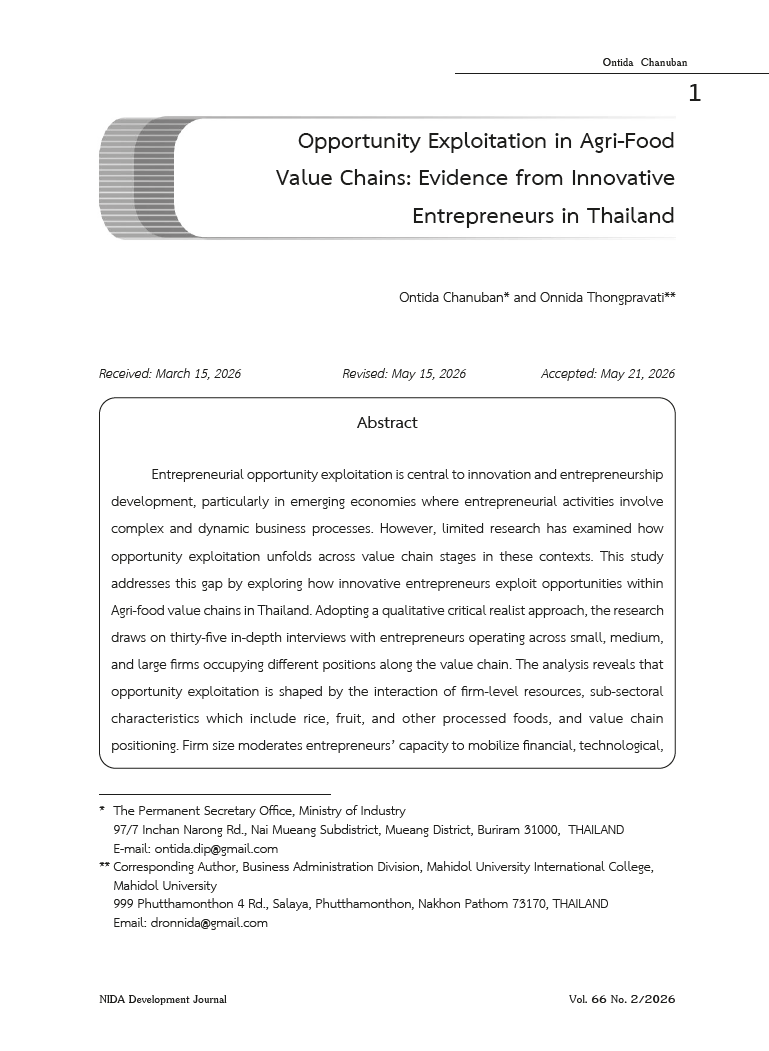
การใช้ประโยชน์จากโอกาส (opportunity exploitation) ในเชิงผู้ประกอบการมีความสำคัญต่อการพัฒนานวัตกรรมและความเป็นผู้ประกอบการ โดยเฉพาะในประเทศเศรษฐกิจเกิดใหม่ที่กิจกรรมของผู้ประกอบการเกี่ยวข้องกับกระบวนการทางธุรกิจที่ซับซ้อนและเปลี่ยนแปลงอย่างต่อเนื่อง งานวิจัยนี้มีวัตถุประสงค์เพื่อศึกษาการใช้ประโยชน์จากโอกาสของผู้ประกอบการนวัตกรรมในห่วงโซ่คุณค่าอาหารเกษตรของประเทศไทย โดยใช้วิธีวิจัยเชิงคุณภาพตามปรัชญา Critical Realist และการสัมภาษณ์เชิงลึกกับผู้ประกอบการจำนวน 35 ราย จากกิจการขนาดเล็ก ขนาดกลาง และขนาดใหญ่ ซึ่งดำเนินธุรกิจในตำแหน่งที่แตกต่างกันตามห่วงโซ่คุณค่า ผลการศึกษาพบว่า การใช้ประโยชน์จากโอกาสถูกกำหนดโดยปฏิสัมพันธ์ระหว่างทรัพยากรระดับกิจการ ลักษณะของสาขาย่อย ได้แก่ ข้าว ผลไม้ และอาหารแปรรูปอื่น ๆ รวมถึงตำแหน่งในห่วงโซ่คุณค่า ขนาดของกิจการมีบทบาทกำกับความสามารถของผู้ประกอบการในการระดมทรัพยากรทางการเงิน เทคโนโลยี และเครือข่ายความสัมพันธ์ ขณะที่บริบทของสาขาย่อยมีอิทธิพลต่อลักษณะ และจังหวะเวลาของการใช้ประโยชน์จากโอกาส เมื่อพิจารณาตามห่วงโซ่คุณค่า พบว่าผู้ประกอบการต้นน้ำ ให้ความสำคัญกับการเพิ่มประสิทธิภาพและการพัฒนานวัตกรรมเพื่อลดต้นทุนการผลิตและส่งเสริม การใช้ประโยชน์จากงานวิจัย ผู้ประกอบการกลางน้ำมุ่งเน้นความสามารถด้านการแปรรูปและกิจกรรม การเพิ่มมูลค่า ขณะที่กิจการปลายน้ำใช้ประโยชน์จากการสร้างตราสินค้า การเข้าถึงตลาด และกลยุทธ์ ที่มุ่งเน้นการส่งออก นอกจากนี้ กิจการขนาดเล็กมีแนวโน้มพึ่งพาเครือข่ายไม่เป็นทางการและความรู้ในท้องถิ่น ในขณะที่กิจการขนาดใหญ่สามารถใช้ประโยชน์จากความร่วมมืออย่างเป็นทางการและเทคโนโลยีขั้นสูง ได้มากกว่า งานวิจัยนี้นำเสนอกรอบแนวคิดที่อธิบายกระบวนการใช้ประโยชน์จากโอกาสของผู้ประกอบการ ผ่านตัวกำกับเชิงบริบท ได้แก่ ขนาดของกิจการ บริบทของห่วงโซ่คุณค่า และบทบาทของผู้ประกอบการ ซึ่งนำไปสู่รูปแบบการใช้ประโยชน์จากโอกาสที่แตกต่างกัน บทความนี้มีส่วนสนับสนุนองค์ความรู้ด้านความเป็น ผู้ประกอบการและห่วงโซ่คุณค่า โดยพัฒนาทฤษฎีความเป็นผู้ประกอบการบนฐานโอกาส และเชื่อมโยงการใช้ ประโยชน์จากโอกาสกับบทบาทของผู้ประกอบการในแต่ละช่วงของห่วงโซ่คุณค่า ผลการศึกษายังมีนัยเชิงนโยบาย และเชิงปฏิบัติ โดยชี้ให้เห็นถึงความสำคัญของกลไกการสนับสนุนที่แตกต่างตามบริบท และความเชื่อมโยง ที่เข้มแข็งระหว่างผู้กำหนดนโยบาย องค์กรสนับสนุน และผู้ประกอบการในการเสริมสร้างระบบนิเวศ อาหารเกษตรของประเทศไทย
เอกสารอ้างอิง
Aldrich, H. E., & Auster, E. R. (1986). Even dwarfs started small: Liabilities of age and size and their strategic implications. Research in Organizational Behavior, 8, 165-198.
Alvarez, S. A., & Barney, J. B. (2007). Discovery and creation: Alternative theories of entrepreneurial action. Strategic Entrepreneurship Journal, 1(1-2), 11-26. https://doi.org/10.1002/sej.4
Alvarez, S. A., Barney, J. B., & Anderson, P. (2013). Forming and exploiting opportunities: The implications of discovery and creation processes for entrepreneurial and organizational research. Organization Science, 24(1), 301-317. https://doi.org/10.1287/orsc.1110.0727
Asad, M., Shabbir, M. S., Salman, R., Hussain Haider, S., & Ahmad, I. (2018). Do entrepreneurial orientation and size of enterprise influence the performance of micro and small enterprises? A study on mediating role of innovation. Management Science Letters, 8(10), 1015-1026.
Baron, R. A. (2006). Opportunity recognition as pattern recognition: How entrepreneurs “connect the dots” to identify new business opportunities. Academy of Management Perspectives, 20(1), 104-119. https://doi.org/10.5465/amp.2006.19873412
Barrett, C. B., Reardon, T., Swinnen, J., & Zilberman, D. (2022). Agri-food value chain revolutions in low- and middle-income countries. Journal of Economic Literature, 60(4), 1316-1377. https://doi.org/10.1257/jel.20201539
Bhaskar, R. (2008). A Realist Theory of Science (1st ed.). Routledge. https://doi.org/10.4324/9780203090732
Bruton, G. D., Ahlstrom, D., & Obloj, K. (2008). Entrepreneurship in emerging economies: Where are we today and where should the research go in the future? Entrepreneurship Theory and Practice, 32(1), 1-14. https://doi.org/10.1111/j.1540-6520.2007.00213.x
Casson, M., & Giusta, M. D. (2007). Entrepreneurship and social capital: Analysing the impact of social networks on entrepreneurial activity from a rational action perspective. International Small Business Journal, 25(3), 220-244. https://doi.org/10.1177/026624260707652
Cenamor, J., Parida, V., & Wincent, J. (2019). How entrepreneurial SMEs compete through digital platforms: The roles of digital platform capability, network capability and ambidexterity. Journal of Business Research, 100, 196-206. https://doi.org/10.1016/j.jbusres.2019.03.035
Chen, Y. (2025). Examining the dynamics of entrepreneurial knowledge and firm performance: A longitudinal study of start-ups in emerging markets. Journal of the Knowledge Economy, 16(1), 2549-2581. https://doi.org/10.1007/s13132-024-02112-7
Choi, Y. R., & Shepherd, D. A. (2004). Entrepreneurs’ decisions to exploit opportunities. Journal of Management, 30(3), 377-395. https://doi.org/10.1016/j.jm.2003.04.002
Cliff, J. E., Jennings, P. D., & Greenwood, R. (2006). New to the game and questioning the rules: The experiences and beliefs of founders who start imitative versus innovative firms. Journal of Business Venturing, 21(5), 633-663. https://doi.org/10.1016/j.jbusvent.2005.02.010
Dallas, M. P., Ponte, S., & Sturgeon, T. J. (2019). Power in global value chains. Review of International Political Economy, 26(4), 666-694. https://doi.org/10.1080/09692290.2019.1608284
Davidsson, P. (2015). Entrepreneurial opportunities and the entrepreneurship nexus: A reconceptualization. Journal of Business Venturing, 30(5), 674-695. https://doi.org/10.1016/j.jbusvent.2015.01.002
Davidsson, P., Recker, J., & Von Briel, F. (2020). External enablement of new venture creation: A framework. Academy of Management Perspectives, 34(3), 311-332. https://doi.org/10.5465/amp.2017.0163
de Jong, J. P. (2013). The decision to exploit opportunities for innovation: A study of high-tech small-business owners. Entrepreneurship Theory and Practice, 37(2), 281-301. https://doi.org/10.1111/j.1540-6520.2011.00459.x
De Massis, A., Eddleston, K. A., & Rovelli, P. (2021). Entrepreneurial by design: How organizational design affects family and non-family firms’ opportunity exploitation. Journal of Management Studies, 58(1), 27-62. https://doi.org/10.1111/joms.12568
Dentoni, D., Cucchi, C., Roglic, M., Lubberink, R., Bender-Salazar, R., & Manyise, T. (2023). Systems thinking, mapping and change in food and agriculture. Bio-Based and Applied Economics, 11(4), 277. https://doi.org/10.36253/bae-13930
Dimov, D. (2010). Nascent entrepreneurs and venture emergence: Opportunity confidence, human capital, and early planning. Journal of Management Studies, 47(6), 1123-1153. https://doi.org/10.1111/j.1467-6486.2009.00874.x
Dimov, D. (2011). Grappling with the unbearable elusiveness of entrepreneurial opportunities. Entrepreneurship Theory and Practice, 35(1), 57-81. https://doi.org/10.1111/j.1540-6520.2010.00423.x
Donbesuur, F., Hultman, M., Oghazi, P., & Boso, N. (2022). External knowledge resources and new venture success in developing economies: Leveraging innovative opportunities and legitimacy strategies. Technological Forecasting and Social Change, 185, 122034. https://doi.org/10.1016/j.techfore.2022.122034
Eisenhardt, K. M. (1989). Building theories from case study research. Academy of Management Review, 14(4), 532-550. https://doi.org/10.2307/258557
Federation of Thai Industries. (2018). OEM manufacturer expo.
Fischer, E., & Reuber, A. R. (2003). Support for rapid-growth firms: A comparison of the views of founders, government policymakers, and private sector resource providers. Journal of Small Business Management, 41(4), 346-365. https://doi.org/10.1111/1540-627X.00087
Foss, N. J., Lyngsie, J., & Zahra, S. A. (2013). The role of external knowledge sources and organizational design in the process of opportunity exploitation. Strategic Management Journal, 34(12), 1453-1471. https://doi.org/10.1002/smj.2135
Gereffi, G., Humphrey, J., & Sturgeon, T. J. (2005). The governance of global value chains. Review of International Political Economy, 12(1), 78-104. https://doi.org/10.1080/09692290500049805
Gerke, A., Benson-Rea, M., & Odlin, D. (2023). SME upgrading in emerging market clusters: The case of Taiwan’s bicycle industry. Journal of Business Research, 164, 113967. https://doi.org/10.1016/j.jbusres.2023.113967
Helfat, C. E., & Peteraf, M. A. (2015). Managerial cognitive capabilities and the microfoundations of dynamic capabilities. Strategic Management Journal, 36(6), 831-850. https://doi.org/10.1002/smj.2247
Helfat, C. E., & Raubitschek, R. S. (2018). Dynamic and integrative capabilities for profiting from innovation in digital platform-based ecosystems. Research Policy, 47(8), 1391-1399. https://doi.org/10.1016/j.respol.2018.01.019
Hulbert, B., Gilmore, A., & Carson, D. (2013). Sources of opportunities used by growth minded owner managers of small and medium sized enterprises. International Business Review, 22(1), 293-303. https://doi.org/10.1016/j.ibusrev.2012.04.004
Humphrey, J., & Schmitz, H. (2002). How does insertion in global value chains affect upgrading in industrial clusters? Regional Studies, 36(9), 1017-1027. https://doi.org/10.1080/0034340022000022198
Jack, S. L., & Anderson, A. R. (2002). The effects of embeddedness on the entrepreneurial process. Journal of Business Venturing, 17(5), 467-487. https://doi.org/10.1016/S0883-9026(01)0076-3
Kaplinsky, R., & Morris, M. (2000). A handbook for value chain research. Institute of Development Studies, University of Sussex.
Kuckertz, A., Kollmann, T., Krell, P., & Stöckmann, C. (2017). Understanding, differentiating, and measuring opportunity recognition and opportunity exploitation. International Journal of Entrepreneurial Behavior & Research, 23(1), 78-97. https://doi.org/10.1108/IJEBR-12-2015-0290
Kano, L., Tsang, E. W. K., & Yeung, H. W.-c. (2020). Global value chains: A review of the multi-disciplinary literature. Journal of International Business Studies, 51(4), 577-622. https://doi.org/10.1057/s41267-020-00304-2
Lincoln, Y. S., & Guba, E. G. (1985). Naturalistic inquiry. Sage.
Malfense Fierro, A. C., Noble, D., Hatem, O., & Balunywa, W. (2018). African portfolio entrepreneurship and the creation of jobs. Journal of Small Business and Enterprise Development, 25(5), 730-751. https://doi.org/10.1108/JSBED-02-2017-0074
Mathafena, R.B., Msimango-Galawe, J. (2023), Entrepreneurial orientation, market orientation and opportunity exploitation in driving business performance: moderating effect of interfunctional coordination. Journal of Entrepreneurship in Emerging Economies, 15(3), 538–565. https://doi-org/10.1108/JEEE-03-2021-0114
McMullen, J. S., & Shepherd, D. A. (2006). Entrepreneurial action and the role of uncertainty in the theory of the entrepreneur. Academy of Management Review, 31(1), 132-152.
Mello, L. P. D., Moraes, G. H. S. M. D., & Fischer, B. B. (2022). The impact of the institutional environment on entrepreneurial activity: An analysis of developing and developed countries. Journal of Entrepreneurship and Public Policy, 11(1), 1-22. https://doi.org/10.1108/JEPP-09-2021-0113
Miles, M. B., & Huberman, A. M. (1994). Qualitative data analysis: An expanded sourcebook (2nd ed.). Sage Publications.
Miles, M. B., Huberman, A. M., & Saldaña, J. (2014). Qualitative data analysis: A methods sourcebook (3rd ed.). Sage Publications.
Morrison, A., Pietrobelli, C., & Rabellotti, R. (2008). Global value chains and technological capabilities: A framework to study learning and innovation in developing countries. Oxford Development Studies, 36(1), 39-58. https://doi.org/10.1080/13600810701848144
National Economic and Social Development Council. (2022). Thailand’s Bio-Circular-Green (BCG) economy model.
Nieto, M., & González-Álvarez, N. (2016). Social capital effects on the discovery and exploitation of entrepreneurial opportunities. International Entrepreneurship and Management Journal, 12(2), 507-530. https://doi.org/10.1007/s11365-014-0353-0
Osei, C. D., Zhuang, J., & Adu, D. (2024). Impact of regulatory, normative and cognitive institutional pressures on rural agribusiness entrepreneurial opportunities and performance: Empirical evidence from Ghana. International Food and Agribusiness Management Review, 27(4), 651-670. https://doi.org/10.22434/ifamr1008
Pietrobelli, C., & Rabellotti, R. (2011). Global value chains meet innovation systems: Are there learning opportunities for developing countries? World Development, 39(11), 1887-1897.
Pitelis, C. N., & Teece, D. J. (2009). The (new) nature and essence of the firm. European Management Review, 6(1), 5-15. https://doi.org/10.1057/emr.2009.1
Ponte, S., Gereffi, G., & Raj-Reichert, G. (Eds.). (2019). Handbook on global value chains. Edward Elgar Publishing. http://doi.org/10.4337/9781788113779
Ponte, S., & Sturgeon, T. J. (2014). Explaining governance in global value chains: A modular theory-building effort. Review of International Political Economy, 21(1), 195-223. https://doi.org/10.1080/09692290.2013.809596
Ponte, S., Gereffi, G., & Raj-Reichert, G. (2019). Handbook on global value chains. Edward Elgar Publishing.
Porter, M. E. (1985). Competitive advantage: Creating and sustaining superior performance. Free Press.
Reardon, T., Liverpool-Tasie, L. S. O., & Minten, B. (2021). Quiet revolution by SMEs in the midstream of value chains in developing regions: Wholesale markets, wholesalers, logistics, and processing. Food Security, 13, 1577-1594. https://doi.org/10.1007/s12571-021-01224-1
Rosa, P. (1998). Entrepreneurial processes of business cluster formation and growth by habitual entrepreneurs. Entrepreneurship Theory and Practice, 22(4), 43-61. https://doi.org/10.1177/104225879802200403
Santamaria, S. (2022). Portfolio entrepreneurs’ behavior and performance: A resource redeployment perspective. Management Science, 68(1), 333-354. https://doi.org/10.1287/mnsc.2020.3929
Schlichte, F., & Junge, S. (2025). The concept of entrepreneurial opportunities: A review and directions for future research. Management Review Quarterly, 75(4), 3699-3725. https://doi.org/10.1007/s11301-024-00466-5
Shane, S. (2003). A general theory of entrepreneurship: The individual–opportunity nexus. Edward Elgar Publishing.
Shane, S., & Venkataraman, S. (2000). The promise of entrepreneurship as a field of research. Academy of Management Review, 25(1), 217-226. https://doi.org/10.5465/amr.2000.2791611
Shepherd, D. A., McMullen, J. S., & Ocasio, W. (2017). Is that an opportunity? An attention model of top managers’ opportunity beliefs for strategic action. Strategic Management Journal, 38(3), 626-644. https://doi.org/10.1002/smj.2499
Sutter, C., Bruton, G. D., & Chen, J. (2019). Entrepreneurship as a solution to extreme poverty: A review and future research directions. Journal of Business Venturing, 34(1), 197-214. https://doi.org/10.1016/j.jbusvent.2018.06.003
Teece, D. J. (2016). Dynamic capabilities and entrepreneurial management in large organizations: Toward a theory of the (entrepreneurial) firm. European Economic Review, 86, 202-216. https://doi.org/10.1016/j.euroecorev.2015.11.006
Tran, M. L., Hong Hue, T., & Vo Thai, H. C. (2026). The transformative power of entrepreneurial self-efficacy on identity aspiration and nascent behaviours: Evidence from Vietnam. Journal of Innovation and Entrepreneurship, 15, 5. https://doi.org/10.1186/s13731-026-00617-w
Tun, M., & Pillai, A. (2012). The impact of ICT and networking on the business performance of One Tambon One Product enterprises in greater Bangkok and metropolitan areas. NIDA Development Journal, 52(2), 85-108. https://so04.tci-thaijo.org/index.php/NDJ/article/view/3048
Ullah, A., Kasim, A., Arafat, M. Y., & Shah, S. M. (2024). Exploring the linkages between entrepreneurship, governance, and economic growth: A longitudinal context-based study. International Journal of Services and Technology Management, 29(4), 261-273 https://doi.org/10.1504/IJSTM.2024.145227
Venkataraman, S. (1997). The distinctive domain of entrepreneurship research. In J. A. Katz & R. Brockhaus (Eds.), Advances in entrepreneurship, firm emergence and growth (Vol. 3, pp. 119-138). JAI Press. https://ssrn.com/abstract=1444184
Welpe, I. M., Sporrle, M., Grichnik, D., Michl, T., & Audretsch, D. B. (2012). Emotions and opportunities: The interplay of opportunity evaluation, fear, joy, and anger as antecedent of entrepreneurial exploitation. Entrepreneurship Theory and Practice, 36(1), 69-96. https://doi.org/10.1111/j.1540-6520.2011.00481.x
Welter, F., Baker, T., Audretsch, D. B., & Gartner, W. B. (2017). Everyday entrepreneurship—A call for entrepreneurship research to embrace entrepreneurial diversity. Entrepreneurship Theory and Practice, 41(3), 311-321. https://doi.org/10.111/etap.12258
Wood, M. S., McKelvie, A., & Haynie, J. M. (2014). Making it personal: Opportunity individuation and the shaping of opportunity beliefs. Journal of Business Venturing, 29(2), 252-272. https://doi.org/10.1016/j.jbusvent.2013.02.001
Yin, R. K. (2018). Case study research and applications: Design and methods (6th ed.). SAGE Publications.
Zahra, S. A. (2007). Contextualizing theory building in entrepreneurship research. Journal of Business Venturing, 22(3), 443-452. https://doi.org/10.1016/j.jbusvent.2006.04.007
ดาวน์โหลด
เผยแพร่แล้ว
รูปแบบการอ้างอิง
ฉบับ
ประเภทบทความ
สัญญาอนุญาต
ลิขสิทธิ์ (c) 2026 วารสารพัฒนบริหารศาสตร์

อนุญาตภายใต้เงื่อนไข Creative Commons Attribution-NonCommercial-NoDerivatives 4.0 International License.