EARTH-SHELTERED ARCHITECTURE : APPLYING WISDOM TO BUILD FOR LIVING PLACE IN NORTHEAST THAILAND
DOI:
https://doi.org/10.14456/nrru-rdi.2020.71Keywords:
Earth-sheltered architecture, History, Applied wisdomAbstract
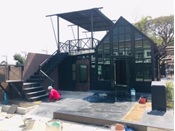
The purpose of this research was to study the history, current conditions and problems of earth-sheltered architecture in the Northeastern region and the application of wisdom to build earth-sheltered living places in Northeastern Thailand. The research methodology was divided into four phases: Phase 1, determining the area of 6 provinces and a group of 34 educators; Phase 2, using the research tools of interviews and questionnaires to collect the data with the knowledge group; Phase 3 was a workshop with 11 practitioners; and Phase 4 was to build earth-sheltered living places with the group of practitioners and general informants. The data were analyzed with a content analysis. The research demonstrated that 70-100 years ago, Chinese immigrants brought many cultures to build earth-sheltered living places in the Northeast. The current state of earth-sheltered living places that were not designed by architects were often seen as being not beautiful. They were replaced by a concrete building because of the forces of modernity. Therefore, in this study good design features of traditional earth-sheltered living places, combined with modern architecture, were applied to produce better examples which blended each material according to its properties and brought out the distinctive value of the material to show it gracefully. The result was an earth-sheltered living place of practical and architectural beauty.
References
Jundi, J. (2014). You Kub Din (3th ed.). Bangkok : Pappim. (In Thai)
Nilsakul, D. (2003). The Conservation of Tuekdin in Sluth I-SAN. Thesis, Master of Architecture Program in Architecture, Chulalongkorn Univesity, Bangkok. (In Thai)
Panin, O. (1997). The studies of villages, houses and building technology of the Chinese Villages in Maehongson. NAJUA : Architecture, Design and Built Environment, 15(3), 3-34. (In Thai)
Permpituck, S. (2011). Clay house build technique. Art and Architecture Journal Naresuan University, 2(2), 93-101. (In Thai)
Ruengtham, P. (2017). Design Theory (2th ed.). Mahasarakham : Mahasarakham University. (In Thai)
Silpsai, D. (2003). Earth House : An Alternative Architectuire Case Study : Baan Srithan,Aumphor Pateaw, Yasothorn Province. Thesis, Master of Architecture Program in Architecture, Silpakorn Univesity, Bangkok. (In Thai)
Sriwattanaprayoon, N. (2009). The Study and Analysis of Translation of Heat from Earth Structure’s Wall. Research report. Rajamangala University of Technology Thanyaburi, Bangkok. (In Thai)
Wechkama, T. (2011). Concept Theory Cultural (2th ed.). Mahasarakham : Mahasarakham University. (In Thai)
Yodmale, B. (2011). Cultural and Ethnographical Theories. Mahasarakham : Mahasarakham University. (In Thai)