A STUDY OF CRITICAL THINKING ABILITY USING SCAFFOLDING OF TEACHERS AND GRADE 1–3 STUDENTS IN NAKHON RATCHASIMA PROVINCE
DOI:
https://doi.org/10.14456/nrru-rdi.2021.42Keywords:
Critical thinking ability, Scaffolding, Techniques for developing scaffolding ability of teachersAbstract
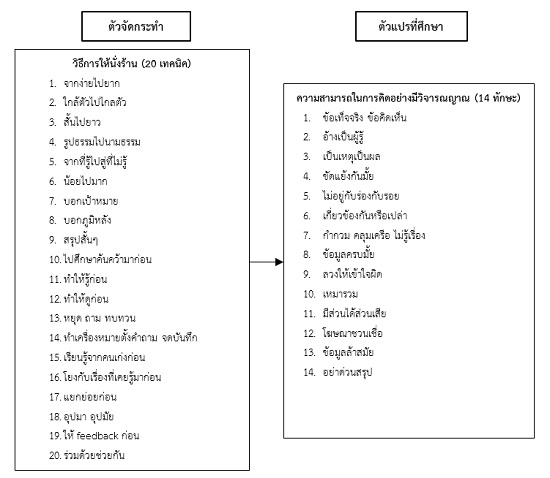
The purposes of this research were to: 1) develop scaffolding ability of Thai teachers, mathematics teachers and science teachers under Nakhon Ratchasima Primary Educational Service Area Office 1 and Office of the Private Education Commission and 2) develop critical thinking ability of grade 1-3 students under Nakhon Ratchasima Primary Educational Service Area Office 1 and Office of the Private Education Commission using scaffolding. The 20 teachers and 335 students from Nakhon Ratchasima Primary Educational Service Area Office 1 and 5 teachers and 175 students from Office of the Private Education Commission were selected to be sample by purposive sampling. The research tools were guidebook for teacher and set of innovations for teachers. Tools used for data collection were evaluation of critical ability (28-item multiple-choice test) and an evaluation form for giving scaffolding by teachers (scoring rubric), which has passed the quality of the tool with an IOC value of 1.00. Data were analyzed using percentage, , S.D. and content analysis.
The finding revealed that 1) teachers had moderate ability to provide scaffolding, 64.00 and high ability to provide scaffolding, 36.00 respectively and 2) grade 1-3 students had moderate critical ability, 44.90 percent; high critical ability, 39.61 and low critical ability, 15.49 respectively.
References
Laowreandee, W. (2010). Thinking Skills Instructional Models and Strategies (10th ed.). Nakhon Prathom : Silpakorn University. (In Thai).
Lutz, S. L., Guthrir, J. T., & Davis, M. H. (2006). Scaffolding for Engagement in Elementary School Reading Instruction. The Journal of Educational Research, 100(1), 3-16.
Majid, A. H. A., & Stapa, S. H. (2017). The Use of Scaffolding Technique via Facebook in Improving Descriptive Writing among ESL Learners. The Southeast Asian Journal of English Language Studies, 23(4), 77-88.
Meepin, T. (1996). Comparison of reading comprehension and attitude towards reading in Thai language of Grade 3 students by KWL Plus Interactive Reading with Handbook Reading. Thesis, Master of Secondary Education Program in Secondary Education, Srinakharinwirot University Prasarnmit, Bangkok. (In Thai).
Ministry of Education. (2008). Basic Education Core Curriculum B.E. 2551 (A.D. 2008). Retrieved September 9, 2020, from https://drive.google.com/file/d/1SjQZqQbmU52DP1ODySpOm VEcUzW-7xP7/view (In Thai)
Ministry of Education. (2010). Guidelines for developing and evaluating reading, analyzing thinking and writing according to the core curriculum basic education, 2008 (2nd ed.). Bangkok : The Agricultural Cooperative Federation of Thailand. (In Thai).
Ministry of Education. (2017). Learning standards and indicators for math, science, and geography subject groups in the learning subject group of Social Studies, Religion and Culture (Revised Edition B.E. 2560) according to the Core Curriculum of Basic Education, B.E. 2551. Bangkok : The Agricultural Cooperative Federation of Thailand. (In Thai)
Panomyam, S. (2001). Basic Psychology for Education. Nakhon Prathom : Faculty of Education Silpakorn University. (In Thai).
Sirinat, J., & others. (2019). Handbook: A Development of Reading, Writing, and Analysis Thinking to Promote Critical Thinking using Scaffolding. Nakhon Ratchasima : Faculty of Education, Nakhon Ratchasima Ratchasima Rajabhat University. (In Thai).
Tanya, S. (2012). Educational Research Methodology. Nakhon Ratchasima : Nakhon Ratchasima Rajabhat University. (In Thai).
The Institute for the Promotion of Teaching Science and Technology (IPST). (2019). PISA Assessment Results 2018: Executive Summary. Retrieved September 9, 2020, from https://pisathailand. ipst.ac.th/pisa2018-summary-result/ (In Thai).
Vygotsky, L. S. (1987). Instructional Implication and Applications of Social Stoical Psychology. New York : Cambridge University Press.