INNOVATIVE KNOWLEDGE MANAGEMENT IN PREPARATION OF HOUSEHOLD ACCOUNTS BASED ON THE PHILOSOPHY OF SUFFICIENCY ECONOMY TO ENHANCE KNOWLEDGE SUSTAINABILITY OF SAI YAO COMMUNITY, THALUNG LEK, MEUANG, BURIRAM
DOI:
https://doi.org/10.14456/nrru-rdi.2022.8Keywords:
Innovation, Knowledge management, Innovation Knowledge Management, Household Accounting, Sufficiency Economy, Household accounting, Sufficiency economy philosophyAbstract
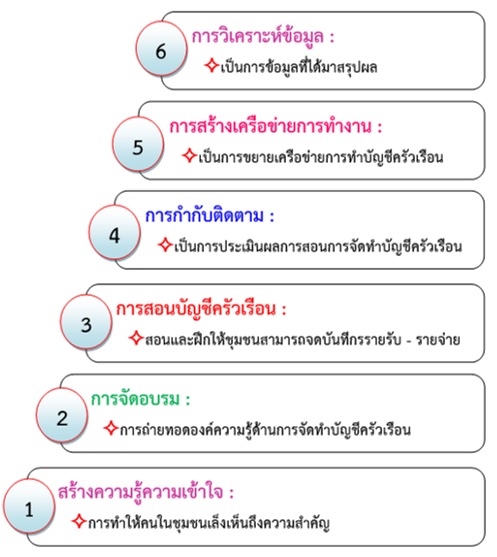
To support the community to increase their incomes and to be independent, this study aimed to provide them with an accounting knowledge in integrated research in order to create and assess innovations in household accounting knowledge management based on Sufficiency Economy Philosophy (SEP) of Sai Yao Community, Talung Lek Subdistrict, Mueang District, Buriram Province. The target participants of 30 households were selected by a specific group of accountants and teaching accountants. Documents and in-depth interviews with an unstructured interview form were conducted to create an innovative model. Then, group discussion involving brainstorming using a fishbone model was employed to create an innovative model and manual, whose appropriateness was assessed using an assessment form with a high consistency value. Data were analyzed by the descriptive statistics of mean and standard deviation. The results showed that there were 6 components of innovative knowledge management in household accounting: 1) understanding, 2) training, 3) household auditing, 4) monitoring, 5) building a working network, and 6) analyzing. Also, 10 elements were included in the manual: 1) data source, 2) occupational group, 3) knowledge management process, 4) goals, 5) guidelines for creating a household account book format, 6) methods for household account recording, 7) household incomes, 8) household expenditures, 9) household account book, and 10) suitability of utilization. Thus, the overall appropriateness of the model and manual was at a high level. As a result, the community members recognized their profits and clearer spending patterns, that can reduce their unnecessary expenses and increase savings.
References
Butsalee, P., Worarit, T., & Karin, K. (2016). To Study Participatory of Accounting System of the Silk Weaving Community in Ban Non Sila, Tambol Thalung Lek, Muang Buriam, Buriam Privince. Journal of Research and Development Buriam Rajabhat University, Special Issue, 14-20. (In Thai)
Chaipinchana, P. (2014). Development of Household Accounting System Under Sufficiency Economy Philosophy with Participation of Community, Nong Pa Krung Sub-district, Muang District, Chiang Mai Province. Journal of Community Development and Life Quality, 2(1), 37-48. (In Thai)
Chakphithak, N. (2009). Knowledge Management Theory. Chiang Mai : Chiang Mai University. (In Thai)
Chuanchom, J. (2015). Guidelines for Promoting Household Accounting for Students in Rajabhat University. Research Report. Suan Dusit University, Bangkok. (In Thai)
Jaensirisak, S. & Pahumunto, S. (2011). Accounting System Development for OTOP in Ubon Ratchathani. Jourmal of MIS of Naresuan University, 6(1), 1-15. (In Thai)
Jokkaew, J. (2016). Cognitive Management of Accounting and Finalcial Management for Bangbua building contractor business unit, Bang Khen, Bangkok. Area Based Development Research Jouanl, 8(1), 22-41. (In Thai)
Langkhunsaen, S. (2011). Development of Accounting System Applied to the Participation of Community Shops, Tambol San Don Kaew, Amphur Maetha, Lampang Province. In The Graduate Research Conference (12thed) (pp. 373-377). Khon Kaen University, Khon Kaen. (In Thai)
Likitwongkajon, N (2007). Households Accounting : Tools to Sufficiency Economy. Journal of Academic Services Khon Kaen University, 15(3), 25-29. (In Thai)
Musik, N. (2014). The Effect of Household Accounting Efficiency on the Quality of Life Under the Sufficiency Economy Philosophy of Famers in Maha Sarakham Province. Journal of Graduate School of Commerce-Burapha Review, 9(1), 45-58. (In Thai)
Office of the National Economic and Social Development Council. (2014). Human and Social Development. Retrieved September 4, 2016, from http://social.nesdb.go.th/social (In Thai)
Panich, V. (2016). Knowledge Management: KM (Definition to Perform). Retrieved September 4, 2016, from http://kmi.trf.or.th/Document/AboutKM/About_KM.pdf (In Thai)
Peuchthonglang, P & Namwongprom, A. (2013). Strong Community Livable Society, Sustainable Economy. Journal of Community Development and Life Quality, 1(3), 1-6. (In Thai)
Phasukyoet, P. (2006). Knowledge Management. Bangkok : Yaimai Creative Group. (In Thai)
Pintakaewm A. & Phokhathong, T. (2015). Knowledge Management of Community Welfare Fund in Saraphi Sub-district, Amphoe Saraphi, Chiang Mai Province. Journal of Management and Marketing, 2(1), 87-95. (In Thai)
Pusriaon, T. (2018). Research and development in Education. Mahasarakham : Takkasila Karphim. (In Thai)
Srisa-ard, B. (2011). Preliminary Research (8th ed.). Bangkok : Suwiriyasan. (In Thai)
Suwannaraj, S. (2016). Development approach of household accounting Cooperative Credit Unions : A Case Study Cooperative Credit Union Thipchang, Tambon Pongyangkhok, Amphurhangchat Lampang Province. Journal of Modern Management Science, 9(1), 154-166. (In Thai).
Wasi, P. (2007). Sufficiency Economy and Civil Socity. Bangkok : Mochaoban. (In Thai)
Downloads
Published
How to Cite
Issue
Section
License

This work is licensed under a Creative Commons Attribution-NonCommercial-NoDerivatives 4.0 International License.