MANAGEMENT OF AIRCRAFT MAINTENANCE ORGANIZATIONS IN THAI COMMERCIAL AVIATION INDUSTRY
DOI:
https://doi.org/10.14456/nrru-rdi.2021.53Keywords:
Policy management, Resource management, Cost management, Capability managementAbstract
This is a mixed-method research study of both Qualitative research and Quantitative research for an exploratory sequential design. The objectives of the study were to create and evaluate aircraft maintenance organizations' management models. The population is a stakeholder in the Thai commercial aviation industry who choose a purposive specific group of twenty-seven, also set a sample size allowing for a total of 600 people. Group of the sample size, according to Thomson's method, reserved for a total of 400, random sampling with lottery means. Research instruments was the interview form, the questionnaire has content validity of 0.99, and quality assessment. Consolidate data by in-depth interviews, the questions for opinion of online email, and assess the quality with sub-group discussions, also elemental with content analysis, Comment data, and quality assessment by averaging and standard deviation were analyzed. Then, test hypotheses by analyzing structural equations with AMOS was conducted..
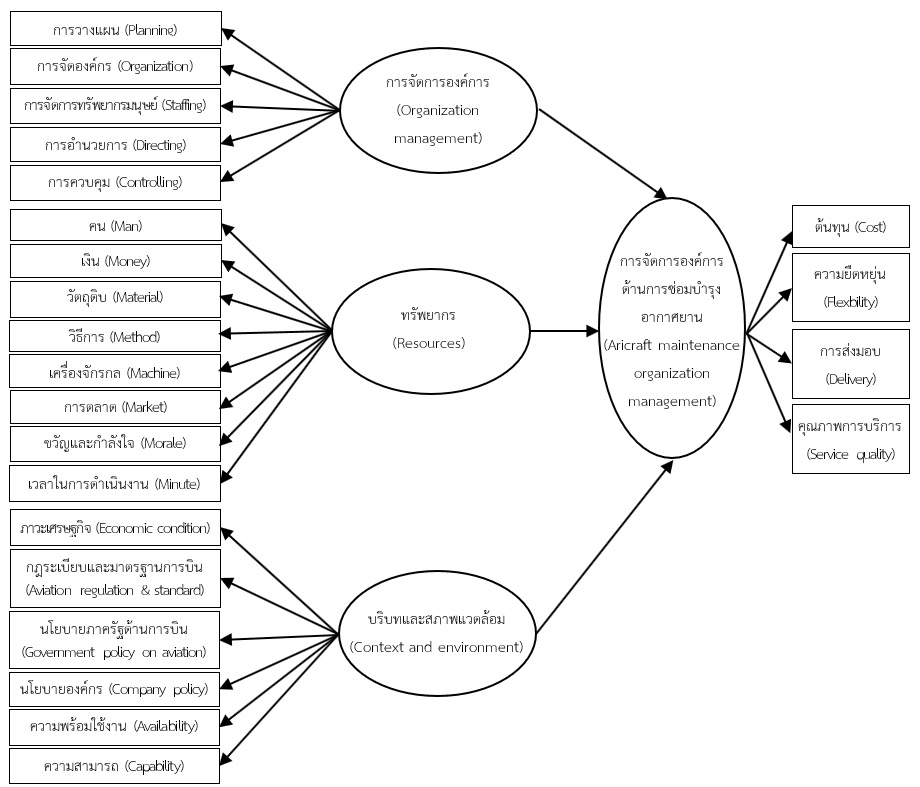
The findings showed that the developed model consists of three elements in nineteen areas: 1) five organizational managements, 2) eight resources, and 3) six contexts, which they were at a high level. By passing the specified criteria and being consistent with the empirical data. The most important element was Human resources, moreover, the definiteness in government policy, tax rates, development grouping should be more mentioned, which they must be related with cost, efficiency, and the number of organization’s employees.
References
Ahmad, Z. S., Harun, N., & Shuhaimi, H. (2015). Using technological, organizational, environment framework to investigate the determinants of the adoption of electronic publishing amongst Malaysian publishers. Aust. J. Basic & Appl. Sci., 9(3), 37-44.
Allen, L. A. (1958). MANAGEMENT AND ORGANIZATION. New York: McGraw-Hill.
Anvari, F., & Edwards, R. (2011). Maintenance engineering in capital-intensive manufacturing systems. Journal of Quality in Maintenance Engineering, 17(4), 351-370.
Aviation Economy Division, Aviation Industry PormotionDepartment. (2018). Report of the state of Aviation Industry of Thailand 2018. Bangkok : The Civil Aviation Authority of Thailand. (In Thai)
Bangmo, S. (2010). Organization and management. Bangkok : Wittayaphat. (In Thai)
Barney, J. B., Wright, M., & Ketchen Jr., D. J. (2001). The resource-based view of the firm: Ten years after 1991. Journal of Management, 27(6), 625-641.
Creswell, J. W., & Plano Clark, V. L. (2018). Designing and Conducting Mixed Methods Research (3rd ed.). Los Angeles : SAGE Publications, Inc.
Cronbach, L. J. (1970). Essentials of psychological testing (3rd ed.). New York : Harper & Row.
Deming, W.E. (1986). Out of the Crisis. Cambridge, Mass : Massachusetts Institute of Technology, Center for Advanced Engineering Study.
Fahy, J. (2000). “The Resource-Based View of the Firm: Some Stumbling-Blocks on the Road to Understanding Sustainable Competitive Advantage”. Journal of European Industrial Training, 24(2-4), 94-104.
Ghezzi, A., Rangone, A., & Balocco, R. (2013). Technology diffusion theory revisited: a regulation, environment, strategy, technology model for technology activation analysis of mobile ICT. Technology Analysis & Strategic Management, 25(10), 1223-1249.
Griffin, E. (1996). The Human Side of Reengineering. Journal for Healthcare Quality, 18(5), 4-8.
Gulick, L., & Urwick, L. (1937). Paper on the Science of Administration. Clifton : Augustus M. Kelley.
Haddara, M., & Elragal, A. (2013). ERP adoption cost factors identification and classification: a study in SMEs. International Journal of Information Systems and Project Management, 1(2), 5-21.
Hirt, F. G. (2008). Business Introduction. Pornprom Promphet (Translater). Bangkok : Top. (In Thai)
Kanasawat, Y. (2014). Golden opportunity, aircraft maintenance business AEC. Investment Promotion Journal, 25(6), 23-27. (In Thai)
Khosantia, N. (2019). Thailand’s Strategic Guidelines in Developing Aircraft Maintenance, Repair and overhaul industry. Desiertation, Doctor of Philosophy Program in Public enterprise management, Graduate School of Commerce, Burapha University, Chonburi. (In Thai)
Koontz, H. D. (1972). Analysis of Managerial Functions. New York : McGraw Hill.
Likert, R. (1967). “The Method of Constructing and Attitude Scale”. In Reading in Attitude Theory and Measurement (pp.90-95). Fishbeic, Matin, Ed. New York : Wiley & Son.
Mottaeva, A. (2018). Formation of mechanism of programme management for the development of medical organizations. In MATEC Web of Conferences (Vol. 170, p. 01053). EDP Sciences.
Phukaoluan, S., & Sinnok, T. (2014). How to win people’s minds. Bangkok : SE-ED book center. (In Thai)
Pungwiwatnikul, V. (2012). Seminar in public organization management. Bangkok : Department of Public Administration, Ramkhamhaeng University. (In Thai)
Ratchakit, T. (2019). POCCC Management Theory and Principles of Enterprise Management for Success Based on Henri Fayoil Concept. Retrieved March 10, 2019, from https:// th.hrnote.asia/ orgdevelopment/190626-poccc-henri-fayol/ (In Thai)
Rujjanapan, B. (2013). Interpretation criteria. Retrieved October 19, 2020, from http://www.thaiall.com/ blog /burin/4967/ (In Thai)
Samual, S. C., & Trevis, C. S. (2006). Modern management : International edition (10th ed.). USA : Person.
Sararatana, W. (2012). Concepts, theories and issues for educational administration (8th ed.). Bangkok : Thiphayawut. (In Thai)
Schumacher, R. E., & Lomax, R. G. (2010). A beginner’s guide to structural equation modeling (3rd ed.). New Jersey : Lawrence Erlbaum Associates.
Shanmugam, A., & Robert, T. P. (2015). Raking of Aircraft Maintenance Organization based on Human Factor Performance. Computers & Industrial Engineering, 88, 410-416.
Sittiwong, C. (2016). Factors Affecting Readiness of State Enterprises in Thailand for the Competition in the ASEAN Economic Community. Thesis, Master of Business Administration Program in International Business, Faculty of Business Administration, Rajamangala University of Technology, Pathumthani. (In Thai)
Srisamran, S. (2017). Thai aircraft maintenance business. EIC ARTICLE. Retrieved January 23, 2017, from https://www.scbeic.com/th/detail/product/3136 (In Thai)
Suksriwong, S. (2014). Management : from the executive’s viewpoint. Bangkok : Chulalongkorn University Book Center. (In Thai)
Wanichabancha, K. (2019). Structural equation analysis (SEM) with AMOS (3rd ed.). Bangkok : Samlada. (In Thai)
Witthayudom, W. (2007). Organization development. Bangkok : Thanat Publication. (In Thai)