EFFECTS OF ONLINE INQUIRY-BASED LEARNING ON GRADE 11 STUDENTS’ COLLABORATION SKILLS
DOI:
https://doi.org/10.14456/nrru-rdi.2022.40Keywords:
Online inquiry-based learning, Collaboration skills, Upper secondary schoolAbstract
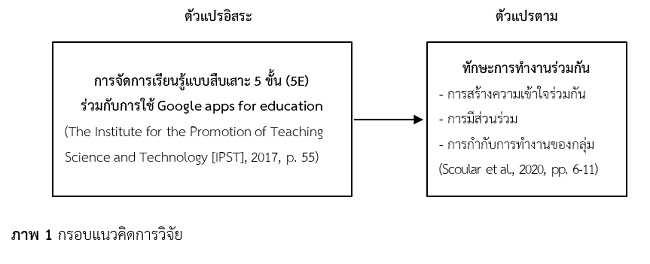
Collaboration skill is one of necessary skills in the 21st century. It increases morale, as well as builds community, which enhances engagement and productivity. In addition, during the COVID-19 pandemic, schools have been forced to use online learning. Thus, the objective of this research was to study the effects of online inquiry-based learning on Grade 11 students’ collaboration skills. The samples were 21 grade 11 students. The research instruments were online inquiry-based learning lesson plans, in which IOC were between 0.67 to 1.00 and collaboration skills observation form. The data was collected before and after learning in the semester 2/2020. Students’ collaboration skills were grouped into 3 levels and analyzed by normalized gain. The results indicated that online inquiry-based learning could enhance students’ collaboration skills. 52.38 percent of the students were at an intermediate level and 23.81 percent were at a high level of collaboration skills after learning, whereas 76.19 percent of the students were at a low level and 23.81 percent were at an intermediate level before. The class normalized gain was at a medium level (N-gain=0.59). The normalized gain in building shared understanding aspect was also at a high level (N-gain=0.74), while collectively contributing and regulating aspects were at a medium level (N-gain=0.63 and 0.47, respectively).
References
Bybee, R. W., Taylor, J. A., Gardner, A., Scotter, P. V., Westbrook, A. L., Landes, N., & Carlson, J. (2006). The BSCS 5E Instruction Model: Origins and Effectiveness. A Report Prepared for the office of science Education and National Institutes of Health.
Chantama, M., Kijkuakul, S., & Nakkuntood, M. (2020). Research-Based Learning Approach to enhance the 11th grade Students’ Competency in Evaluating and Designing Scientific Enquiry and Teamwork Skills on Plant Reproduction and Growth. Humanities and Social Science Sciences Journal of Graduate School, Pibulsongkram Rajabhat University, 14(1), 141-157. (In Thai)
Colburn, A. (2000). An Inquiry Primer. Science Scope, 23(6), 42-44.
Creswell, J. W., & Clark, V. L. P. (2018). Designing and Conducting Mixed Methods Research (3nd ed.). Los Angeles : SAGE Publication.
Hake, R. R. (1998). Interactive-engagement versus traditional methods: A six-thousand-student survey of mechanics test data for introductory physics courses. American journal of Physics, 66(1), 64-74.
Jenthanawit, P. (2011). The effect of using the 4MAT instruction model in the social studies 2 course topic of consumption economics and sufficiency on learning achievement and group work skills of Mathayom Suksa 1 students at Pak Chong School in Nakhon Ratchachima Province. Thesis, Master of Education Program in Curriculum and Instruction, Sukhothai Thammathirat Open University, Nonthaburi. (In Thai)
Johnson, D. W. (1973). Interpersonal Skills for Cooperative Work. Retrived May 1, 2021, from https://eric.ed.gov/?id=ED078911
Keeratichamroen, W., & Phonnong, I. (2019). A Study of 21st Century Learning Skills of Nakhon Ratchasima Rajabhat’ s Undergraduate Students Using Inquiry Method Management (7E) With Concept Map. NRRU Community Research Journal, 13(3), 31-44. (In Thai)
Keeratichamroen, W., & Phonnong, I. (2020).A Comparison of Learning Achievement and Communication Skills for Undergraduate Students’ Using 5E inquiry-Based Learning and Phenomenon-Based Learning. NRRU Community Research Journal, 14(1), 29-43. (In Thai)
Kositbovornchai, S. (2017). How to Build Up Effective Teamwork for Excellent Performance. Retrieved May 1, 2021, from https://stepplustraining.com/ (In Thai)
Lai, E. R. (2011). Collaborative: A Literature Review. Retrieved May 1, 2021, from https://images.pearsonassessments.com/images/tmrs/Collaboration-Review.pdf
Laohaphaiboon, P. (1999). Approach to teaching science (3nd ed.). Bangkok : Thai Wattanapanich. (In Thai)
Moog, R. S., & Spencer, J. N. (2008). Process oriented guided inquiry learning (POGIL) (Vol. 994). Washington, DC : American Chemical Society.
Partnership for 21st Century Learning. (2019). Framework for 21st Century Learning Definitions. Retrieved May 1, 2021, from https://www.battelleforkids.org/learning-hub/learning-hub-item /framework-for 21st-century-learning-definitions
Podapol, J. (2020). Online Learning Management: New Normal of Education. Retrieved May 1, 2021, from https://slc.mbu.ac.th/article/28181 (In Thai)
Putri, F. A., Anggraito, Y. U., & Alimah, S. (2018). The Effectiveness of Guided Inquiry Strategy on Students’ Collaborative Skill. Journal of Biology Education, 7(2), 144-150.
Saenboonsong, S. (2017). The Development of Project-based Learning Model via Learning Environment on Cloud Computing to Enhance Creative Products and Collaborative Skills of Undergraduate Students. Thesis, Doctor of Education Program in Computer Education, King Mongkut’ s University of Technology North Bangkok, Bangkok. (In Thai)
Satjit, W., Suwanjinda, D., & Chindanurak, T. (2020). The Effects of Science Learning Management Using CIPPA Model together with STAD Technique of Cooperative Learning on Learning Achievement on the Topic of Force and Motion and Group Working Ability of Prathom Suksa III Students at Koh Klang Klong Yang Network School Cluster in Krabi Province. Journal of Education Thaksin University, 20(1), 147-161. (In Thai)
Scoular, C., Duckworth, D., Heard, J., & Ramalingam, D. (2020). Collaboration: Skill Development Framework. Retrieved May 1, 2021, from https://research/acer/edu.au/ar_misc/42
Sinthaphanon, S. (2015). Learning management of Teacher fot student in the 21st Century. Bangkok : Chulalongkorn University Book Center. (In Thai)
Srisa-ard, B. (2017). Preliminary research (10th ed.). Bangkok : Suwiriyasan. (In Thai)
Tepsuribun, P., Nuankaew, J., & Liumthong. (2019). Development of Science Creative Thinking in the Topic of Biodiversity of Mathayom Suksa 3 Students Learning under the 5E inquiry Cycle. STOU Education Journal, 12(1), 168-177. (In Thai)
The Institute for the Promotion of Teaching Science and Technology. (2017). Course Guide for Additional Courses Science High School Chemistry. Retrieved May 1, 2021, from http://www.scimath.org/e-books/8417/flippingbook/index.html (In Thai)
Wattanakul, P., & Mungsing, S. (2015). Knowledge and skills necessary for learning in the 21st century. APHEIT Journals, Science & Technology, 4(1), 84-94. (In Thai)
Wongnai, N., Intasingh, S., & Assapaporn, N. (2020). Effects of using POGIL on the science concepts and collaborative skills of grade 4 student. Rajabhat Chiang Mai Research journal, 21(3), 99-109. (In Thai)
Yingheng, P., & Rampai, N. (2020). Development model of blended cloud learning technology by using imagineering concept to enhance innovative creativity thinking of higher education students. NRRU Community Research Journal, 14(3), 208-221. (In Thai)
Downloads
Published
How to Cite
Issue
Section
License

This work is licensed under a Creative Commons Attribution-NonCommercial-NoDerivatives 4.0 International License.