DEVELOPING COACHING AND MENTORING PROCESSES TO ENHANCE THE LEARNING MANAGEMENT CAPABILITIES OF ENGLISH TEACHERS. IN SMALL PRIMARY SCHOOLS
DOI:
https://doi.org/10.14456/nrru-rdi.2022.31Keywords:
Coaching and mentoring process, Learning management of English teachers, Small school elementary schoolsAbstract
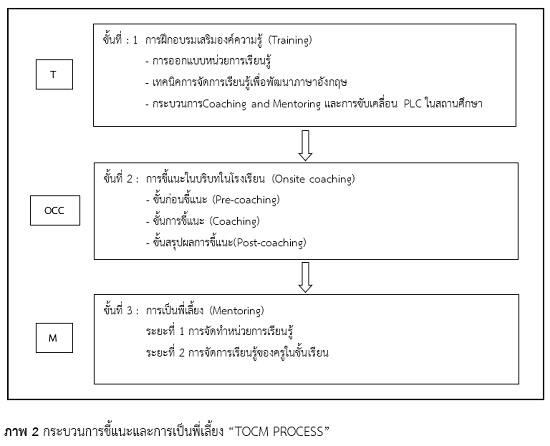
A vital role in upgrading an educational institution to be a global learning organization through participation in learning activities is found in this study. The research purpose was to develop the process of coaching and mentoring. For developing the learning management ability of English teachers in small primary schools, the qualitative and quantitative research were conducted. A specific target group as qualified 7 participants were observed in creating the draft process of coaching and mentoring, also the quality assessment form on suitability and possibility. The content accuracy is between 0.80-1.00, and the data was collected by postal method. This study also showed the analytics on recommendation data with content analysis and analyzed the evaluation score data by using descriptive statistics to find the mean, and the standard deviation. The results showed the process of coaching and mentoring in developing the learning management ability of English teachers in small primary schools. Its appropriateness and feasibleness were at the highest level. The mean is between 4.20-4.80, according to research hypothesis. It is fully developed under the name “TOCM PROCESS” that focused on three key stages: T: Training, OC: Onsite Coaching, and M: Mentoring. Thus, good mentoring processes should be consistent with ethical principles to support the development of the learning environment and increase participation in learning activities on an ongoing basis.
References
Amornkitpinyo, P., Wiratchai, N., & Kajornsin, S. (2008). Effects of Mentoring System on Service Quality and Organizational Loyalty Mediating Job-Based Measures: A Study for Improving of Human Resorce Management in the Private Hospitals. Journal of Research Methodology, 21(3), 341-366. (In Thai)
Best, J., & Kahn, J. V. (1993). Research in Education (7th ed.). Boston : Allyn and Bacon.
Bruner, J. (1990). Acts of meaning. Cambridge, MA : Harvard University Press.
Buendía, X. P. & Macías, D. F. (2019). The professional development of English language teachers in Colombia: a review of the literature. Colomb. Appl. Linguist. J., 21(1), 93-106.
Cornelius, K. E., Rosenberg, M. S., & Sandmel, K. N. (2017). Examining the Impact of Professional Development and Coachning on Mentoring of Novice Special Educators. Action in Teacher Education, 42, 253-270. https://doi.org/10.1080/01626620.2019.1638847
Huat, C., & Torring, D. (2004). Human Resource management in Asia (3rd ed.). Jurong, Singapore : Prentice-Hill.
Jill, A. (2016). Coaching and mentoring in higher education: a step-by-step guide to exemplary practice. New York : Palgrave Macmillan.
Koopman, R., Englis, P. D., Ehrenhard, M. L., & Groen, A. (2021). The Chronological Development of Coaching and Mentoring: Side by Side Disciplines. International Journal of Evidence Based Coaching and Mentoring, 19(1), 137-151. DOI: 10.24384/3w69-k922
Kreitner, R., & Kinicki, A. (2007). Organizational Behavior (7th ed.). New York : McGraw Hill.
Kreitner, R., & Kinicki, A. (2007). Organizational behavior (7th ed.). New York : McGraw-Hill.
Krippendorff, K. (2018). Content analysis: An introduction to its methodology. Los Angeles : Sage publications.
Lancer, N., Clutterbuck, D., & Megginson, D. (2016). Techniques for Coaching and Mentoring (2nd ed.). New York, NY : Routledge Taylor & Francis Group.
Maclennan, N. (2017). Coaching and Mentoring. New York NY : Routledge Taylor & Francis Group.
Mathew, P., Mathew, P., & Peechattu, P. J. (2017). Reflective Practices: A Means to Teacher Development. Asia Pacific Journal of Contemporary Education and Communication Technology (APJCECT), 3(1), 125-131.
Nelson & Quick (2006). Organizational Behavior : Foundations, Realities & Challenges (7th ed.). Mason, Ohio : Thomson Corporation.
Nounlong, T., Intajuck, Y., & Rujimethabhas, S. (2015). The Scenarios and Problems of English Learning and Teaching for Prathomsuksa 4-6 in Dararajchawit School Group under the Uttaradit Primary Educational Service Area Office 1. In National and International Conference Interdisciplinary Research for Local Development Sustainability (IRLDS 2015) (pp. 491-502). Nakhon Sawan : Nakhon Sawan Rajabhat University. (In Thai)
Songbatumis, A. M. (2017). Challenges in Teaching English Faced by English Teachers at MTsN Taliwang, Indonesia. Journal of Foreign Language Teaching & Learning, 2(2), 54-67.
Srisa-ard, B. (2017). Preliminary research (10th ed.). Bangkok : Suwiriyasan. (In Thai)
Stokes, P., Diochon, P. F., & Otter, K. (2021). ‘Two sides of the same coin?’ Coaching & mentoring and the agentic role context. Sheffield Hallam University Research Archive (SHURA), 1-21.
Stufflebeam, D. L. (2000). The CIPP model for evaluation. In D.L. Stufflebeam, G.F. Madaus, & T. Kellaghan, (Eds.), Evaluation Models (2nd ed.). (Chapter 16). Boston : Kluwer Academic Publishers.
Surapaithun Saephung, S. (2019). Development of a supervision model by using coaching process and mentoring system to promote teaching and learning in parallel classrooms for autistic persons in schools under the Office of Secondary Education Service Area 25. Research Report. Bangkok : Office of Secondary Education Service Area 25. (In Thai)
Thanosawan, P., & Datesong, T. (2018). Problems of Teaching and Learning in the ASEAN Economic Community: Case Study of a Bangkok University. In Supporting professional learning in Southeast Asian universities through DEPISA (DEPISA Monograph no. 5) (pp. 174-187). University of Sydney & Phranakhon Rajabhat University, Thailand.
Uppinjai, S., Sukpraphaporn, T., Yavirat, P., Tunkaew, S., & Ariya, S. (2019). The Model of Using the Coaching and Mentoring System in for Induction Program of Teachers in School Under the Office of Primary Education Area, Chiang Rai province. Buabandit Journal of Educational Administration (BUAJEAD), 19(4), 1-13. (In Thai)
Wongyai, W., & Pattaphol, M. (2014). Cognitive Coaching. Bangkok : Charansanitwong Printing. (In Thai)
Downloads
Published
How to Cite
Issue
Section
License

This work is licensed under a Creative Commons Attribution-NonCommercial-NoDerivatives 4.0 International License.