ROLES AND SELF-REGULATION IN ONLINE NEWS ORGANIZATIONS
DOI:
https://doi.org/10.14456/nrru-rdi.2023.42Keywords:
Roles, Online news organization, Self-regulationAbstract
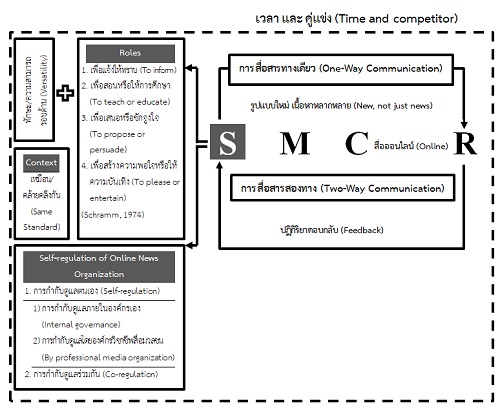
In the era of massive information flow, online media have become an important platform for presentation, and creating many online news organizations. This study aimed to study the roles and responsibilities of the mass media within the context of being an online news organization and a self-regulation. This qualitative research methods were employed, including document collection and in-depth interviews with 6 key informants from traditional media organizations that have transitioned to online news production simultaneously, brand new established organizations, and stand-alone news websites. Data was analyzed using selection criteria under specific conditions. The instruments used were a research framework, and semi-structured interviews (IOC≥0.67) using descriptive analysis. It was found that all online mass media adhered to their roles in presenting news, educating, entertaining, and persuading in the form of two-way communication. As the importance of the receivers increases, presentations need to be more cautious, diverse, and in new formats under factors of timing and competition, and one must be versatile. In term of the context, there are internal standards and shared across all platforms, adapting to technology and consumers. Self-regulation consists of internal regulation, professional association regulation, and joint regulation between professional organizations and the public, which can be seen to change, role development, and standards maintenance, all of which are important for credibility.
References
AmornIsriyachai, A. (2022). SOCIAL MEDIA Social media in the hands of the people. How will the media accept it?. Retrieved June 1, 2022, from https://tu.ac.th/thammasat-090365 -social-media-adaptation-journalists (In Thai)
Chanachaiphuwapat, S., & Timmuang, R. (2019). The study of valuable concepts and the decision criteria development in the white TV award project. Journal of Communication Arts Review, 23(9), 114-129. (In Thai)
Euamornvanich, P. (2019). MASS MEDIA AND SELF-REGUATION. Silpakorn University Journal, 39(3), 150-161. (In Thai)
Freiberg, A. (2010). The Tools of Regulation. New South Wales : The Federation Press.
Haraszti, M. (2008). The Media Self-Regulation Guidebook. Vienna : The OSCE Representative on Freedom of the Media.
Internet Innovation Research Center. (2022). Popular online news site. Retrieved June 1, 2022, from https://truehits.net/ (In Thai)
Key Informants no.1. (2023, 23 March). Professional. Interview. (In Thai)
Key Informants no.2. (2023, 3 March). Professional. Interview. (In Thai)
Key Informants no.3. (2023, 9 March). Professional. Interview. (In Thai)
Key Informants no.4. (2023, 2 March). Professional. Interview. (In Thai)
Key Informants no.5. (2023, 10 March). Professional. Interview. (In Thai)
Key Informants no.6. (2023, 13 March). Professional. Interview. (In Thai)
Lievens, E. (2010). Protecting Children in the Digital Era: The Use of Alternative Regulatory Instruments. Boston : Martinus Nijhoff Publishers.
Rodyu, C. (2019). NEWS IN DIGITAL MEDIA ERA. Parichart Journal Thaksin University, 33(2), 17-33. (In Thai)
Schramm, W. (1974). Mass Media and National Development. London : Standford University Press.
Somkanae, S. (2020). Online news and crises of faith in Thai. Retrieved on June 1, 2022, from media://www.presscouncil.or.th/academic/5400 (In Thai)
Sothanasathien, S. (1990). Communication with society. Bangkok : Chulalongkorn University. (In Thai)
Srisa-ard, B. (2017). Preliminary research. Bangkok : Suwiriyasan. (In Thai)
Straubhaar, J. D., & LaRose, R. (2000). Media Now: Communications Media in the Information Age. California : Wadsworth.
Thai Civil Rights and Investigative Journalism. (2019). Media Disruption: EP10 online media Hopes, dreams, reality. Retrieved on June 1, 2022, from https://www.tcijthai.com/news/2019/8/asean/9615 (In Thai)
Downloads
Published
How to Cite
Issue
Section
License

This work is licensed under a Creative Commons Attribution-NonCommercial-NoDerivatives 4.0 International License.