The Causal Relationships among Competencies, Innovativeness, and Competitive Advantages Affecting the Performance of Smart Farmers in Nakhon Ratchasima, Thailand
DOI:
https://doi.org/10.14456/nrru-rdi.2024.15Keywords:
Competencies, Innovativeness, Competitive Advantages, Performance, Smart FarmersAbstract
Background and Objective: Business operations require innovation to raise the competitiveness of entrepreneurs. Therefore, this research aims to study importance and causal relationships between competencies, innovation capabilities, and competitive advantages that affect operating results. Additional, the study seek to create strategies for promoting and developing smart farmers in Nakhon Ratchasima Province.
Methology: Mixed methods research, a sample size of 400 people was determined through multistage random sampling and a target group of 15 people selected through purposive sampling by using a closed-ended questionnaire with an index of consistency between the questions and the entire objective of 0.96. Field data were collected, distributed, and received back directly. Drafting strategy, organizing a strategy critique workshop, and data analysis were conducted by mean, standard deviation, structural equation analysis, hypothesis testing, SWOT Analysis, and TOWS Matrix.
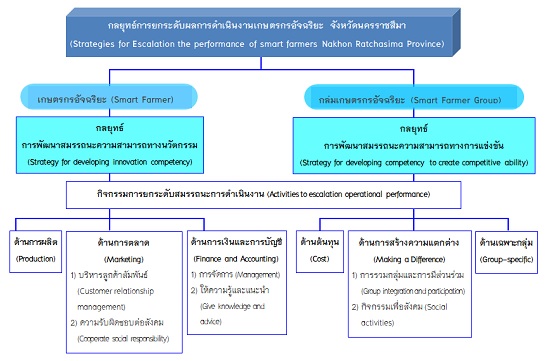
Results: 1) Smart farmers value innovation capabilities and competitive advantage. 2) Competencies directly and positively influence on innovation ability and competitive advantage. Innovation capabilities has a positive direct impact on the performance of smart farmers. Competitive advantage has a positive direct influence on the performance of smart farmers. Competencies have a positive indirect influence on the performance of smart farmers through innovation capabilities and competitive advantage. 3) Strategies of escalating the performance of smart farmers, Nakhon Ratchasima Province has 2 strategies: strategy for developing innovation competencies for smart farmers; and strategies for developing competency and competitiveness for smart farmer groups.
Discussion: Competencies, innovation capabilities, and competitive advantage are an important thing that affects operations. These used to set strategies for optimization and add value for the agricultural industry positively, both directly and indirectly, at the national and global levels.
Suggestion: Emphasis should be placed on creating a technological basis for smart farmers to develop, improve, and promote agricultural innovations appropriating with local wisdom which are in line with needs, economic, social, and environmental dimensions, and have been accepted for long term at all worldwide levels.
References
Aboul-Dahab, S., Agag, G., & Abdelmoety, Z. H. (2021). Examining the influence of cultural and ethical ideology on consumers’ perceptions about the ethics of online retailers and its effects on their loyalty. Journal of Retailing and Consumer Services, 61, 102559. https://doi.org/10.1016/j.jretconser.2021.102559
Agag, G., Brown, A., Hassanein, A., & Shaalan, A. (2020). Decoding travelers’ willingness to pay more for green travel products: Closing the intention–behavior gap. Journal of Sustainable Tourism, 28(10), 1551-1575. https://doi.org/10.1080/09669582.2020.1745215
Agag, G., Durrani, B. A., Shehawy, Y. M., Alharthi, M., Alamoudi, H., El-Halaby, S., Hassanein, A., & Abdelmoety, Z. H. (2023). Understanding the link between customer feedback metrics and firm performance. Journal of Retailing and Consumer Services, 73, 103301. https://doi.org/10.1016/j.jretconser.2023.103301
Agritch and Innovation Center. (2022). Manual for driving the Agricultural Technology and Innovation Center. https://aic.moac.go.th/downloads/document/66.pdf
Aidara, S., Mamun, A. A., Nasir, N. A. M., Mohiuddin, M., Nawi, N. C., & Zainol, N. R. (2021). Competitive advantages of the relationship between entrepreneurial competencies and economic sustainability performance. Sustainability, 13(2), 864. https://doi.org/10.3390/su13020864
Alekseeva, S., Volkova, G., Sukhanova, O., & Fudina, E. (2021). Digital transformation of the agricultural industrial complex in the implementation of its development strategy. Scientific Papers Series Management, Economic Engineering in Agriculture and Rural Development, 21(2), 19-25.
Alshira’h, A. F., Alsqour, M. D., Lutfi, A., Alsyouf, A., & Alshirah, M. (2020). A socio-economic model of sales tax compliance. Economies, 8(4), 88. https://doi.org/10.3390/economies8040088
Ang Thong Provincial Agriculture and Cooperatives Office. (2020). Ang Thong Provincial Agricultural and Cooperative Development Plan 2018-2022, Review Edition 2020. https://www.opsmoac.go.th/angthong-strategic-preview-422791791844
Arshi, T., Burns, P., Ramanathan, U., & Zhang, M. (2020). Bringing back the discourse on entrepreneurial orientation construct: Further clarification on its dimensions. Journal for International Business and Entrepreneurship Development, 12(4), 235257. http://dx.doi.org/10.13140/RG.2.2.24011.54568
Beluhova-Uzunova, R., & Dunchev, D. (2020). Precision technologies in soft fruit production. Scientific Papers Series Management, Economic Engineering in Agriculture and Rural Development, 20(3), 131-137.
Best, J. W., & Kahn, J. (2006). Research in Education. Prentice Hall of India.
Bhatti, S. H., Hussain, W. M. H. W., Khan, J., Sultan, S., & Ferraris, A. (2024). Exploring data-driven innovation: what’s missing in the relationship between big data analytics capabilities and supply chain innovation? Annals of Operations Research, 333(2), 799-824. https://doi.org/10.1007/s10479-022-04772-7
Carvalho, A. M., Sampaio, P., Rebentisch, E., Carvalho, J. Á., & Saraiva, P. (2021). The influence of operational excellence on the culture and agility of organizations: Evidence from industry. International Journal of Quality & Reliability Management, 38, 1520–1549. https://doi.org/10.1108/IJQRM-07-2020-0248
Chan-iam, R. (2021). How has modern agriculture changed? Journal of Chemical Industry, 63, 9-12.
Chaudhuri, A., Subramanian, N., & Dora, M. (2022). Circular economy and digital capabilities of SMEs for providing value to customers: Combined resource-based view and ambidexterity perspective. Journal of Business Research, 142, 32-44. https://doi.org/10.1016/j.jbusres.2021.12.039
Chelliah, M. K., Aravindan, K. L., & Muthaiyah, S. (2022). Entrepreneurial orientation and open innovation promote the performance of services SMEs: The mediating role of cost leadership. Administrative Sciences, 13(1), 1. https://doi.org/10.3390/admsci13010001
Comrey, A. L., & Lee, H. B. (1992). A first course in factor analysis (2nd ed.). Lawrence Erlbaum Associates.
Cukier, K. (2021). Commentary: How AI shapes consumer experiences and expectations. Journal of Marketing, 85(1), 152–155. https://doi.org/10.1177/0022242920972932
Duangnirat, B. (n.d.). Agriculture, is a choice, a way to survive. Digital Economy Promotion Agency. https://www.depa.or.th/en/article-view/agriculture-alternative-way-of-survival
Ferreira, J., Coelho, A., & Moutinho, L. (2020). Dynamic capabilities, creativity, and innovation capability and their impact on competitive advantage and firm performance: The moderating role of entrepreneurial orientation. Technovation, 92, 102061. https://doi.org/10.1016/j.technovation.2018.11.004
Gall, M. D., Borg, W. R., & Gall, J. P. (1996). Educational Research: An Introduction (6th ed.). Longman Publisher.
Giannakis, M., Dubey, R., Yan, S., Spanaki, K., & Papadopoulos, T. (2022). Social media and sensemaking patterns in new product development: Demystifying the customer sentiment. Annals of Operations Research, 308(1), 145–175. https://doi.org/10.1007/s10479-020-03775-6
Hair, J. F. JR., Anderson R. E., Tatham, R. L., & Black, W. C. (2010). Multivariate Data Analysis. Prentice hall.
Hindasah, L., & Nuryakin, N. (2020). The Relationship between Organizational Capability, Organizational Learning, and Financial Performance. Journal of Asian Finance, Economics and Business, 7(8), 625-633. https://doi.org/10.13106/jafeb.2020.vol7.no8.625
Kamket, W. (2012). Research methods in behavioral science (3rd ed.). Chulalongkorn University Press.
Kline, R. B. (2011). Principles and Practice of Structural Equation Modeling (3rd ed.). The Guilford Press.
Kozak, J., Kania, K., Juszczuk, P., & Mitręga, M. (2021). Swarm intelligence goal-oriented approach to data-driven innovation in customer churn management. International Journal of Information Management, 60, 102357. https://doi.org/10.1016/j.ijinfomgt.2021.102357
Kulovic, D., Celebic, N., & Omercevic, S. (2023). Advanced Human Resource Management. University Sarajevo School of Science and Technology.
Lalicic, L., & Weismayer, C. (2021). Consumers’ reasons and perceived value co-creation of using artificial intelligence-enabled travel service agents. Journal of Business Research, 129, 891-901. https://doi.org/10.1016/j.jbusres.2020.11.005
Lee, C. C., Yuan, Z., & Wang, Q. (2022). How does information and communication technology affect energy security? International evidence. Energy Economics, 109, 105969. https://doi.org/10.1016/j.eneco.2022.105969
Maity, R., Sudhakar, K., Abdul Razak, A., Karthick, A., & Barbulescu, D. (2023). Agrivoltaic: A strategic assessment using SWOT and TOWS Matrix. Energies, 16(8), 3313. https://doi.org/10.3390/en16083313
Malinina, O., & Gurieva, A. (2024). Methodological foundations for the application of the competency-based approach to personnel development in the context of agriculture digitalization. In BIO Web of Conferences (Vol. 103, p. 00052). EDP Sciences.
Naguib, H. M., Kassem, H. M., & Naem, A. E. H. M. A. (2024). The impact of IT governance and data governance on financial and non-financial performance. Future Business Journal, 10(1), 1-22. https://doi.org/10.1186/s43093-024-00300-0
Nakhon Ratchasima Provincial Agriculture and Cooperatives Office. (2022). Nakhon Ratchasima Province Agricultural and Cooperative Development Plan 2023–2027. https://www.opsmoac.go.th/nakhonratchasima-strategic-files-442791791797
Nakhon Ratchasima Provincial Agriculture Office. (2020). Annual Report 2020-Smart farmers [Unpublished Data]. (n.p.)
Nakhon Ratchasima Provincial Office. (2023). Nakhon Ratchasima Provincial Development Plan, 5-year period (2023-2027). https://www2.nakhonratchasima.go.th/files/com_ebook_strategy/2023-11_86d83e18dd2fc32.pdf
Office of the National Economic and Social Development Council. (2023). Report on the economic and social development of the country Under the Development Plan No. 12. https://www.nesdc.go.th/download/document/Yearend/2023/yearend2023-02.pdf
Pallant, J. (2020). SPSS survival manual: A step-by-step guide to data analysis using IBM SPSS. Routledge.
Rammal, H. G., Rose, E. L., & Ferreira, J. J. (2023). Managing cross-border knowledge transfer for innovation: An introduction to the special issue. International Business Review, 32(2), 102098. https://doi.org/10.1016/j.ibusrev.2022.102098
Rumondang, A., Sudirman, A., & Sitorus, S. (2020). Pemasaran Digital dan Perilaku Konsumen. Yayasan Kita Menulis.
Schumacker, R. E., & Lomax, R. G. (2010). A beginner’s guide to structural equation modeling. Routledge Taylor & Francis Group.
Strategy and Information for Provincial Development Group, Nakhon Ratchasima Provincial Office. (2022). Nakhon Ratchasima Provincial Development Plan ( 2023-2027 ), revised edition, year 2024. https://pld.vu.ac.th/wp/wp-content/uploads/2023/01/แผนพัฒนาkorat5ปี-65-70_230111_083511-1.pdf
Sultana, S., Akter, S., & Kyriazis, E. (2022). How data-driven innovation capability is shaping the future of market agility and competitive performance? Technological Forecasting and Social Change, 174, 121260. https://doi.org/10.1016/j.techfore.2021.121260
Tan, T. F., & Staats, B. R. (2020). Behavioral drivers of routing decisions: Evidence from restaurant table assignment. Production and Operations Management, 29(4), 1050–1070. https://doi.org/10.1111/poms.13155
The working group was driving the policy of Smart Farmer and Smart Officer, Department of Agricultural Extension. (2013). Guide to driving Smart Farmer and Smart Officer policies. Nakhon Ratchasima Provincial Agriculture Office. http://www.khorat.doae.go.th/WEB2012/Smartfarmer/book.pdf
Wijethilake, C., Upadhaya, B., & Lama, T. (2023). The role of organizational culture in organizational change towards sustainability: Evidence from the garment manufacturing industry. Production Planning & Control, 34(3), 275–294. https://doi.org/10.1080/09537287.2021.1913524
Downloads
Published
How to Cite
Issue
Section
License
Copyright (c) 2024 Research and Development Institute, Nakhon Ratchasima Rajabhat University

This work is licensed under a Creative Commons Attribution-NonCommercial-NoDerivatives 4.0 International License.