Preparation Model for professional teaching experience training of mathematics teachers' students, Yala Rajabhat University
DOI:
https://doi.org/10.14456/rc-sdj.2025.12Keywords:
PROM model, professional teaching experience training, student mathematics teachersAbstract
Background: Preparing student teachers for professional practicum is essential to build confidence before engaging in real classroom practice. This study aimed to investigate the model and examine student satisfaction with practicum readiness among mathematics education students at Yala Rajabhat University.
Methods: This research and development study was conducted in four phases. Phase one, data exploration, involved nine key informants who participated in semi-structured, in-depth individual interviews, which were analyzed through descriptive content analysis. Phase two, model development, involved engaging five participants to evaluate the appropriateness of the model through focus group discussions, which were analyzed using the mean index of item-objective congruence. Phase three, model implementation, applied the developed model to 32 cluster-sampled students. Instruments used a readiness assessment and satisfaction questionnaire, employing a one-group pretest–posttest design. Data were analyzed using descriptive statistics (mean, standard deviation) and inferential statistics (t-test). Phase four, model refinement, analyzed open-ended responses from readiness and satisfaction evaluations.
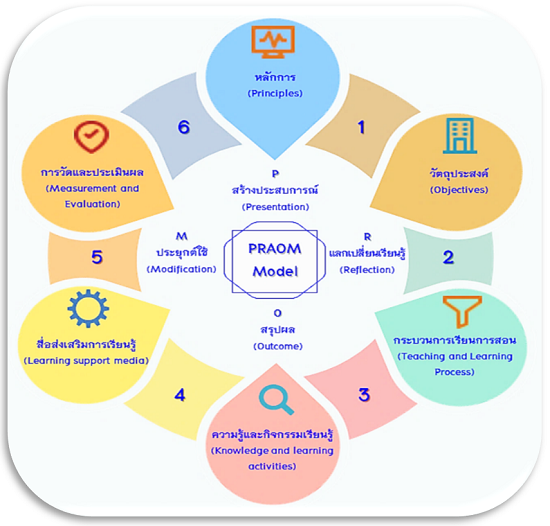
Results: The developed “PROM Model” consisted of components principles, objectives, instructional processes, knowledge content, learning activities, and supportive learning media and steps: experience building, knowledge sharing, summarization, and application. The model demonstrated high appropriateness. Comparative results indicated significant improvement after implementation (M=4.41) compared to before (M=3.75), with statistical significance at the 0.05 level (p=-6.171). Student satisfaction with the model was high (M=4.06, S.D.=0.84).
Conclusions: The preparation model for mathematics student teachers’ professional practicum at Yala Rajabhat University comprises six elements and four steps, showing high appropriateness and effectiveness. The model significantly enhanced students’ readiness and satisfaction, particularly emphasizing the role of instructors in supporting model development and application. This suggests the model’s potential for practical use in teacher education institutions to strengthen professional practice.
References
Announcement of the Ministry of Education on Higher Education Standards B.E. 2561. (2018, August 17). Royal Gazette. Volume 135, Special Issue 199, pp. 19-21.
Ardae, A., & Alhusein, I. (2018). The Study of Results of Teaching Professional Practicum on Students in Teaching Islamic Education Program, Yala Rajabhat University. Faculty of Education, Yala Rajabhat University.
Arends, R. I. (1999). Classroom instruction and management. McGraw Hill.
Arifin, A., Suryaningsih, S. S., M. Pd. K., & Arifudin, O. (2024). The Relationship Between Classroom Environment, Teacher Professional Development, and Student Academic Performance in Secondary Education. International Education Trend Issues, 2(2), 151-159. https://doi.org/10.56442/ieti.v2i2.467
Bailey, K. D. (1987). Methods of Social Research (3rd ed.). The Free Press.
Bhagoji, M. D. (2024). Navigating Global Dynamics in Teacher Education: A Comprehensive Overview. Shodh Sari-An International Multidisciplinary Journal, 3(01), 123-133. https://doi.org/10.59231/SARI7660
Biggs, J., & Tang, C. (2011). Teaching for quality learning at university (4th ed.). Open University Press.
Biggs, J., & Tang, C. (2014). Constructive alignment: An outcomes-based approach to teaching anatomy. In Teaching anatomy: A practical guide (pp. 31-38). Springer International Publishing.
Biggs, J., & Tang, C. (2014). Teaching for quality learning at university (4th ed.). Open University Press.
Bunphirom, S. (2014). Self-actualization for teachers. Triple Education.
Cronbach, L. J. (1951). Coefficient alpha and the internal structure of tests. Psychometrika, 16(3), 297-334.
Field, A. (2024). Discovering statistics using IBM SPSS statistics (6th ed.). Sage.
Guse, J. (2011). Communicative Activities for EAP. Cambridge: Cambridge University Press.
Hargie, O. (2019). The handbook of Communication Skills (4th ed.). Routledge.
Jatikul, S., Srikaew, P., Sangka, P., Chaipa, K., & Phrakrusophitchaiwong. (2024). Evaluation of Teaching Practices of Teaching Professional Training Students Thai Language Teaching Field, Mahachulalongkornrajavidyalaya University, Phayao Campus. Journal of SaengKhomKham Buddhist Studies, 9(2), 378-394.
Joyce, B., & Calhoun, E. (2025). Models of Teaching (10th ed.). Routledge.
Joyce, B., Weil, M., & Calhoun, E. (2004). Models of teaching. Allyn and Bacon.
Killian, J., & Todnem, G. (1991). Reflective Judgement: Concepts of Justification and there relationship to age and education. Journal of Applied Developmental Psychology, 2(2), 89-116.
Liu, W. C. (2024). The teaching profession and teacher education in Singapore (1950 to present): From surviving to thriving. Revista Española de Educación Comparada, 44, 23-50. http://dx.doi.org/10.5944/reec.44.2024.37808
Magill, R., & Anderson, D. (2014). Motor learning and control: concepts and applications (10th ed.). McGraw-Hill.
Mariam, N. (2016). Educational Research Methods (9th ed.). Faculty of Education, Silpakorn University.
Marlina, R., Suwono, H., Yuenyong, C., & Ibrohim, P. R., & Hamdani, H. (2024). Micro teaching as efficient technique to increase self-efficacy of prospective biology teacher: evidence from first year teacher. Jurnal Pendidikan Sains Indonesia (Indonesian Journal of Science Education), 12(4), 769-785. https://dx.doi.org/10.24815/jpsi.v12i4.38720
Maxwell, J. A. (2005). Qualitative Research Design: An Interactive Approach (2nd ed.). Sage.
Ministry of Education. (2019, February 16). Bachelor's degree qualification standards in education and educational sciences (four-year curriculum) 2019. In the document appended to the Ministry of Education announcement on Bachelor's degree qualification standards in education and educational sciences (four-year curriculum) 2019 (pp. 1-39). Announcement of the Ministry of Education. https://www.ratchakitcha.soc.go.th/DATA/PDF/2562/E/056/T_0012.PDF
Moon, J. A. (2004). A handbook of reflective and experiential learning: theory and practice. RoutledFalmer.
Nopas, D. S., & Kerdsomboon, C. (2024). Fostering Global Competence in Teacher Education: Curriculum Integration and Professional Development. Higher Education Studies, 14(2), 1-13. https://doi.org/10.5539/hes.v14n2p1
OECD (Organisation for Economic Co-operation and Development). (2021, April 15). Thailand’s education system and skills imbalances: Assessmentand policy recommendations. https://one.oecd.org/document/ECO/WKP(2020)49/En/pdf
Poolbun, P. (2020). Development Of A Teacher Professional Development Model To Enhance The Science Teaching Ability Using Scientfic Argumentation For Pre-Service Science Teachers [Doctoral’ dissertation, Srinakharinwirot University]. http://ir-ithesis.swu.ac.th/dspace/bitstream/123456789/1005/1/gs571120040.pdf
Rerksamut, P. (2022). Development of a teacher professional experience training model to improve student teachers' learning management through action research processes at Srinakharinwirot University Demonstration School, Ongkharak. Srinakharinwirot Research and Development Journal, Humanities and Social Sciences, 14(28), 81–92.
Srisa-ard, B. (2017). Preliminary Research (10th ed.). Suwiriyasan.
Teachers Council Regulations on Professional Standards B.E. 2556. (2013, October 4). Royal Gazette. Volume 130, Special Issue 130, pp. 65-71.
Uchuap, P. (2019). Education and teaching profession. Chulalongkorn University Press.
Vygotsky, L. S. (1978). Mind in society: The development of higher psychological processes. Harvard University Press.
Vygotsky, L. S. (1997). The Historical Meaning of the Crisis in Psychology: A Methodological Investigation. In R. W. Rieber & J. Wollock (Eds.), Problems of the Theory and History of Psychology (pp. 233-344). Plenum.
Vygotsky, L. S. (2012). Thought and language (Vol. 29). MIT press.
Wertsch, J. V. (1998). Mind as Action. Oxford University Press.
Wisalaphon, S. (2008). Leadership. In Compilation of theories and practices in educational administration (Unit 5, pages 33-34). Sukhothai Thammathirat Open University.
Yala Rajabhat University. (2015, October 24). Teacher Professional Practice Manual 1 (Observation and Participation in Educational Institutions). Download Document. https://edu.yru.ac.th/prof/view/111_คู่มือฝึกปฏิบัติการวิชาชีพครู1_ขั้นสังเกตและมีส่วนร่วมในสถานศึกษา_(ปี4_1_59).html