
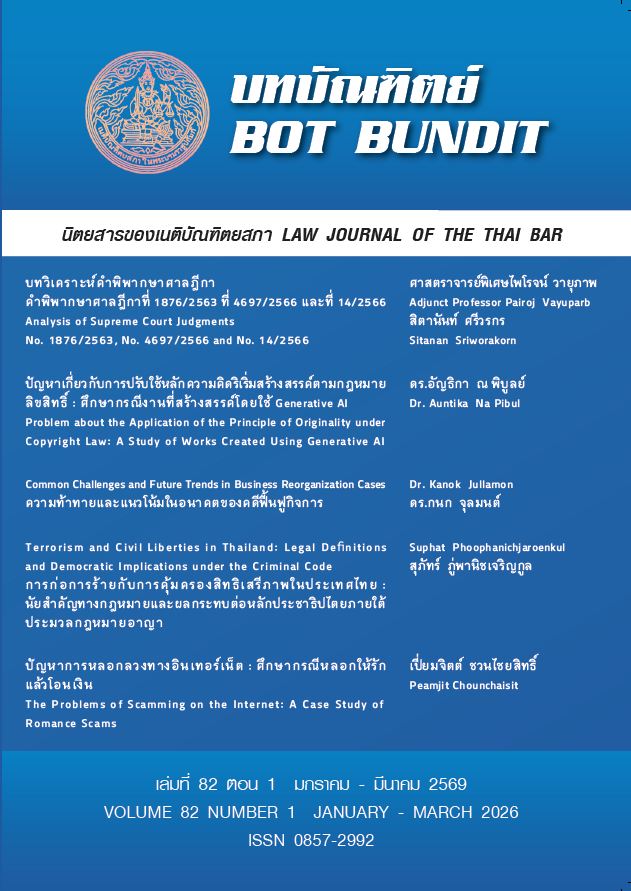
ปัญหาเกี่ยวกับการปรับใช้หลักความคิดริเริ่มสร้างสรรค์ตามกฎหมายลิขสิทธิ์ : ศึกษากรณีงานที่สร้างสรรค์โดยใช้ Generative Al
Article Sidebar
Main Article Content
บทคัดย่อ
ความคิดริเริ่มสร้างสรรค์เป็นหลักเกณฑ์สำคัญที่ใช้ในการพิจารณาว่างานใดสมควรได้รับความคุ้มครองตามกฎหมายลิขสิทธิ์ แต่อย่างไรก็ตาม การเกิดขึ้นของปัญญาประดิษฐ์เชิงสร้างสรรค์ (Generative Al) ซึ่งสามารถสร้างผลงานโดยเลียนแบบความคิดของมนุษย์ได้โดยอัตโนมัติได้สร้างความท้าทายอย่างยิ่งต่อกรอบแนวคิดดั้งเดิมเกี่ยวกับหลักเกณฑ์ในเรื่องความคิดสร้างสรรค์ดังกล่าว งานวิจัยนี้มุ่งศึกษาลักษณะและสถานะทางกฎหมายของงานสร้างสรรค์ที่เกิดขึ้นจากการใช้ปัญญาประดิษฐ์เชิงสร้างสรรค์ โดยจำแนกออกเป็นสองประเภท ได้แก่ (1) งานที่สร้างสรรค์โดยปัญญาประดิษฐ์โดยสมบูรณ์ (Al-generated works) และ (2) งานที่มนุษย์ใช้ปัญญาประดิษฐ์เป็นเครื่องมือช่วยในการสร้างสรรค์ผลงาน (Al-assisted works) งานวิจัยใช้วิธีการศึกษากฎหมายเชิงเปรียบเทียบโดยวิเคราะห์บทบัญญัติทางกฎหมาย แนวปฏิบัติ และกรณีศึกษาที่เกี่ยวข้องกับการปรับใช้หลักความคิดริเริ่มสร้างสรรค์ตามกฎหมายลิขสิทธิ์ของประเทศไทยและต่างประเทศ ได้แก่ สหรัฐอเมริกา สหภาพยุโรป สหราชอาณาจักร และสาธารณรัฐประชาชนจีน เพื่อวิเคราะห์ปัญหาที่เกิดขึ้นจากการปรับใช้ความหลักความคิดริเริ่มสร้างสรรค์ภายใต้กฎหมายไทยในบริบทของงานสร้างสรรค์แต่ละประเภท
ผลการศึกษาพบว่า หลักความคิดริเริ่มสร้างสรรค์ตามกฎหมายลิขสิทธิ์ไทยในปัจจุบัน ซึ่งยังคงยึดโยงอยู่กับแนวคิดของผู้สร้างสรรค์ที่เป็นมนุษย์นั้น ยังไม่สามารถรองรับลักษณะการสร้างสรรค์ที่เกี่ยวข้องกับปัญญาประดิษฐ์เชิงสร้างสรรค์ได้ โดยเฉพาะในกรณีที่บทบาทของมนุษย์และปัญญาประดิษฐ์มีความทับซ้อนกัน ส่งผลให้เกิดความไม่แน่นอนทางกฎหมายในการกำหนดสถานะความเป็นผู้สร้างสรรค์และการคุ้มครองลิขสิทธิ์ ในท้ายที่สุด งานวิจัยนี้เสนอแนะแนวทางเชิงนโยบายเพื่อปรับใช้หลักความคิดริเริ่มสร้างสรรค์ให้สอดคล้องกับพัฒนาการทางเทคโนโลยี อันจะช่วยสร้างสมดุลระหว่างการคุ้มครองสิทธิของผู้สร้างสรรค์และการส่งเสริมนวัตกรรมในยุคดิจิทัลอย่างเหมาะสมและยั่งยืน
Article Details

อนุญาตภายใต้เงื่อนไข Creative Commons Attribution-NonCommercial-NoDerivatives 4.0 International License.
เอกสารอ้างอิง
กฎหมาย
Berne Convention for the Protection of Literary and Artistic Works (adopted 9 September 1886, as amended).
Agreement on Trade-Related Aspects of Intellectual Property Rights (TRIPS) (adopted 15 April 1994, entered into force 1 January 1995).
WIPO Copyright Treaty (WCT) (adopted 20 December 1996, entered into force 6 March 2002).
Copyright Act 1976 (United States).
Copyright, Designs and Patents Act 1988 (UK).
Copyright Law of the People's Republic of China (amended 2020).
Directive 2001/29/EC (InfoSoc Directive).
Directive 2009/24/EC (Software Directive).
เอกสารหน่วยงานที่เกี่ยวข้อง
European Parliamentary Research Service, Copyright of Al-generated Works: Approaches in the EU and Beyond (December 2025, PE 782.585).
European Parliament, Report on Intellectual Property Rights for the Development of Artificial Intelligence TechnologiesA9-0176/2020 (Committee on Legal Affairs, 2 October 2020).
European Union Intellectual Property Office, The Development of Generative Artificial Intelligence from a Copyright Perspective (Publications Office of the European Union 2025).
UK Intellectual Property Office, Artificial Intelligence and Intellectual Property: Copyright and Patents (2021).
U.S. Copyright Office, Copyright Registration Guidance: Works Containing Material Generated by Artificial Intelligence (Federal Register, vol 88 no 51, 16 March 2023).
U.S. Copyright Office, Copyright and Artificial Intelligence Part 2: Copyrightability (January 2025).
คดีและกรณีศึกษา
Football Dataco Ltd and Others v Yahoo! UK Ltd and Others (C-604/10) [2012] ECLI:EU:C:2012:115.
Infopaq International A/S v Danske Dagblades Forening (C-5/08) EU:C:2009:465.
Naruto v Slater 888 F 3d 418 (9th Cir 2018).
SAS Institute Inc v World Programming Ltd (C-406/10) [2012] ECLI:EU:C:2012:259.
Sarah Andersen and others v Stability Al Ltd and others, No 3:23-cv-00201 (ND Cal, filed 13 January 2023).
Shenzhen Tencent Computer System Co Ltd v Shanghai Yingxun Technology Co Ltd (Nanshan District People's Court, Shenzhen, 24 December 2019) (2019) Yue 0305 Min Chu No 14010.
Stichting de Thuiskopie v Minister voor Justitie (Business Software Alliance intervening) (C-393/09) [2010] ECLI:EU:C:2010:816.
University of London Press Ltd v University Tutorial Press Ltd [1916] 2 Ch 601 (Ch).
Li v Liu (Beijing Internet Court, 27 November 2023) (2023) Jing 0491 Min Chu No 1127.
บทความ
Abbott R and Rothman E, 'Disrupting Creativity: Copyright Law in the Age of Generative Artificial Intelligence' (2023) 75 Florida Law Review.
Anthi Gaidartzi and Irini Stamatoudi, 'Authorship and Ownership Issues Raised by Al-Generated Works: A Comparative Analysis' (2025) 14 Laws (MDPI) art 57.
Dan L. Burk, 'Intellectual Property and the Problem of Machine Creativity' (2018) 57 UC Davis Law Review 1149.
Han Wang, 'Authorship of Artificial Intelligence-Generated Works and Possible System Improvement in China' (2023) 14 Beijing Law Review 903.
Jane C. Ginsburg, 'People Not Machines: Authorship and What It Means in International Copyright Law' in Graeme W Austin and others (eds), Across Intellectual Property: Essays in Honour of Sam Ricketson (CUP 2020).
Lionel Bently, Brad Sherman, Dev Gangjee and Phillip Johnson, Intellectual Property Law (5th edn, OUP 2018)
Marian Mazzone and Ahmed Elgammal, 'Art, Creativity, and the Potential of Artificial Intelligence' (2019) 8(1) Arts 26.
Mark A. Casey and Guido Noto La Diega, 'Generative Artificial Intelligence, Copyright and the Training-Output Divide' (2024) 47 Columbia Journal of Law & the Arts 1.
Mark A. Lemley and Bryan Casey, 'Fair Learning' (2021) 109 Texas Law Review 743.
Mark A. Lemley and Bryan Casey, 'How Generative Al Turns Copyright Upside Down' (2024) 25 Science & Technology Law Review 21.
Mark Sample, 'Creative Machines and the Novel: Ross Goodwin's 1 the Road' (2018) 55(3) American Book Review.
Matteo Da Pelo, 'Artificial Creativity: Can There Be Creativity Without Cognition?' (2025) Al & Society.
P Bernt Hugenholtz and João Pedro Quintais, 'Copyright and Artificial Creation: Does EU Copyright Law Protect Al-Assisted Output?' (2021) 52 IIC 1190.
Pamela Samuelson, 'Allocating Ownership Rights in Computer-Generated Works' (1985) 47 University of Pittsburgh Law Review 1185.
Pamela Samuelson, 'Implications of Artificial Intelligence for Copyright Law' (2020) 25 Journal of Intellectual Property Law 1.
Rita Matulionyte and Jyh-An Lee, 'Copyright in Al-generated Works: Lessons from Recent Developments in Patent Law' (2022) 19(1) SCRIPTed.
Sofia Karttunen, 'Copyright of Al-generated Works: Approaches in the EU and Beyond' (European Parliamentary Research Service, Members' Research Service 2025).
Stefan Feuerriegel, Jochen Hartmann, Christian Janiesch and Patrick Zschech, 'Generative Artificial Intelligence: Foundations, Models and Applications' (2023) LMU Munich Working Paper.
