
On The Exponential Diophantine Equation (4n-1)^x +63^y =z^2 where (4n-1) is Prime
Article Sidebar
Main Article Content
Abstract
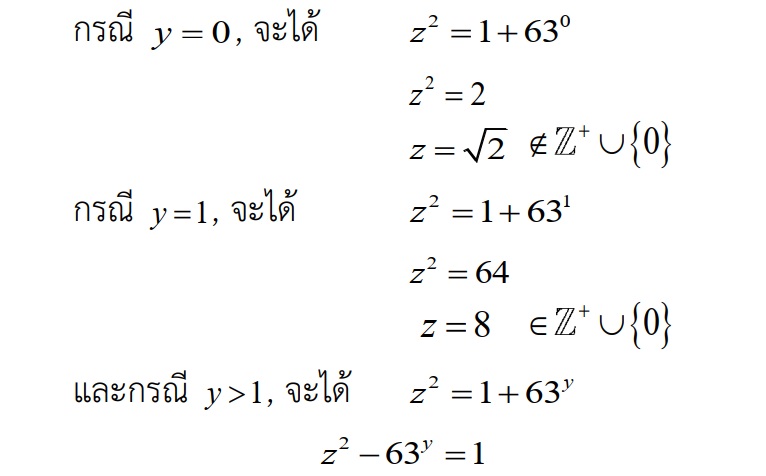
In this paper, we study the exponential Diophantine equation (4n-1)^x +63^y =z^2 where (4n-1) is prime. We found that all non-negative integer solutions are of the following (n,x,y,z)\epsilon \left\{ (1,1,0,2),(1,4,1,12),(8,2,1,32)\right\}\cup \left\{(n,0,1,8)\right\}\cup \left\{ \left ( \frac{63^m+1}{2},1,2m,63^m+1 \right )\right\}, where n,m are positive integers x,y and z are non-negative integers. In the proof, we apply reasonably Catalan's conjecture and various theorems concerning the congruence to obtain the solution.
Article Details
References
สุทธิวัฒน์ ทองนาค' วาเรียม ช่วยจันทร์ และ ธีรเดช เกี้อวงค์. วารสารคณิตศาสตร์ Mathematical Journal 66(703) มกราคม – เมษายน 2564. สมการไดโอแฟนไทน์เลขชี้กำลัง 7^x-5^y=z^2 มีผลเฉลยเพียงผลเฉลยหนึ่งเดียว คือ (x,y,z)=(0,0,0) เมื่อ x,y และ z เป็นจำนวนเต็มที่ไม่เป็นลบ: สมาคมคณิตศาสตร์แห่งประเทศไทยในพระบรมราชูปถัมภ์
Acu, D. (2007). On A Diophantine Equation 2^x+5^y=z^2 . General Mathematics, 4, p. 145 - 148.
Catalan, E. (1844). Note Extraite Dune Lettre Adressee a Lediteur. Journal fur die Reine and Angewandte Mathematik, 27, p. 192.
Makate, N., Srimud, K, Warong, A., and Supjaroen, W. (2019). On The Diophantine Equation 8^x+61^y=z^2 and 8^x+67^y=z^2 . Mathematical Journal by The Mathematical Association of Thailand Under The Patronage of His Majesty the King, 64 (697), p. 24 - 29.
Khan, Md. A. A., Rashid, A. and Uddin, Md. S. (2016). Non-Negative Integer Solutions of Two Diophantine Equations 2^x+9^y=z^2 and 5^x+9^y=z^2 . Journal of Applied Mathematics and Physics,4(4), p. 762 - 765.
