
Factors Associated with Rabies Prevention Behavior Among Residents in Lom Kao Subdistrict Municipality, Lom Kao District, Phetchabun Province
Article Sidebar
Main Article Content
Abstract
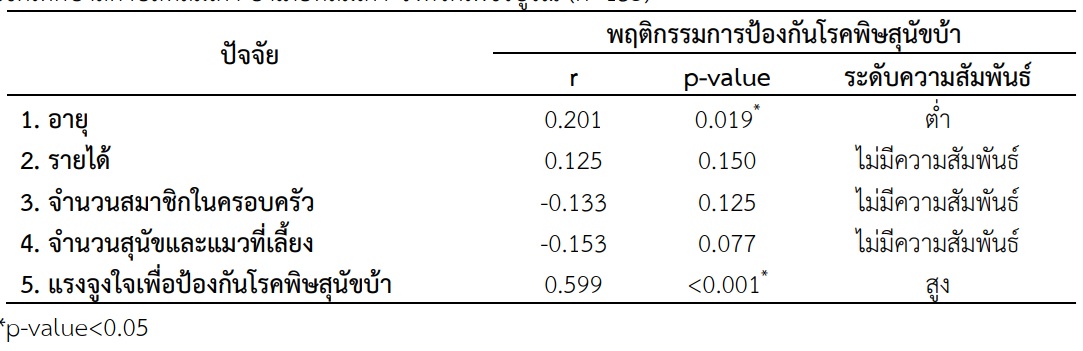
Rabies is a serious zoonotic disease that continues to be a significant public health problem in many areas around the world. It affects lives and causes fear and anxiety in society. This study is a cross-sectional descriptive research aimed at studying behaviors and factors associated with rabies prevention behaviors among the population in Lom Kao Subdistrict Municipality, Lom Kao District, Phetchabun Province. The sample consisted of 135 pet-owning residents selected through simple random sampling. Data were collected using questionnaires and analyzed using descriptive statistics and inferential statistics, including Chi-square analysis and Pearson’s correlation coefficient, with the statistical significance level set at 0.05. The results revealed that the overall rabies prevention behavior among the participants was at a high level ( = 3.87, S.D. = 0.63), while the overall motivation for rabies prevention was at a moderate level ( = 3.64, S.D. = 0.38). Factors found to be significantly associated with rabies prevention behavior included age (r = 0.201, p-value = 0.019), occupation (p-value = 0.033), history of animal bites, scratches, or licks (p-value = 0.011), access to rabies-related information (p-value = 0.026), and motivation for rabies prevention (r = 0.599, p-value < 0.001). The findings of this study will lead to the development of strategies and guidelines to promote rabies prevention behaviors by local administrative organizations, public health agencies, livestock departments, as well as community networks, to effectively and appropriately prevent rabies in accordance with the community context.
Article Details
References
กรมควบคุมโรค. 2568. แพทย์เตือน ไม่ชำแหละสัตว์ที่ป่วยตายผิดปกติ สัตว์เลี้ยงอาจติดเชื้อโรคพิษสุนัขบ้า ย้ำโรคนี้พบได้ในทุกฤดู. แหล่งข้อมูล:
https://ddc.moph.go.th/odpc7/news.php?news=49522&deptcode=odpc7&news_views=695. ค้นเมื่อ 12 มิถุนายน 2568.
เคโก๊ะ อาไก, จิราพร ชมพิกุล และชีระวิทย์ รัตนพันธ์. 2558. พฤติกรรมการป้องกันโรคพิษสุนัขบ้าของเจ้าของ สุนัขในจังหวัดนครปฐม ประเทศไทย. วารสารสาธารณสุขและการพัฒนา, 13(1): 17-28.
เทศบาลตำบลหล่มเก่า. 2566. ระบบสารสนเทศเพื่อเฝ้าระวังโรคพิษสุนัขบ้า. แหล่งข้อมูล:http://www.thairabies.net/trn/. ค้นเมื่อ 1 พฤศจิกายน 2567.
พรชนก ยี่ลังกา. 2564. ปัจจัยที่มีความสัมพันธ์กับพฤติกรรมสุขภาพของผู้สัมผัสโรคพิษสุนัขบ้าที่มารับบริการที่ โรงพยาบาลแม่อาย จังหวัดเชียงใหม่. วารสารการส่งเสริมสุขภาพและอนามัยสิ่งแวดล้อมล้านนา, 11(1): 28-38.
พุธิตา ภู่มี. 2565. ปัจจัยที่มีผลต่อพฤติกรรมการป้องกันโรคพิษสุนัขบ้าของเจ้าของสัตว์เลี้ยง ตำบลพุทธบาท อำเภอชนแดน จังหวัดเพชรบูรณ์. วารสารควบคุมโรค, 48(2): 278-292.
ยุทธพงษ์ ครชาตรี. 2565. ปัจจัยที่มีความสัมพันธ์กับพฤติกรรมการป้องกันโรคพิษสุนัขบ้าของเจ้าของสุนัข
ตำบลเขาวิเศษ อำเภอวังวิเศษ จังหวัดตรัง. Thaksin University Online Journal: 1-11.
โรงพยาบาลสมเด็จพระยุพราชหล่มเก่า. 2566. รายงานผู้สัมผัสโรคพิษสุนัขบ้า ปี 2566.
วรรณวิมล สุรินทร์ศักดิ์, กาญจนา อ่ำอินทร์ ประวิทย์ คำนึง และเอกรินทร์ วัฒนพลายชยกูร. 2559. พฤติกรรมการป้องกันโรคพิษสุนัขบ้าของประชาชนในพื้นที่ชายแดนจังหวัดสระแก้ว. รายงานการเฝ้าระวังทางระบาด วิทยาประจำสัปดาห์, 47(34): 529-535.
ศิรินันท์ คำสี. 2561. ความเชื่อด้านสุขภาพที่ส่งผลต่อพฤติกรรมการป้องกันโรคพิษสุนัขบ้าในพื้นที่มีการระบาด ตำบลหัวไทร อำเภอบางคล้า จังหวัดฉะเชิงเทรา. วารสารกรมการแพทย์, 43(2): 137–140.
สุธิดา ม่วงน้อยเจริญ เฮิร์น, ประวิทย์ ชุมเกษียณ และภาวินี ด้วงเงิน. 2566. การวิเคราะห์สถานการณ์โรคพิษ สุนัขบ้า ประเทศไทย ปี พ.ศ.2566. รายงานเฝ้าระวังทางระบาดวิทยาประจำสัปดาห์, 54(21): 321–324.สุรเดช สำราญจิตต์. 2567. พฤติกรรมสุขภาพทางสาธารณสุข. เอกสารประกอบการสอนวิชา PHA 6303 พฤติกรรมสุขภาพทางสาธารณสุข. กรุงเทพมหานคร: สำนักพิมพ์มหาวิทยาลัยรามคำแหง.
สำนักงานปศุสัตว์จังหวัดเพชรบูรณ์. 2561. การดำเนินงานป้องกันและควบคุมโรคพิษสุนัขบ้า. แหล่งข้อมูล:
http://pvlo-pbn.dld.go.th/webnew/index.php/th/. ค้นเมื่อ 1 พฤศจิกายน 2567.
สำนักโรคติดต่อทั่วไป. 2560. แนวทางการดำเนินงานป้องกันควบคุมโรคพิษสุนัขบ้า. กรุงเทพมหานคร: อักษร กราฟฟิคแอนด์ดีไซน์.
Best, J. W. 1977. Research in education. New Jersey: Prentice Hall Inc.
Davies, I.K. 1971. The management of learning. London: McGraw-Hill.
Hampson, K., Coudeville, L., Lembo, T., Sambo, M., Kieffer, A., Attlan, M., ... & Cleaveland, S. 2015. Estimating the global burden of endemic canine rabies. PLoS Neglected Tropical Diseases, 9(4), e0003709. Available: https://doi.org/10.1371/journal.pntd.0003709. Accessed Jun.12, 2025.
Krejcie, R.V., & D.W.Morgan. 1970. Determining sample size for research activities. Educational and Psychological Measurement, 30(3): 607–610.
Likert, R. 1932. A technique for the measurement of attitudes. Archives of Psychology, 140: 1-55.
Mackay, B. C. 1992. AIDS and protection motivation theory (PMT): Effects of imagined scenarios on intent to use condoms. Michigan: A Bell and Howell Information Company.
Roger, E. M. 1973. Community strategy for rapidly planning. New York: The Free Press.
Roger, R. W., & Maddux, J. E. 1983. Protection motivation and self-efficacy: A revised theory of fear appeals and attitude change. Journal of Experimental Social Psychology, 19: 469–479.
Tenzin, L., Dhand, N. K., Rai, B. D., Changlo, T., Tenzin, S., & Ward, M. P. 2017. Community-based
cost-benefit analysis of a rabies control program in Bhutan. Preventive Veterinary Medicine, 137: 1–10.
WHO. 2021. Rabies. Available: https://www.who.int/health-topics/rabies#tab=tab_1. Accessed
Nov.1, 2024.
