
Yangon Slums: Urbanization and Change
Article Sidebar
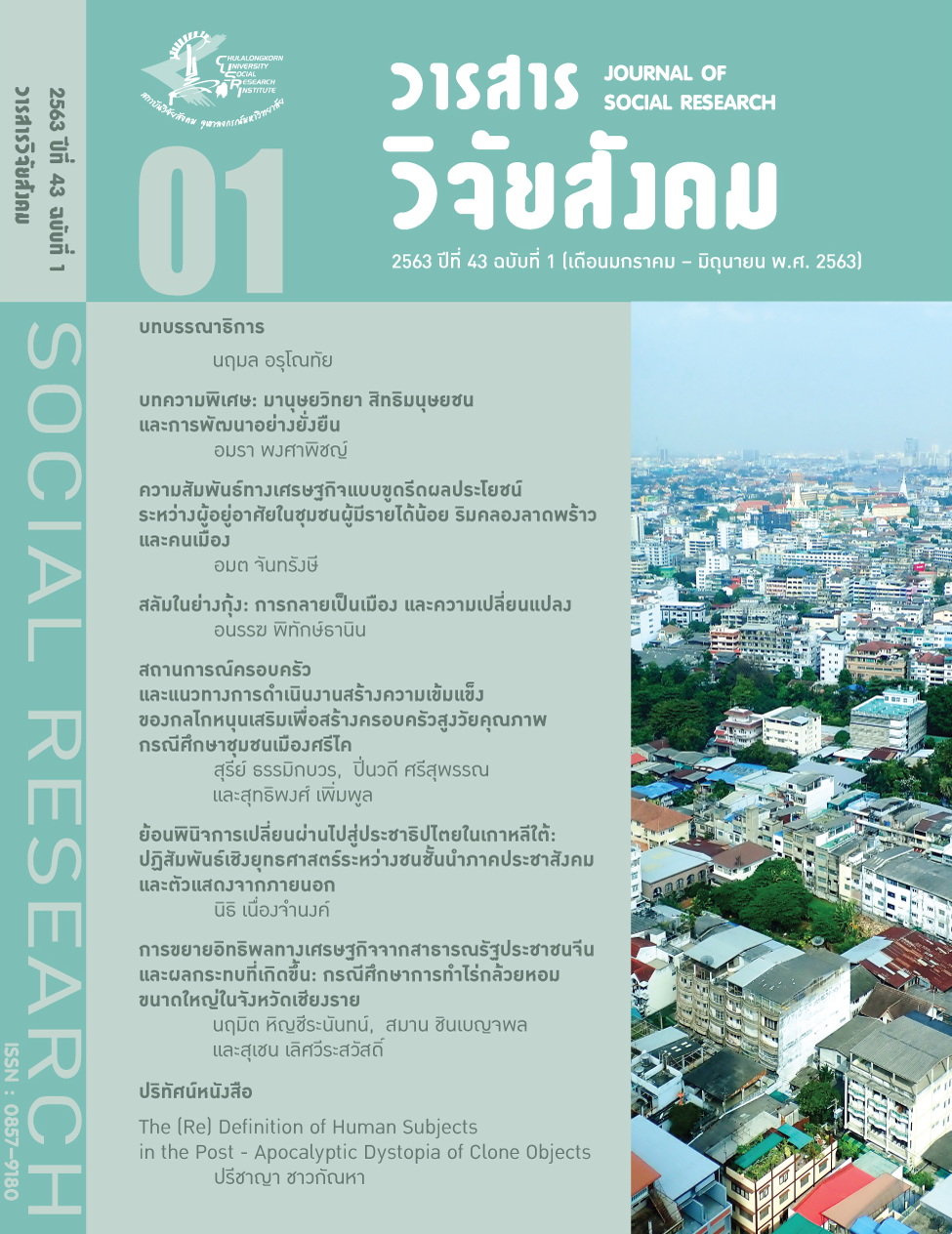
Main Article Content
Abstract
In the last two decades, there has been a rapid growth in urbanization in Myanmar and a lack of efficient housing policy planning for low-income people, leaded to slum expansion in several cities, especially, in Yangon, the capital and the central of economy for the country.
This article examines and explains the expansion of slum in Myanmar in relation to economic and social contexts of the country. The survey in this research was conducted by the researcher and Bendar Social Development Group, in 467 households of 10 communities in Hlaing Tharyar industrial estate in Yangon city. The result of the survey shows that the important causes of slum expansion in Yangon city constitute of three interrelated factors; firstly, Cyclone Nargis in 2008 and the climate change, secondly, economic inequality between urban and rural area and thirdly, technological change in agriculture sector. These causes are significantly associated with unemployment, land loss and migration of rural people, especially migrating from Ayearwaddy to Hlaing Tharyar in order to pursue better living and career opportunities.
Nevertheless, the article shows the overview detail that slum people’s living condition and environment condition are lower than their living standard as they have to live with high living costs, which is challenging for them to improve their quality of life. Furthermore, welfare and housing policy of the state have not been able to enhance social safety net.
Article Details
- The copyright for this article belongs to the Social Research Institute at Chulalongkorn University. However, the views and content within are solely those of the authors.
- The views and opinions expressed in the articles published in the Journal of Social Research and Review, Social Research Institute, Chulalongkorn University, are the sole responsibility of the authors and do not reflect the views or responsibilities of the editorial board of the Journal of Social Research and Review, Social Research Institute, Chulalongkorn University. The editorial board does not reserve the rights to reproduction but requires proper citation for referencing.
