
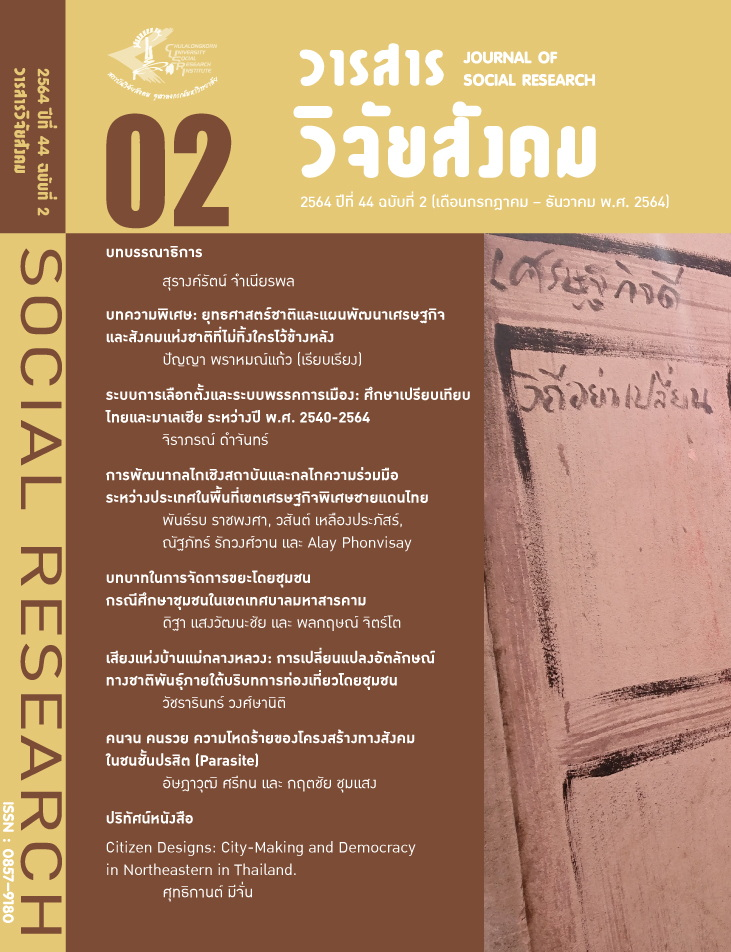
The Voice of KAREN: Changing Personal Identity Ethnicity Under the Context of Community-Based Tourism
Article Sidebar
Main Article Content
Abstract
This article aims to study the way of life and community-based tourism management process of the Pga Knyaw ethnic group, Ban Mae Klang Luang, Chom Thong District, Chiang Mai Province, and to analyze ethnic identity changes. Under the context of community-based tourism, the study found that, in the past, the Pga Knyaw ethnic group faced prejudice from the state and society in implementing the agricultural system. The government agencies did not accept shifting cultivation as it resulted in a wildfire or the destruction of natural resources. In addition, the residential area was declared to overlap with the national park. As a result, they have to bargain for power relations in various ways. One model is community-based tourism based on cultural resources and capital culture—rice terrace farming and tourism, with the support of the government, in order to generate income for better livelihood, providing the opportunity for the community to exercise their right, opinion, and participation that are beneficial to the community. At the same time, the state does not grant all communities the right to use the forest. It's just a relief and encourages the community in accordance with the law. Therefore, the community's identity in the tourism context is instead constructed as a model to show the traditional way of life for tourists. Commercializing transformed the community become a symbol or selling point of ethnic tourism. According to the changing context, it was also found that people in Pga Knyaw ethnic communities, especially teenagers have adopted modern culture.
Article Details

This work is licensed under a Creative Commons Attribution-NonCommercial-NoDerivatives 4.0 International License.
- The copyright for this article belongs to the Social Research Institute at Chulalongkorn University. However, the views and content within are solely those of the authors.
- The views and opinions expressed in the articles published in the Journal of Social Research and Review, Social Research Institute, Chulalongkorn University, are the sole responsibility of the authors and do not reflect the views or responsibilities of the editorial board of the Journal of Social Research and Review, Social Research Institute, Chulalongkorn University. The editorial board does not reserve the rights to reproduction but requires proper citation for referencing.
