
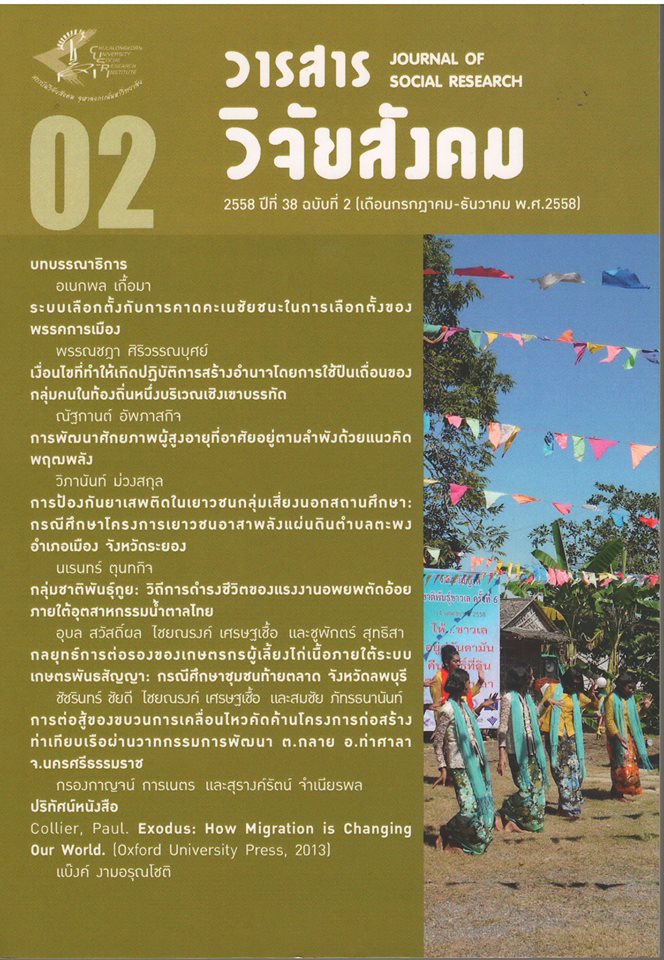
ระบบเลือกตั้งกับการคาดคะเนชัยชนะในการเลือกตั้ง ของพรรคการเมือง
Article Sidebar
Main Article Content
Abstract
งานวิจัยฉบับนี้มุ่งเน้นศึกษาเปรียบเทียบระบบเลือกตั้งแบบจัดลำดับความชอบ (Alternative Vote: AV) และระบบเลือกตั้งแบบถ่ายโอนคะแนนเสียง (Single Transferable Vote: STV) ในการเลือกตั้งสมาชิกสภาผู้แทนราษฎรในประเทศไทย โดยนำระบบเลือกตั้งดังกล่าวมาปรับใช้เพื่อทดสอบผลเลือกตั้งสมาชิกสภาผู้แทนราษฎรเมื่อ พ.ศ.2550 และ 2554 ว่าจะส่งผลต่อการเปลี่ยนแปลงผลเลือกตั้งในอดีตหรือไม่ อย่างไร จากการทดสอบดังกล่าว พบว่าผลเลือกตั้งเมื่อพ.ศ.2550 และ 2554 โดยรวมไม่เปลี่ยนแปลง เมื่อนำมาทดสอบกับระบบเลือกตั้งแบบจัดลำดับความชอบ และระบบเลือกตั้งแบบถ่ายโอนคะแนนเสียง กล่าวคือ พรรคเพื่อไทยหรือพรรคพลังประชาชนในอดีตยังคงครองที่นั่งมากกว่าพรรคการเมืองอื่นๆ แม้ที่นั่งจะลดลงจากการคำนวณที่นั่งโดยระบบ AV และ STV ก็ตาม อย่างไรก็ดี ผลจากการทดสอบยังแสดงให้เห็นด้วยว่า พรรคการเมืองขนาดเล็ก เช่น พรรคชาติไทย มัชฌิมาธิปไตย และพรรคเพื่อแผ่นดิน ได้ประโยชน์หากนำระบบเลือกตั้งทั้ง 2 แบบนี้มาใช้ โดยจะได้จำนวนที่นั่งเพิ่มขึ้นกว่าเดิม ซึ่งส่งผลให้พรรคขนาดเล็กเหล่านี้อาจมีอำนาจในการต่อรองเพื่อจัดตั้งรัฐบาลมากขึ้นเช่นกัน ส่วนในกรณีของพรรคประชาธิปัตย์นั้นจำนวนที่นั่งไม่เปลี่ยนแปลงหากคิดคำนวณผลเลือกตั้งโดยระบบ จัดลำดับความชอบ และระบบเลือกตั้งแบบถ่ายโอนคะแนนเสียง กล่าวคือ จำนวนที่นั่งที่เสียไปและได้เพิ่มขึ้นอยู่ในระดับที่เท่ากัน
Electoral System and the Alternative Prediction of Party Competition in Thailand
This research project is focusing on a comparative study of two electoral systems, Alternative Vote (AV) and Single Transferable Vote (STV), and their impact on the parliamentary elections in Thailand. In order to understand their effect on the elections in Thailand, we applied the AV and STV systems to examine the electoral results in 2007 and 2011, respectively. The results show that the electoral outcomes in 2007 and 2011 were not changed much under the AV and STV counting formulas. The Phuea Thai or former People Power Party continues to maintain the highest parliamentary seats compared to other political parties. On the other hand many small parties benefit the most from the AV and STV systems. Those small parties such as Chart Thai Party, Phuea Pandin Party and Matchimathipatai Party receive more seats from the AV and STV simulations. The increasing number of seats among small parties may allow them to enhance their negotiation power when the major party forms the coalition government. In the case of the Democrat Party, however, it does not advantage from the AV and STV systems since the party gain no extra seat under these systems.
Article Details
- The copyright for this article belongs to the Social Research Institute at Chulalongkorn University. However, the views and content within are solely those of the authors.
- The views and opinions expressed in the articles published in the Journal of Social Research and Review, Social Research Institute, Chulalongkorn University, are the sole responsibility of the authors and do not reflect the views or responsibilities of the editorial board of the Journal of Social Research and Review, Social Research Institute, Chulalongkorn University. The editorial board does not reserve the rights to reproduction but requires proper citation for referencing.
