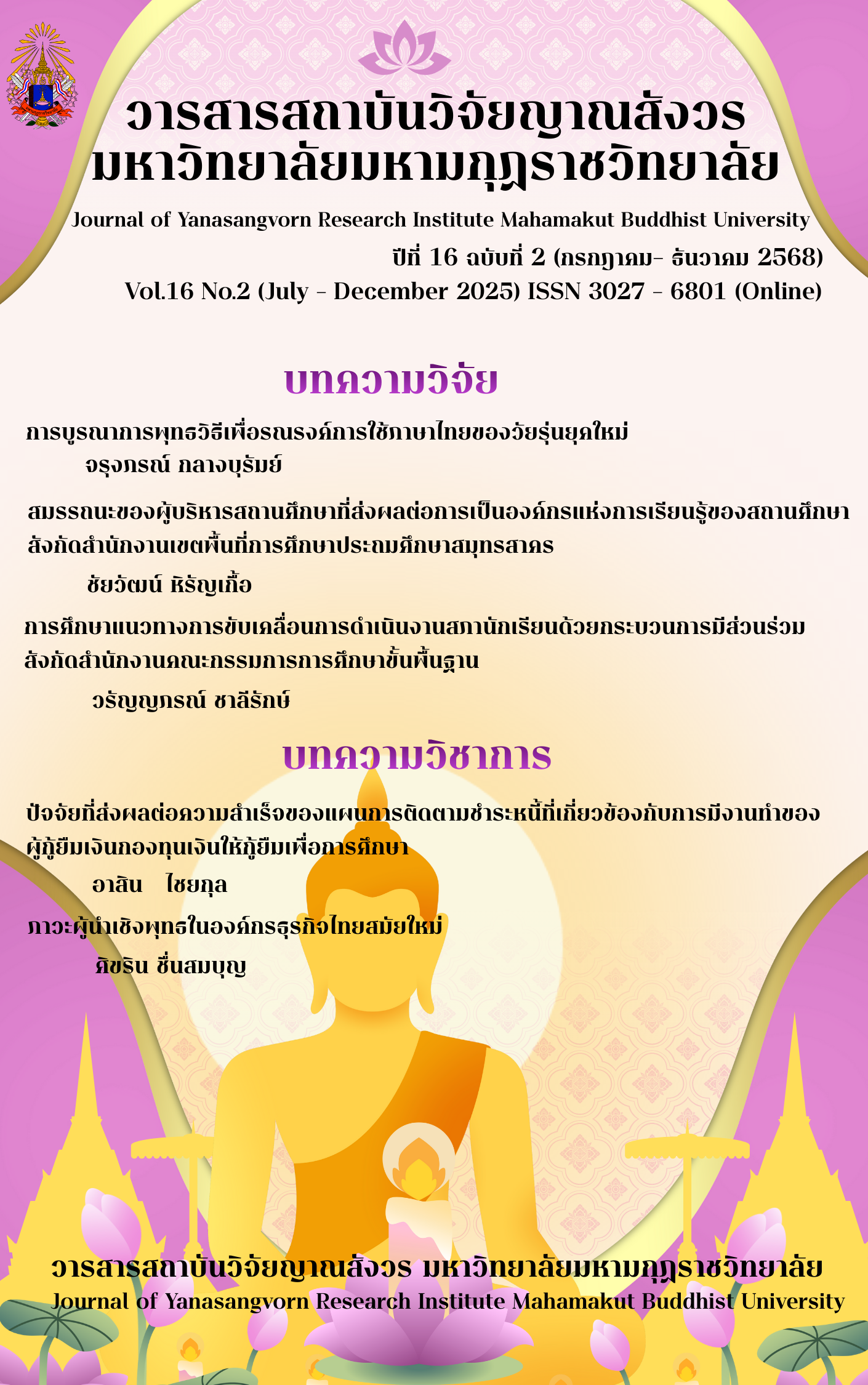
BUDDHIST LEADERSHIP IN MODERN THAI BUSINESS ORGANIZATIONS
Article Sidebar
Main Article Content
Abstract
This academic article, titled "Buddhist Leadership in Modern Thai Business Organizations," has two main objectives: 1. To study the characteristics and application guidelines of Buddhist leadership and 2. To develop a Buddhist leadership model applicable for modern Thai business organizations.The article employs a documentary research approach, synthesizing concepts, theories, and research related to Buddhist leadership and Modern Business Management. The study found that leadership focused solely on material outcomes is insufficient for achieving sustainability. It suggests that leaders must initiate an inner transformation through the cultivation of Mindfulness (Sati) and Wisdom (Panya) to overcome greed, anger, and delusion—the root causes of organizational problems. Key Buddhist principles integrated as management tools include the following: 1. The principles of Iddhipada 4 (Four Bases of Accomplishment) for fostering motivation and perseverance in work, 2. The principles of Brahmavihara 4 (Four Sublime States) for relationship management and building emotional connection, and 3. The principles of Sappurisa-dhamma 7 (Seven Qualities of a Virtuous Person), providing an ethical framework for stable, fair, and balanced decision-making. These findings led to the development of a three-level Buddhist Leadership Model in modern Thai business organizations, comprising the following levels: 1. The Personal Level (self-leadership), 2. The Private Level (leadership within close teams), and 3. The Public Level (the leader's sphere of influence on society and the organization).
Article Details

This work is licensed under a Creative Commons Attribution-NonCommercial-NoDerivatives 4.0 International License.
References
พระธรรมปิฎก. (2540). พุทธธรรมกับกรพัฒนาชีวิต. กรุงเทพมหานคร: โรงพิมพ์ธรรมสภา. (2546). ภาวะผู้นำ: ความสำคัญต่อการพัฒนาคน พัฒนาประเทศ.
กรุงเทพมหานคร: โรงพิมพ์ธรรมสภา.พระธรรมโกศาจารย์ (ปัญญานันทภิกขุ). (n.d.). พจนานุกรมธรรมปัญญานันทะ. ธรรมสภา.
พระปลัดชัยรัตน์ ปิยสีโล (เกตุสุวรรณ์). (2023). สัปปุริส ธรรม 7, การบริหารงานบุคคล. วารสาร มจร บาฬีศึกษาพุทธโฆสปริทรรศน์, 9(3), 196-208.
ศิริพร มหากิจศิริ. (2563). การประยุกต์ใช้หลักธรรมทางพระพุทธศาสนาในการบริหารจัดการองค์กรธุรกิจไทย. กรุงเทพฯ: สำนักพิมพ์จุฬาลงกรณ์มหาวิทยาลัย.
Gunaratna, V. (2003). Buddhist Leadership in Modern Management. Wisdom Publications.Jindasawad, W. (2021). Students aid system
based on the four Brahmavihara. Journal of BovornMulti-Education and Human Social Sciences, 2(2), 33–40.
Kumkeiw, W. (2002). A critique of Buddhism's “Compassion”. MANUTSAT PARITAT: Journal of Humanities, 24(1), 15–19.
Mokharat, B. (2017). The relationship between Brahmavihāra and ethics of teacher towards students. Journal of Graduate MCU
KhonKaen Campus, 4(1), 1–14.
Nair, S., & Ramnarayan, S. (2020). Compassionate leadership: Buddhist philosophy and modern business practice. Business Horizons,
(2), 273–283. https://doi.org/10.1016/j.bushor.2019.12.004
Pannawaro, K. (2017). Principles of 4 growth in daily life. Journal of Philosophical Vision, 22(1), 64–71.
Payutto, P. A. (2005). Buddhist Economics: A Middle Way for the Marketplace. Buddhadhamma Foundation.
Sujai, P. (2020). Buddhist Leadership and Human Resource Development in Thai Organizations. Journal of Human Resource and
Sustainability Development, 8(1), 45–57.
Suwankiri, P. (2021). The Application of Buddhist Virtues in Thai Corporate Culture. Asian Management Review, 13(2), 23–39.
