THE DEVELOPMENT OF A THAI LANGUAGE SKILLS PROJECT ACTIVITIES MODEL USING PROJECT-BASED LEARNING, PRACTICAL INTELLIGENCE AND A LANGUAGE SUB-SKILLS APPROACH TO ENHANCE THAI LANGUAGE SKILLS OF BASIC EDUCATION LEARNERS IN CHIANG MAI
DOI:
https://doi.org/10.14456/nrru-rdi.2020.42Keywords:
Activity management model, Project-based learning, Practical intelligence, Language sub-skills approach, Thai language skills projectAbstract
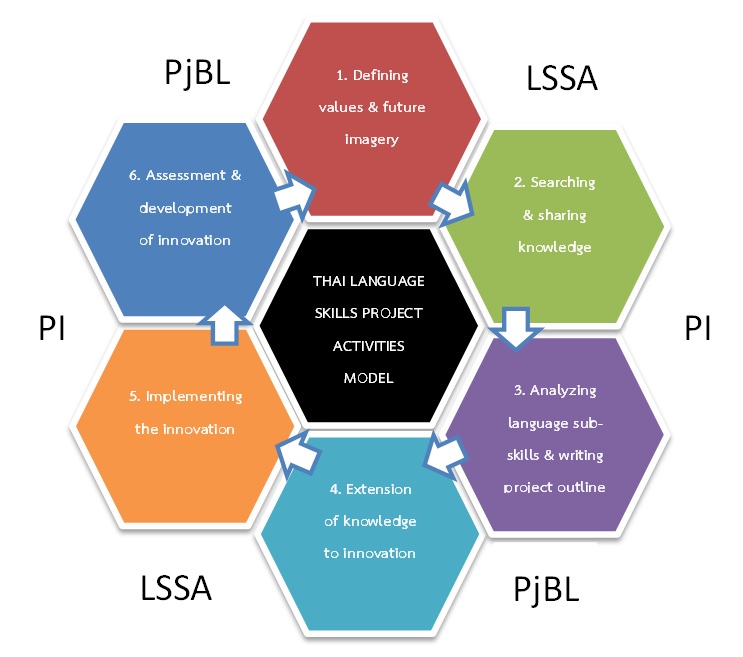
The purposes of this research were: To develop a model of a Thai language skills project activities using project-based learning, practical intelligence and a language sub-skills approach to enhance Thai language skills of basic education learners in Chiang Mai and To study the effectiveness of this model. The research target group consisted of 241 elementary school students, 318 secondary school students, 8 elementary school teachers, 8 secondary school teachers, 33 Thai language elementary school student teachers and 16 Thai language secondary school student teachers. The research Instruments were: 1) A questionnaire on the need for promoting Thai language skills for learners; 2) A model quality evaluation form; 3) An activity plans quality evaluation form; 4) An analyzing Thai language sub-skills quality evaluation form; 5) A Thai language skills test; and 6) A satisfaction questionnaire. The data were analyzed by using mean, standard deviation, and t-test. The findings were as follows: The Model consists of : 1) Principles, 2) Objectives, 3) Six steps learning activity, which are: (1) Defining values and future imagery, (2) Searching and sharing knowledge, (3) Analyzing language sub-skills and writing project outline, (4) Extension to innovation, (5) Implementing the innovation, and (6) Assessment of the innovation, and 4) Evaluation of the model. The findings regarding the model were as follows: 1) The average post-test was significantly higher than that of the pre-test score; 2) The research target group were able to analyze Thai language sub-skills; and 3) The research target group was highly satisfied with the model.
References
Aryadoust, V. (2010). Investigating writing sub-skills in testing English as a foreign language: a structural equation modeling study. National institute of education, Singapore.
British Council. (2019). Sub-skills. Retrieved January 7, 2020, from https://www.teachingenglish. org.uk/article/sub-skills
Cambridge Assessment English. (2009). Describing language skills and sub-skills. Cambridge Assessment English.
Hargis, J. (2005). Collaboration, community and project-based learning-does it still work online? International journal of Instructional media, 32(2), 157.
Iyer, M. (2015). Role of sub-skill approach to enhance listening: a study in the university of Jaffna, Sri Lanka ESL classrooms. ELT Voices, 5(6), 8-18.
Katz, L., & Chard, S. C. (2000). Engaging children’s mind: The project approach. Greenwood Publishing Group.
Lackman, K. (2010). Teaching speaking sub-skills. Ken Lackman & Associates Educational Consultants.
Moongthaisong, S. et al. (2018). The state and problems in Thai language instructional management of school in high land area under Chiang Rai educational service area office 3. Journal of social academic, 10(Special issue), 9-22. (In Thai)
Moursund, D. (1998). Project-based learning in an information-technology environment. Learning and leading with technology, 25(8), 4-5.
Nitayawan, K. & Jongkonklang, S. (2019). Stuey of Learning Outcome and Life and Career Skills of Grade 9 Students with Project-Based Learning Focuses on Local Wisdom NRRU Community Research Journal, 13(3), 247-259. (In Thai)
Office of the education council, ministry of education. (2018). National education plan 2017-2036. Bangkok : Prikwan graphic. (In Thai)
Pan, L. (2009). Sub-skills approach and extensive approach to reading in TEFL. Journal of Cambridge Studies, 4(3),112-120.
Phoyen, K. (2004). A model for developing systematic thinking to improve Thai language writing skill abilities for undergraduate students based on Triarchic theory and Scaffolding approach. Thesis, Doctor of philosophy degree in Educational Psychology, Chulalongkorn University, Bangkok. (In Thai)
Poonpipat, N. et al. (2018). The Study on curriculum for Thai language teaching at elementary education level of schools in local and ethnic areas in the north. Ganesha Journal, 14(2), 31-47. (In Thai)
Shin, S. (2002). Effects of sub-skills and text types of Korean EFL reading scores. Second language studies, 20(2),107-130.
Sirichan, P. (2006). Effects of instructional activity provision through project based vocabulary learning from environment for Prathom Suksa 1 students. Thesis, Master of education degree in Teaching Thai Language, Chiang Mai university, Chiang Mai. (In Thai)
Sternberg, R. J. (1985). Beyond IQ: A triarchic theory of human intelligence. CUP Archive.
Sternberg, R. J. (1994). Diversifying instruction and assessment. The Education Forum, 59, 48-52.
Sternberg, R. J., Jarvin, L., & Grigorenko, E. L. (Eds.). (2009). Teaching for wisdom, intelligence, creativity, and success. Corwin Press.
Thongaime, A. (2018). Project-based learning for developing student in the 21st century. Valaya Alongkorn Review (Humanities and Social Science), 8(3),185-199. (In Thai)